🏭 Looking for a Custom Apparel Manufacturer?
We are a leading OEM/ODM clothing factory with 20+ years of export experience. Custom styles, flexible MOQs, and retail-ready quality.
Fabric quality is one of the biggest factors determining whether a zip-up hoodie feels comfortable, breathable, durable, and dependable over time. The zipper affects how the garment opens and functions, but the fabric determines how it feels against the body, how it manages warmth, and how well it maintains its structure through repeated wear.
For brands, designers, and apparel buyers, choosing the right zip-up hoodie fabric is therefore more than selecting a soft material. The textile must balance hand feel, breathability, warmth, weight, stretch recovery, structural stability, and long-term durability.
This guide explains how material selection influences the everyday performance of a zip-up hoodie and provides a practical framework for evaluating fabric quality before production.
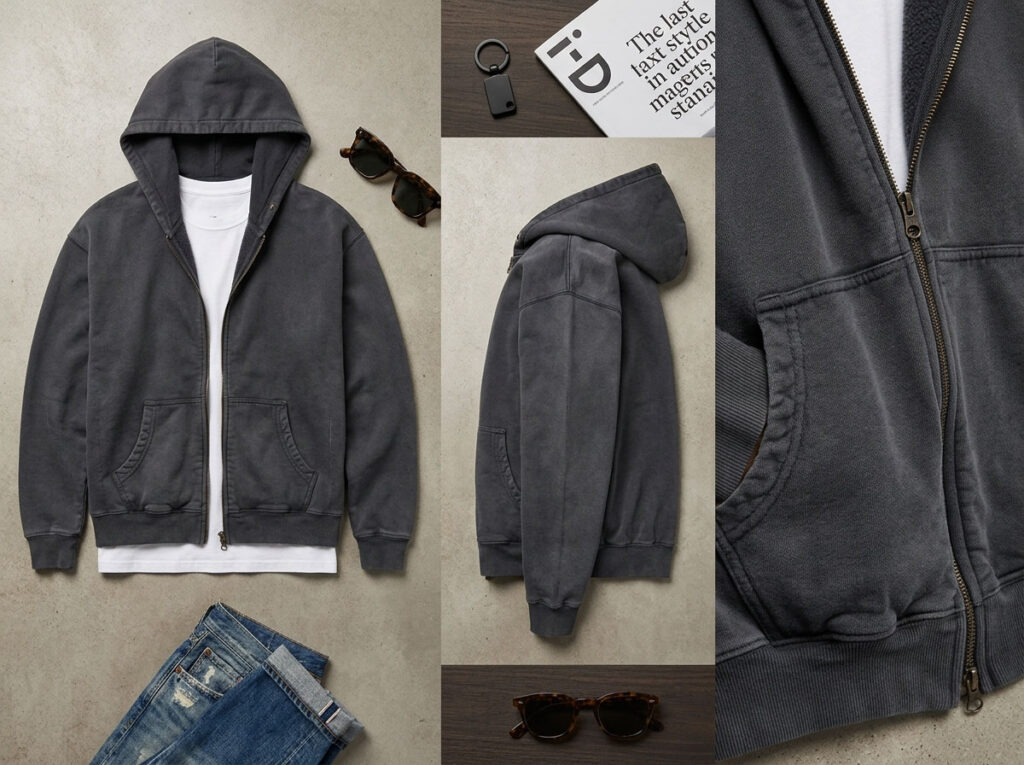
Fabric choice matters because the material controls how a hoodie feels, moves, performs, and ages.
A zipper may define the garment construction, but the fabric defines much of the wearing experience. Warmth, softness, airflow, flexibility, and structural stability all begin with the textile itself. For manufacturers and buyers, fabric selection should therefore be considered at the same stage as garment construction and zipper specifications.
Fabric is the foundation of hoodie comfort because it remains in contact with the wearer for extended periods.
A zip up hoodie can offer convenient front opening and flexible layering, but these advantages become less meaningful if the fabric feels rough, stiff, overly heavy, or unstable. Comfort depends on several material properties, including softness, weight, flexibility, surface texture, and overall hand feel.
For a well-developed zip hoodie, the fabric should make the garment easy to wear repeatedly rather than simply feel impressive during the first touch test.
For manufacturers, this means fabric development should consider both initial hand feel and long-term wearing comfort. A fabric that feels soft but loses its surface quality after repeated washing may not deliver the expected product value.
Material structure affects both warmth and airflow because the fabric determines how much heat is retained and how easily air and moisture can move through the garment.
A denser or more insulating textile generally provides more warmth, while a lighter and more breathable construction can improve comfort during movement and indoor wear. Zip up hoodies are frequently used across commuting, layering, travel, and indoor-outdoor environments, so this balance is particularly important.
The ideal fabric should provide useful insulation without trapping excessive heat during ordinary activity. In practical product development, warmth and breathability should be treated as complementary performance factors rather than competing features.
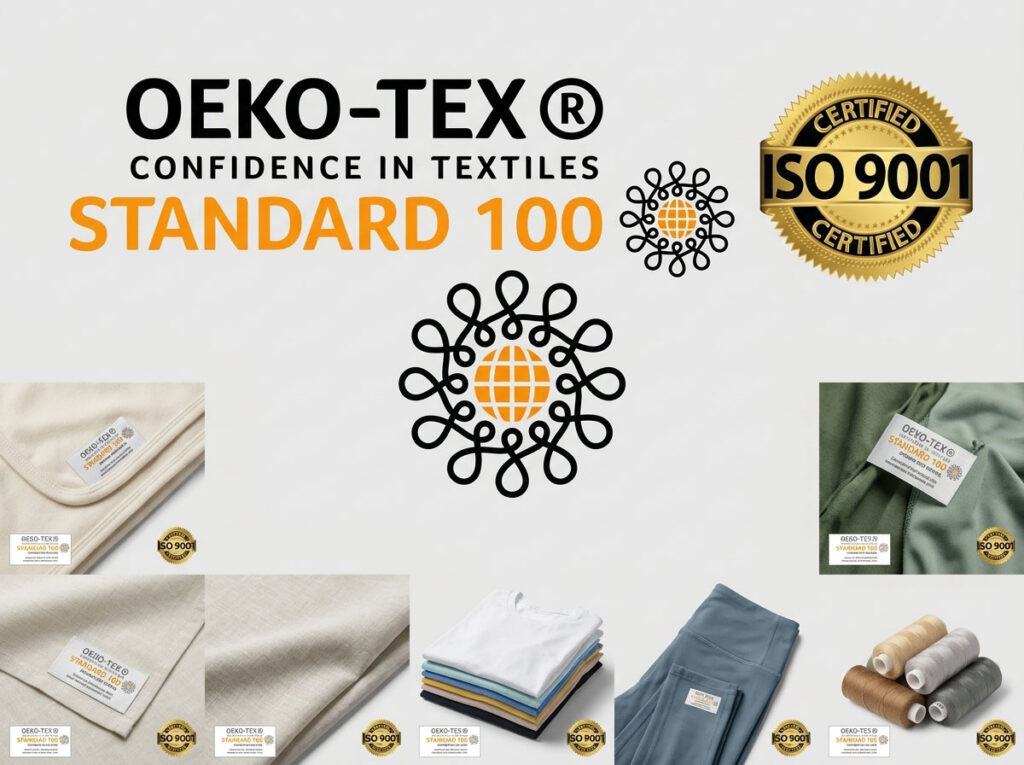
Fabric quality becomes increasingly important after repeated wear because a hoodie is judged by its performance over time, not just by its appearance when new.
A lower-quality fabric may begin to pill, stretch, thin, lose softness, or become structurally unstable after regular use. A higher-quality textile should maintain its shape, comfort, surface appearance, and functional performance for considerably longer.
For a zip up hoodie, this is especially important because repeated opening and closing of the zipper creates additional stress around the front opening and seams.
A reliable hoodie fabric should therefore remain dependable through repeated wear, washing, movement, and zipper use.
Most zip up hoodies use several core fabric categories, and each material offers a different balance of comfort, performance, weight, and durability.
The right hoodie material should be selected according to the garment’s intended use rather than based solely on the fiber name. Casual lifestyle hoodies, lightweight layering pieces, and performance-oriented hoodies may require very different textile specifications.
Cotton is widely used in casual zip up hoodies because it offers a familiar, comfortable hand feel and works well for everyday apparel.
Cotton generally provides softness and a natural wearing experience, making it suitable for long-hour casual use. However, cotton performance depends heavily on yarn quality, knit construction, finishing, and fabric density.
A stronger cotton knit can provide a stable structure and comfortable breathability, while a weaker construction may lose shape or show wear more quickly.
Cotton is particularly effective for zip hoodies when its natural softness is combined with enough structural strength to handle repeated wear and zipper-related tension.
Cotton-polyester blends are popular because they can combine the comfort of cotton with some of the durability and shape-retention advantages associated with polyester.
Cotton contributes softness and a familiar casual hand feel, while polyester can improve resilience, recovery, and dimensional stability. The resulting blend can be useful for everyday zip hoodies that need to transition between commuting, leisure, travel, and light activity.
For a zip hoodie, this balance is valuable because the front zipper introduces additional structural demands around the seams.
The best blend should not simply have an attractive fiber composition on paper. The finished fabric should demonstrate stable construction, comfortable hand feel, appropriate stretch and recovery, and reliable performance after repeated use.
Synthetic fabrics are often selected for performance-oriented zip hoodies because they can support lightweight construction, quick drying, moisture management, and greater resistance to certain forms of wear.
These properties can be useful when a hoodie is intended for active movement, variable weather, travel, or a technical casual-sports market.
However, performance should not come at the expense of comfort. A synthetic fabric that feels excessively slick, harsh, or artificial may be less suitable for an everyday lifestyle hoodie.
For product development, synthetic materials work best when their functional advantages complement the intended wearing experience. The right choice depends on the balance between moisture management, breathability, stretch, durability, hand feel, and end use.
Warmth and breathability need to work together because a zip up hoodie may be worn across different temperatures and activity levels.
Too much insulation can make the garment feel heavy or uncomfortable indoors, while insufficient insulation may reduce its usefulness in cooler environments. The ideal fabric depends on the intended season, climate, layering strategy, and consumer use case.
Insulating fabrics help a hoodie retain warmth during cooler weather, light outdoor activities, and transitional seasons.
A zip up hoodie can function as either a light outer layer or a mid-layer, so the appropriate insulation level depends on the product positioning. A commuter hoodie may require a different fabric weight from a winter lifestyle hoodie.
The goal is not simply to maximize insulation. The fabric should retain enough warmth to provide comfort without making temperature regulation difficult during indoor movement.
Breathable fabrics improve airflow by allowing heat and moisture to escape more efficiently during walking, commuting, and everyday movement.
This is important because zip hoodies are often worn for extended periods and across changing environments. Breathability can reduce stuffiness and help the wearer maintain a more comfortable temperature.
The zipper provides an additional way to regulate ventilation, but the textile still determines much of the underlying breathability. A good hoodie fabric should allow sufficient airflow for everyday use rather than relying entirely on the front opening for temperature control.
Balanced fabrics are often the most versatile choice for everyday zip up hoodies because most users need a combination of warmth, breathability, comfort, and durability.
A well-balanced fabric can handle mild outdoor conditions, indoor wear, commuting, travel, and moderate movement without becoming overly specialized.
For brands developing versatile lifestyle products, this balance can increase the number of situations in which the hoodie is comfortable and practical.
The ideal everyday fabric provides enough protection to feel useful while remaining breathable enough for extended indoor and outdoor wear.
Softness matters because zip up hoodies are commonly worn for several hours at a time, often over a T-shirt or close to the body.
A fabric can have strong technical performance and still feel uncomfortable if its surface texture is rough or irritating. At the same time, extreme softness is not automatically a sign of high quality.
The better approach is to evaluate softness together with durability, stability, and long-term hand feel.
Interior fabric texture has a direct effect on how the hoodie feels during actual wear.
A smooth and comfortable inner surface can make a hoodie easier to wear for long periods, particularly during daily routines that combine movement, commuting, and relaxation.
This is why hand feel should be evaluated from both the outer and inner surfaces of the fabric. A well-designed zip hoodie should remain comfortable whether it is fully zipped, partially open, layered, or worn casually.
Interior comfort is not merely a finishing detail. It is an important part of overall garment usability.

Softness improves long-hour wearability because comfortable fabric reduces friction and makes the garment less noticeable during extended use.
A hoodie may be worn from morning commuting through evening leisure, so its material needs to remain comfortable rather than become distracting after several hours.
However, softness should be evaluated over time. A fabric that feels exceptionally soft during the first inspection but becomes rough after repeated washing may not provide strong long-term value.
Real fabric quality is reflected in consistent comfort, not just initial softness.
Softness must be balanced with durability because an extremely soft but weak fabric may not remain comfortable for long.
If the material pills heavily, loses structural integrity, stretches out, or becomes thin, its original comfort advantage quickly disappears.
The strongest hoodie fabrics combine a pleasant hand feel with sufficient resistance to repeated wear and washing.
For manufacturers, the target should be a fabric that feels soft without feeling fragile. This balance helps create a zip hoodie that remains comfortable and dependable throughout its useful life.
Durability begins with fabric structure because the textile must maintain its form through movement, washing, and repeated garment use.
A zip hoodie places particular demands on the fabric because the front opening, hood, seams, and zipper create multiple areas where structural stability matters.
Knit density affects structural strength because a more consistent and appropriately dense construction can provide a stronger foundation for the garment.
In a zip up hoodie, the fabric needs to support the hood, shoulder seams, front opening, zipper construction, and body panels without becoming unstable.
A denser fabric is not automatically better. Excessive density can increase weight and reduce flexibility. What matters is whether the knit construction provides the right combination of strength, hand feel, flexibility, and shape retention.
A quality zip hoodie fabric should resist excessive stretching and deformation because repeated wear creates tension across the chest, shoulders, hem, and zipper area.
If the material stretches easily without recovering, the garment may gradually become loose, uneven, or misshapen.
For casual garments designed for repeat use, shape retention is an important part of perceived quality. A strong fabric should remain balanced after movement instead of becoming stretched in some areas and tight in others.
Fabric recovery refers to the ability of the textile to return toward its intended shape after stretching and movement.
Good recovery helps prevent gradual deformation after the hoodie has been worn, zipped, layered, and washed repeatedly.
This is particularly important in zip hoodies because structural imbalance around the front opening can become visually obvious.
For product development, elasticity and recovery should therefore be evaluated alongside fabric strength. The best material maintains enough flexibility for comfort while recovering sufficiently to preserve the garment’s intended silhouette.
Fabric weight affects warmth, drape, flexibility, structure, and overall wearing experience.
A heavier fabric is not automatically higher quality, and a lighter fabric is not necessarily less durable. Weight should always be considered in relation to the garment’s intended use, climate, season, and target customer.
Lightweight fabrics are useful when flexibility, layering, and easy movement are important.
A lightweight zip hoodie can work particularly well for indoor environments, travel, mild climates, and transitional weather. It is also easier to pack and can be worn comfortably under another outer layer.
The trade-off is that very lightweight fabrics may provide less insulation and less structural support.
The key is finding enough stability to prevent the hoodie from feeling underbuilt while retaining the flexibility expected from a lightweight garment.
Midweight fabrics are often a versatile option for everyday zip hoodies because they provide a practical balance between warmth, structure, comfort, and mobility.
A midweight hoodie can work across commuting, urban lifestyles, indoor environments, and mild outdoor conditions.
This versatility makes midweight construction particularly useful for brands seeking an everyday product rather than a highly specialized seasonal piece.
The right midweight fabric should feel substantial enough to hold the garment’s shape without becoming unnecessarily heavy.
Heavyweight fabrics provide more warmth and often create a stronger, more substantial garment feel.
They can be useful for colder climates, winter collections, and hoodies designed to function as protective casual layers. Heavyweight construction may also provide a more structured silhouette.
However, increased weight can reduce flexibility and increase heat retention indoors.
Heavyweight fabric therefore works best when the product’s purpose genuinely requires additional warmth and substance rather than simply using weight as a quality signal.
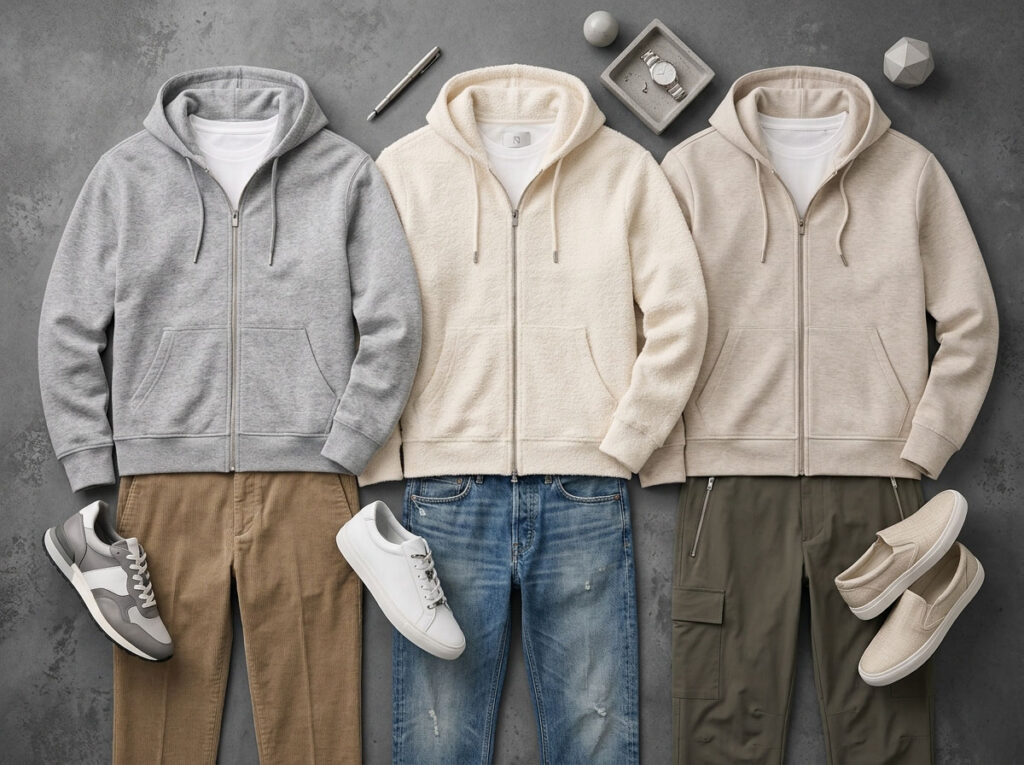
Fabric stability is particularly important in zip up hoodies because the zipper creates a structural line across the front of the garment.
The textile must support seam tension, maintain alignment, and prevent distortion around the opening.
This makes fabric stability one of the most important differences between evaluating a basic sweatshirt fabric and developing a high-quality zip hoodie.
Fabric tension around zipper seams matters because the zipper is repeatedly opened and closed while remaining visually exposed.
If the surrounding fabric is weak or unstable, the front panel may ripple, pull, twist, or become misaligned.
A stable textile provides a stronger foundation for the zipper and helps the garment remain visually clean during movement.
The key quality check is whether the front remains smooth and balanced when the hoodie is zipped, partially opened, and worn through normal activity.
Strong fabric helps prevent distortion around the zipper because the front opening is one of the most structurally demanding areas of the garment.
Weak material can lead to twisting, bubbling, pulling, or uneven drape around the chest and zipper tape.
A stable fabric reduces these risks by supporting the zipper seam and surrounding body panels.
For quality control, the hoodie should be inspected not only when lying flat but also when zipped, opened, and worn. Structural problems often become more visible when tension is applied.
Fabric stability helps the hoodie maintain a balanced appearance while the wearer moves.
A weak material may allow the front to shift, the hood to pull on the neckline, or the zipper area to sag. A well-engineered fabric provides enough structure to support these components without making the hoodie unnecessarily stiff.
The goal is a balance between relaxed comfort and controlled structure.
For zip hoodies, strong fabric stability allows the garment to feel casual while still maintaining a composed and reliable appearance.
Low-quality fabric often reveals itself through performance problems rather than through the fiber label alone.
A hoodie can feel acceptable during the first inspection and still deteriorate quickly after washing and repeated wear.
Recognizing these warning signs can help buyers and manufacturers identify material problems before large-scale production.
Fabric thinning and excessive pilling are common warning signs because they indicate that the surface or fiber structure is not handling friction and repeated use effectively.
Pilling can make the garment look worn prematurely, while thinning reduces both durability and perceived quality.
For a zip hoodie designed for repeat wear, the fabric should retain reasonable surface integrity after normal use.
A small amount of surface change can occur with many textile constructions, but rapid or excessive deterioration should trigger a quality review.
Loss of softness is another warning sign because everyday comfort depends on the fabric maintaining a reasonably stable hand feel.
If the hoodie becomes noticeably rough, dry, or unpleasant after washing, part of its original product value has been lost.
A better fabric should either maintain its original hand feel reasonably well or develop a controlled, comfortable softness over time.
The important test is not how soft the fabric feels on day one, but how it feels after repeated use and care.
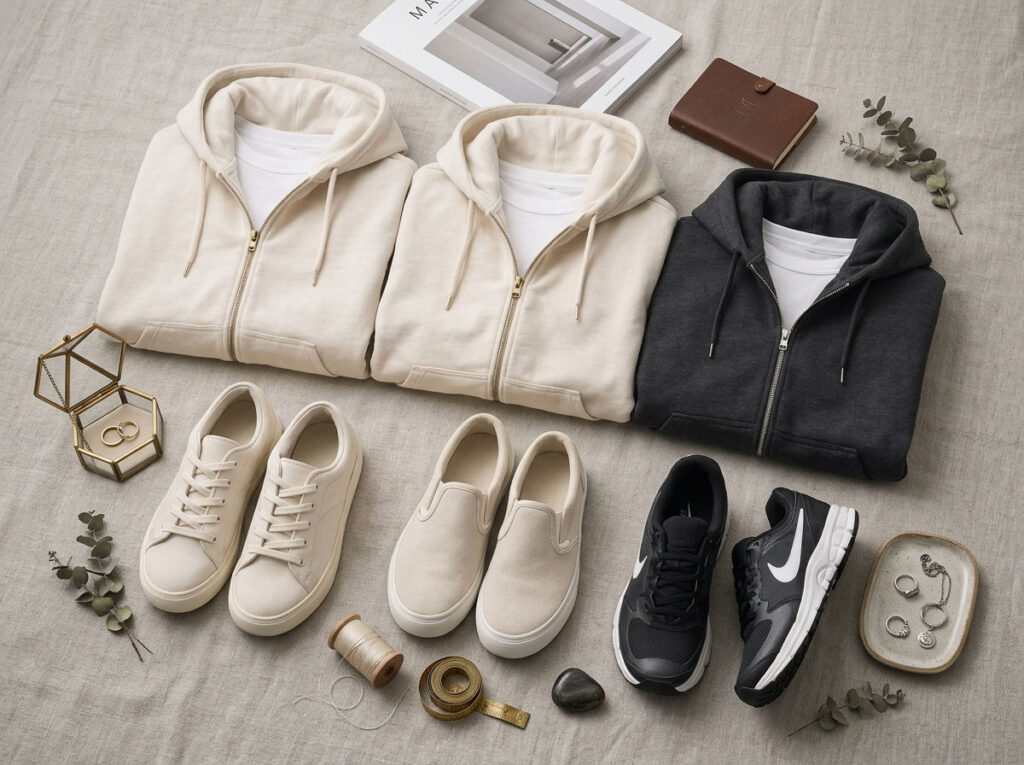
Structural sagging indicates that the fabric is no longer providing enough support for the garment’s intended shape.
In a zip up hoodie, sagging may appear around the zipper opening, hem, shoulders, hood attachment, or other high-stress areas.
Because the zipper creates a visible front structure, deformation can be particularly noticeable.
A quality fabric should resist excessive collapse and maintain a balanced silhouette after repeated wear. If the front begins hanging unevenly or key areas become stretched out, the material may not have sufficient structural stability.
A strong zip up hoodie fabric can be evaluated systematically by checking comfort, temperature balance, structural durability, and long-term performance.
This framework helps separate genuine material quality from first-impression softness or marketing language.
The most useful evaluation begins with how the fabric feels but ends with how it performs.
A fabric softness and comfort check determines whether the material feels comfortable and non-irritating during direct wear.
Check both the outer hand feel and the interior texture. The fabric should feel soft enough for extended use without feeling excessively delicate or unstable.
This check is important because zip hoodies are often long-hour garments. Comfort should remain consistent through movement, layering, and daily wear.
A breathability and warmth check determines whether the fabric provides sufficient insulation while still allowing reasonable airflow.
The fabric should not trap excessive heat, but it should also provide enough substance for the intended climate and use case.
For zip hoodies, this balance is particularly important because the zipper provides ventilation only when opened. The fabric itself still needs to perform comfortably when the garment is fully zipped.
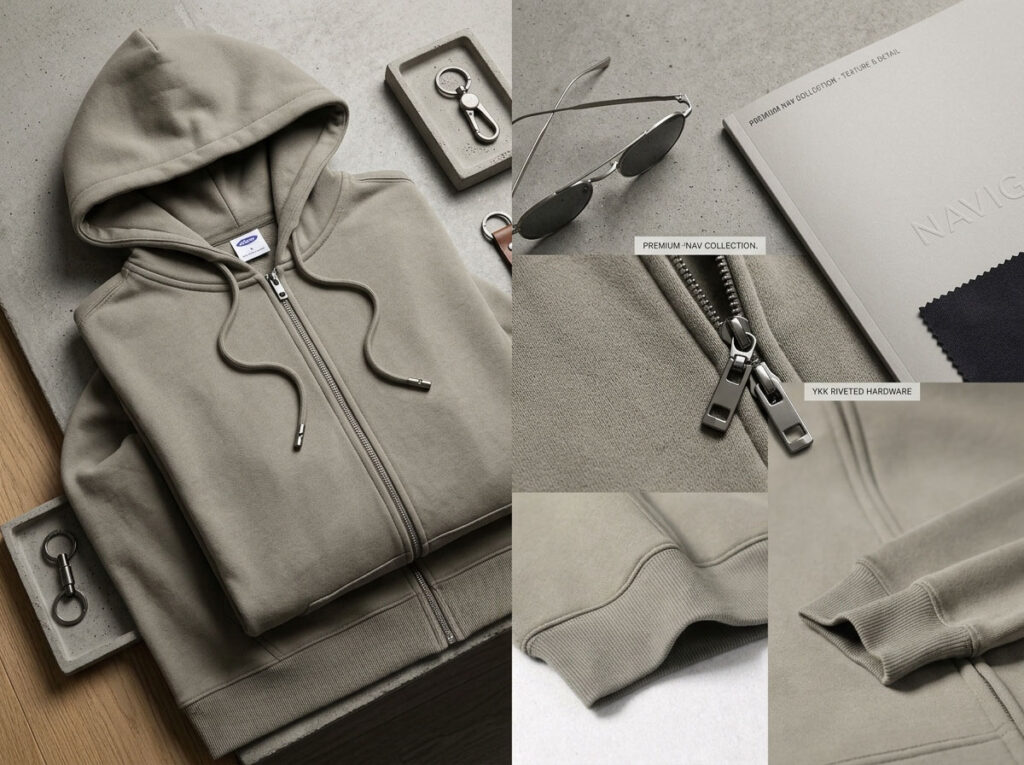
A structural durability check evaluates whether the material can support the zipper, hood, seams, and repeated movement without excessive distortion.
Inspect knit consistency, stretch resistance, recovery, seam support, and overall fabric stability.
This check is particularly important for zip hoodies because weaknesses around the front opening can become visible quickly.
The key question is whether the textile can support the complete garment structure over time rather than simply looking attractive during initial inspection.
A long-term performance check asks whether the fabric is likely to remain comfortable, stable, and structurally reliable after repeated wear and washing.
Consider potential pilling, thinning, sagging, loss of softness, and shape deformation.
For manufacturers and apparel buyers, this is one of the most important checks because the actual value of a hoodie is determined by its useful life.
The strongest material is not necessarily the softest, lightest, or heaviest option. It is the fabric that continues performing appropriately throughout repeated ownership.
For brands developing custom zip up hoodies, fabric selection should ultimately be matched to the target market, garment weight, season, construction, washing requirements, and expected usage frequency. A well-selected textile creates the foundation for a hoodie that is comfortable at first wear and reliable throughout its product life.
If you have any questions or require a quote, please leave
us a message. Our experts will get back to you within 24 hours to help you choose the ideal fashion products tailored to your needs.
Hi, I’m Lucy Cai, the founder of liantaoapparel.com. I’ve been managing a women’s clothing factory in China for over 16 years. With extensive experience in garment production and OEM services, I’m passionate about sharing insights into women’s fashion, apparel manufacturing, and global sourcing.
If you have any questions or need a quote, please contact us.
Please add us WhatsApp:+86 189 4809 3145
Provide us with detailed information about your requirements, supply design drawings or tech packs,
reference images, and share your ideas.
We will customize the best solution based on your needs and drawings, and provide a specific quote within 24 hours.
Once we receive your confirmation and deposit,we will commence mass production and take care of the subsequent shipping arrangements.