🏭 Looking for a Custom Apparel Manufacturer?
We are a leading OEM/ODM clothing factory with 20+ years of export experience. Custom styles, flexible MOQs, and retail-ready quality.
In the late 90s, the apparel world watched in awe (and some confusion) as JNCO Jeans rewrote the rules of denim—effectively using three times the fabric of a standard pair of Levi’s for a single leg. As someone who has spent 20 years managing garment production lines, I’ve always been fascinated by the engineering required to keep a 26-inch leg opening from collapsing under its own weight. After disappearing into the shadows of fashion history, JNCO is making a massive comeback in 2026. But is the quality of today’s denim as indestructible as the originals we wore in high school? Let’s dive into the resurgence of the widest jeans in the world and see if they still hold up on the factory floor.
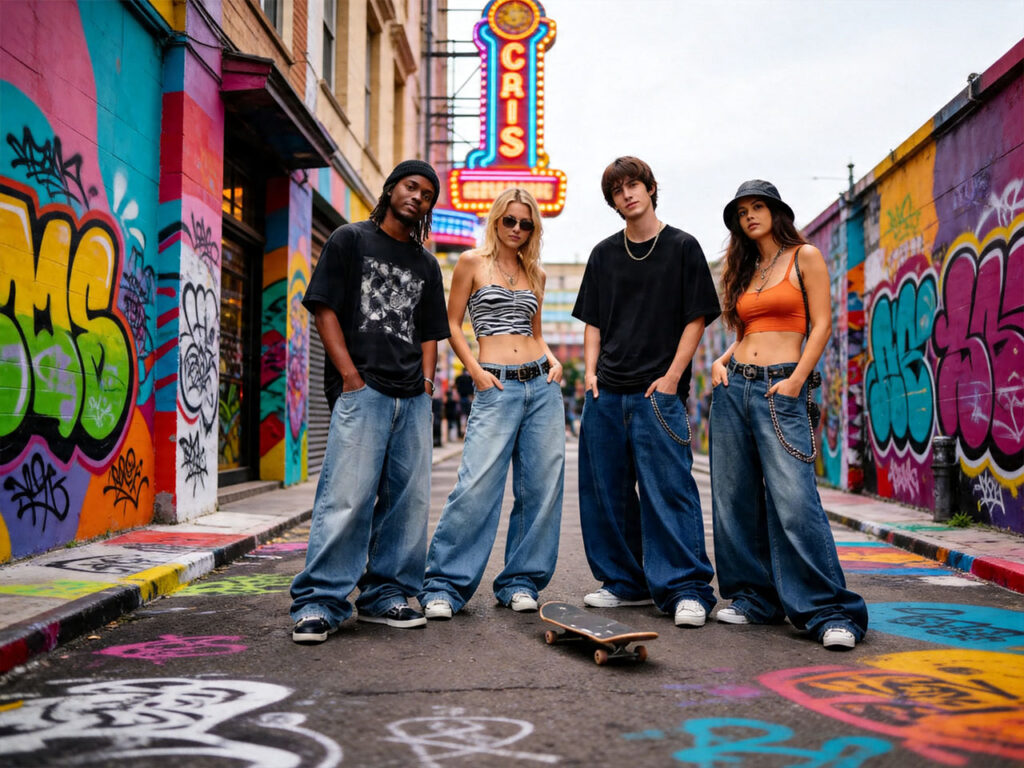
Many buyers are immediately drawn to the bold silhouettes of JNCO jeans, but their next question is often: “What does JNCO actually stand for?” This may seem like a simple question, but it reveals a critical issue—brand clarity. When consumers can’t quickly understand what a brand represents, hesitation follows, and hesitation often leads to lost sales. JNCO is commonly interpreted as “Judge None Choose One,” a name with a strong underlying attitude. However, if that meaning isn’t clearly communicated, its value is significantly weakened in the marketplace.
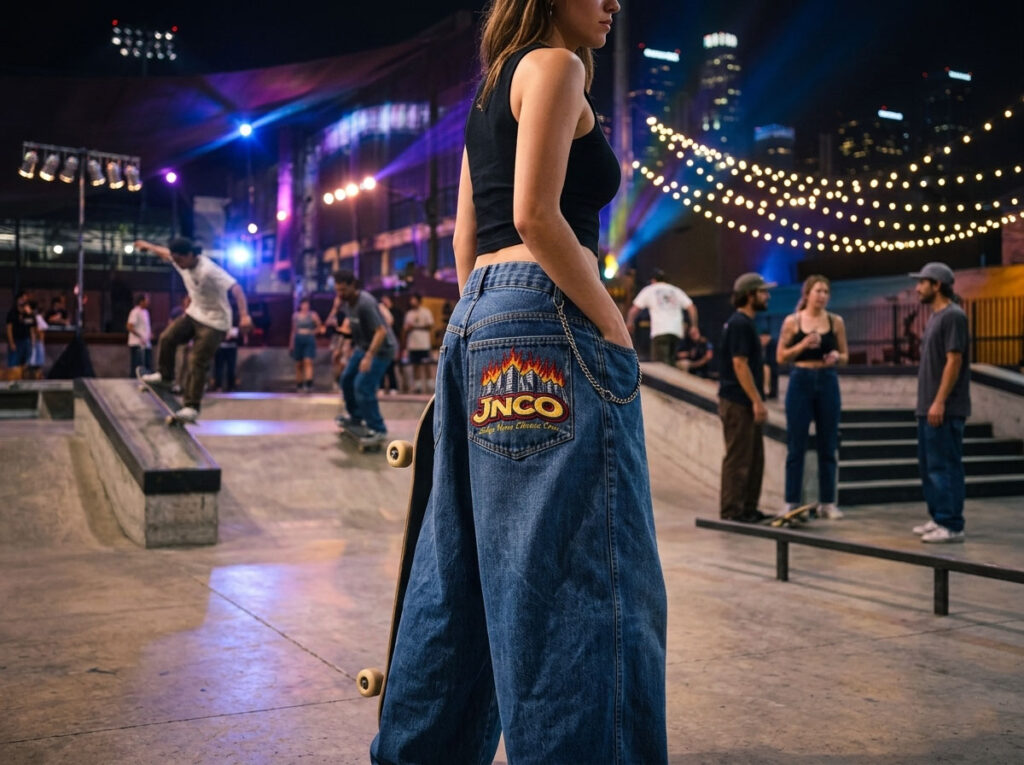
The importance of the JNCO logo goes far beyond visual design—it functions as a cultural symbol. In the 1990s, it didn’t just represent a pair of jeans; it signaled belonging to subcultures like skateboarding, rave, and streetwear communities. Wearing it was less about fashion and more about identity—an expression of “who you are,” not just “what you wear.” This offers a clear takeaway for brands: a logo is not decoration; it is a condensed form of identity. When a brand name, logo, and cultural narrative align, the product becomes more than just aesthetically appealing—it gains meaning. And that sense of meaning is what truly drives purchasing decisions.
Issue Type | Examples Provided by Buyers | My Approach | Reason / Benefit |
Confusing / Misspelled Names | jnco.jeans, jnco’s, jnco jeansgnco jeans, ginko jeans, jeanco jeans, junko jeans, janko jeans | Don’t rush to correct spelling; first ask buyers for photos | Avoid misunderstandings caused by incorrect keywords; ensure order processing is based on the actual item |
Unclear Leg Opening Size | Buyers usually only describe it in words | Confirm the leg opening measurement | Accurately obtain key dimensions to ensure the product meets expectations |
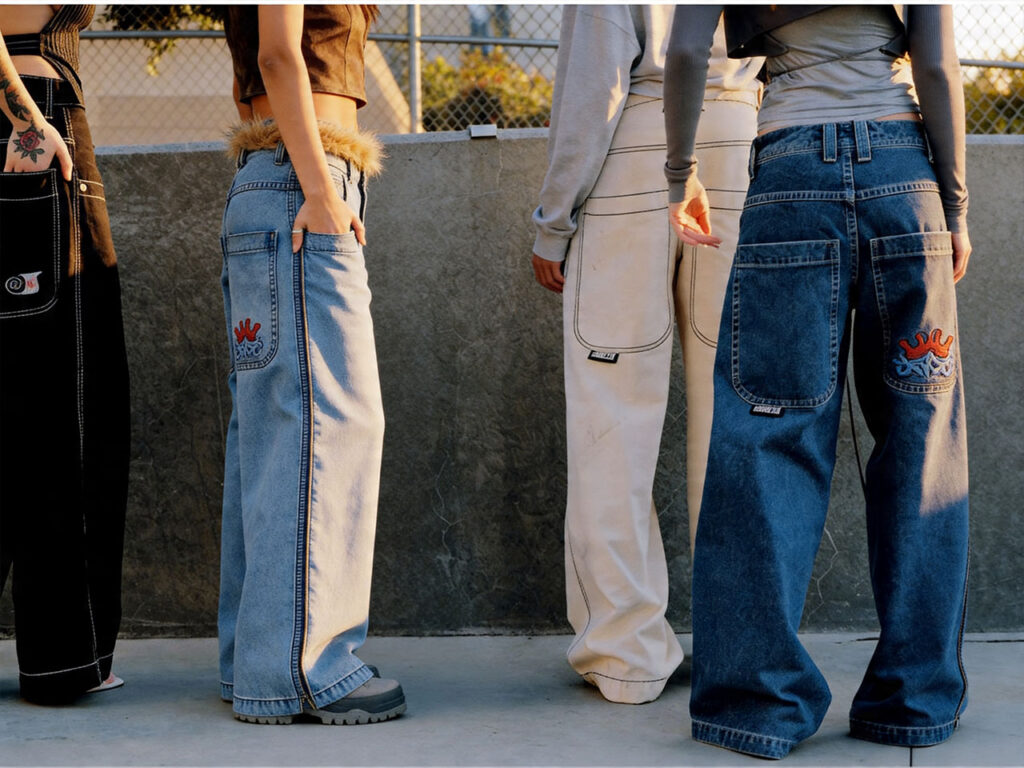
Large pockets and bold embroidery aren’t just design details—they affect stitch count, thread usage, and defect rates. If you want styles like “JNCO Flame Ace”, “JNCO Buddha”, or “JNCO Endangered Species”, you need stable embroidery files and a clear approval process.
Skipping these steps can lead to uneven stitches, misaligned patterns, and even buyer complaints. Confirming embroidery files in advance ensures every product is precise and reliable.
Buyer Message | Typical Meaning | My Next Question |
“jnco” | Buyer wants a recognizable brand | “Do you want an officially licensed logo or just a similar style?” |
“jynco / jnko / jenko pants” | Buyer cares about the silhouette, not the brand | “Please provide 3 reference photos and your target price.” |
“What is JNCO?” | Buyer is new to the trend and unfamiliar with the brand | “Where do you plan to sell? Who is your target customer?” |
“jnco women’s jeans” | Buyer wants a wider hip and a cleaner waist fit | “Do you want mid-rise or high-rise? What size range are you targeting?” |
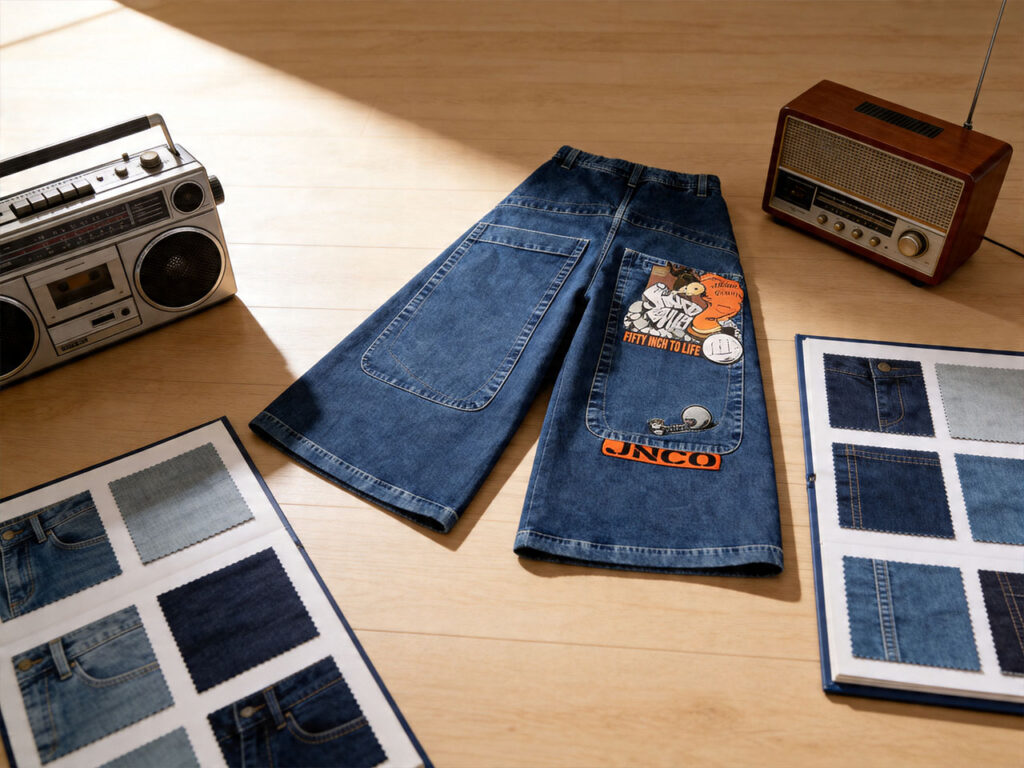
When buyers face streetwear jeans, they often confront a simple but crucial choice: do you want brand recognition, or are you after a specific style? If you want the brand, go for it directly. If you’re drawn to a particular look, then look for “JNCO-style” wide-leg jeans and build your own story around them.
I once worked with a client developing a fall-winter denim collection who tried both approaches: some insisted on the authenticity of the brand, while others focused on cut, fabric, and streetwear vibe to create something unique. The outcome was clear—those who clearly defined their needs early on benefited the most. They didn’t get stuck debating brand versus style; they made a decision and built their product and marketing strategy around it. This principle applies to any apparel category: clarity of positioning and reducing hesitation is key to connecting with consumers quickly and effectively.
Many people ask when JNCO was actually popular, as if it only had a brief moment in the spotlight. But from a trend-cycle perspective, it was never just a one-year phenomenon. It behaved more like a wave—building gradually, surging rapidly, peaking, and then receding just as fast.
JNCO originated in the 1980s, but it truly entered mainstream youth fashion in the 1990s. At its peak, oversized denim silhouettes became a defining visual language of youth culture, especially within skateboarding, streetwear, and music subcultures. The style spread quickly and became a recognizable symbol of that era.
The decline of JNCO was not about the brand losing relevance, but about a structural shift in fashion preferences. In the 2000s, denim trends moved toward slimmer, more minimal silhouettes, and extreme wide-leg cuts were increasingly seen as excessive. At the same time, changes in retail systems and mainstream fashion channels reduced space for highly expressive niche styles.
However, it is more accurate to say the brand did not disappear—it entered a dormancy phase. As retro trends cycle back, its design language is being revisited again. It highlights a key truth in fashion: trends are not linear; they are cyclical. What fades from view often returns when the culture is ready to reinterpret it.
The evolution of JNCO can be understood through a clear trend cycle timeline. This framework helps buyers move from subjective preference-based thinking to a more structured understanding of market behavior.
Period | What Customers Wanted | What JNCO Represented | What Changed in the Market |
Late 1980s–Early 1990s | Loose fits + street expression | A new, exaggerated denim language | Subcultural energy was rising and streetwear identity was forming |
Mid–Late 1990s | Wider legs, bolder visuals, stronger graphics | “I choose my own path” | Streetwear entered mainstream retail and reached its peak |
Early 2000s | Cleaner, slimmer, more minimal silhouettes | “That’s an old-era style” | Fashion shifted toward slim and straight cuts; extreme wide fits declined |
2010s | Nostalgia, vintage, archive aesthetics | “A retro cultural symbol” | Social media revived archival and vintage fashion trends |
2019–Present | Original wide-leg + recreated silhouettes | “Authentic wide-leg revival” | Niche resurgence driven by online demand and micro-communities |
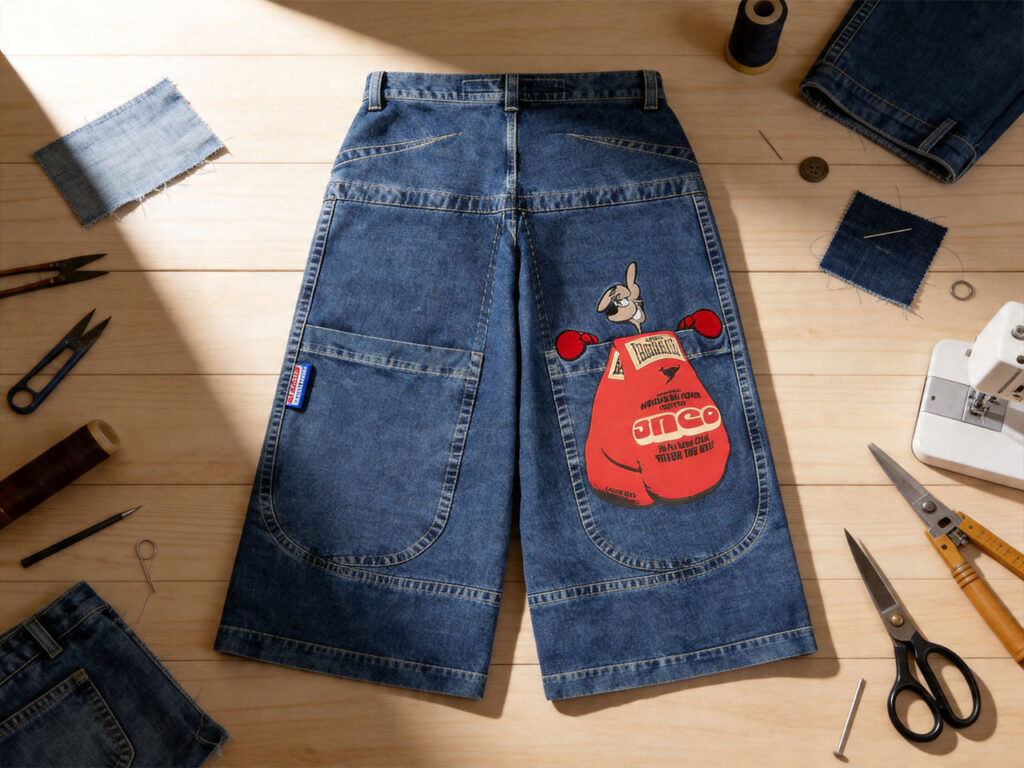
When a fashion wave fades from its peak—such as JNCO—it doesn’t simply disappear. Instead, it typically leaves behind two important things: leftover inventory and lasting cultural memory. Inventory reflects real shifts in supply and demand, while cultural memory gets reactivated in later cycles, sometimes driving prices up again during revival phases. In denim especially, I’ve seen this pattern repeat many times.
For wholesalers and brand owners, understanding this is critical because the market is not single-layered—it operates in distinct segments with different logic.
In this segment, buyers care about authenticity and provenance.
They look for “original 90s JNCO jeans,” study “JNCO era tags,” and are willing to pay premium resale prices for well-preserved pieces.
👉 Key drivers: scarcity + historical authenticity + collectible value
This group is more youth-oriented and focused on visual expression. They want the look of “wide-leg denim + rapper street vibe,” but they don’t necessarily care about the exact brand.
👉 Key drivers: silhouette + styling versatility + emotional expression
While working on a JNCO-inspired denim project with a buyer in Los Angeles, I saw a very common mistake in decision-making: she initially allocated almost her entire budget to ultra-exaggerated wide-leg jeans—styles that can go viral on TikTok, but behave very differently in real retail environments.
The issue is straightforward. These extreme silhouettes can create a false sense of success when social media demand spikes, leading to rapid sell-through. But once that short attention window closes, they can just as quickly turn into slow-moving inventory. On the other hand, if you only focus on safer, moderate wide-leg or straight cuts, you risk missing the peak of the trend cycle entirely and losing visibility during moments of high demand.
After reviewing her lineup, I helped restructure the collection into a more balanced system instead of relying on a single bet:
The question of whether JNCO is “back” keeps coming up in the market—often twice in the same conversation, because people struggle to believe the answer. That reaction is understandable. The silhouettes are bold, and for bulk buyers, bold products often feel like risk.
The reality is clear: JNCO has already re-entered the market, relaunching its wide-leg denim offerings online. At the same time, wider denim silhouettes are not just a brand-specific revival—they are part of a broader market shift where loose and exaggerated fits are gaining relevance again.
For buyers, the key issue is no longer whether JNCO is back, but how to treat this type of high-impact product as a controlled system rather than a single gamble.
Wide-leg denim should not be approached as isolated SKUs, but as a structured category:
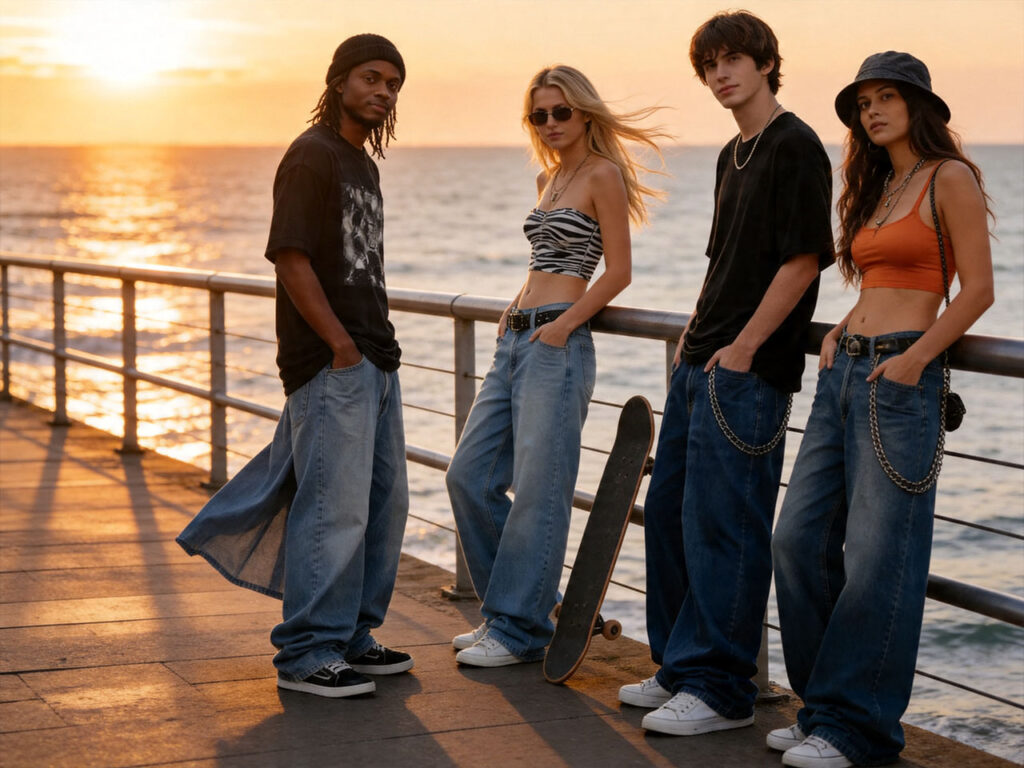
When people talk about whether JNCO is “coming back,” they often frame it as a consumer trend—like a new generation suddenly deciding to wear baggy jeans again. But from a supply-chain and wholesale perspective, “resurgence” means something much more specific and commercially grounded.
A true “return” does not mean every teenager is suddenly wearing JNCO again. It means three structural shifts are happening at the same time:
In other words, a resurgence is really about a coordinated rise in aesthetic tolerance and pricing power.
One interesting pattern I’ve observed is that the brand itself has reintroduced a wide range of baggy silhouettes, including extremely wide-leg cuts and limited editions. These new releases are now priced closer to premium denim brands rather than mass-market mall jeans.
At the same time, the second-hand market has become increasingly active. Listings for “vintage JNCO jeans” continue to appear, and rare graphic pieces can command significant premiums.
This is why many buyers ask: “Why is JNCO so expensive now?”
The answer is not a single factor—it is a combination of three forces:
Before I quote any wide-leg denim program, I always start with a structured checklist to lock down the product definition. For example, I once worked with a buyer in London on a JNCO-inspired project. She initially asked for pricing directly, but my response was simple: we don’t talk price yet—we define the product first.
The reason is straightforward: wide-leg denim is not a standard item—it is a structural product. Any small deviation gets amplified dramatically in an extreme silhouette.
Decision Point | What Can Go Wrong | My Control Method |
Hem opening (20–50 inches) | Unstable drape, awkward stacking, distorted proportions | Develop 2 sample widths before bulk production |
Denim weight & texture | Knee collapse, poor durability, uncontrolled shrinkage | Define exact oz weight, pre-shrink rate, and wash standards |
Pocket size & embroidery | Misalignment, broken stitching, distorted graphics | Stability testing + full stitch pattern approval |
Hardware (zippers/chains) | Rust, breakage, inconsistent batches | Lock suppliers early; run salt-spray and durability tests if needed |
Size chart | High return rates, batch inconsistency | Base sizing on real-body fitting, not mannequins or flat patterns |
In B2B export, I’ve learned one thing very clearly: delayed delivery can miss an entire selling season, slow communication wastes development time, and unreliable documents can destroy trust. For wide-leg denim projects like JNCO, these risks are even more amplified because the garments require more fabric and more complex construction—small issues become highly visible.
1) Lock the Golden Sample
I confirm a “golden sample” early and do not change it during production to avoid drifting standards.
2) Track Key Measurements
I closely monitor waist, hip, thigh, knee, hem, and inseam—any deviation affects the entire silhouette.
3) Inspect During Production, Not Only at the End
I do in-process checks for pocket alignment, embroidery positioning, and leg symmetry to catch issues early.
4) Plan for Shipping Impact
Wide-leg denim takes more space, so I plan packaging and folding methods in advance to avoid creasing or deformation.
Many people ask: where do you actually buy wide-leg denim, and where do you source it from? Using JNCO as an example, the answer depends entirely on whether you are a consumer or a buyer/brand owner. These are two completely different supply paths.
For individual consumers, the path is straightforward:
Here, the focus is simply on getting the product itself—style and condition matter more than supply strategy.
If you are working in wholesale or building a brand, sourcing becomes a strategic decision rather than a shopping activity:
Option 1: Buy Brand Products (Dependency Model)
If you can access wholesale rights and margins are acceptable, you can resell branded products directly.
Pros: low development cost, faster go-to-market
Cons: dependence on brand pricing, supply timing, and availability
Option 2: Build Your Own Wide-Leg Denim Line (Independent Model)
A more sustainable approach is to develop your own wide-leg denim collection using stable silhouettes and original design direction.
Key advantages:
In practice, I usually prefer Option 2, because it reduces dependency on external brands and creates a more stable business system.
However, this does not mean ignoring the value of originals. On the contrary, iconic designs from JNCO—such as Reverbs, Polar Bears, and Crown JNCOs—show how stitching, graphics, and branding can be fused into a recognizable visual identity.
JNCO has never truly disappeared. It has simply shifted from an early mall-based denim system into a more fragmented landscape that includes online direct-to-consumer sales, vintage collector markets, and a growing number of styles that imitate and reinterpret its aesthetic.In essence, demand for wide-leg denim has never stopped—it has only been redistributed across different market layers. Some pieces function as collectibles carrying historical value, others are reinterpreted as retro items through social media, and still others continue to exist as modern wide-leg silhouettes within today’s fashion consumption.In other words, JNCO’s “disappearance” was never about demand fading, but about distribution changing. Trends continue to cycle—just in different forms and through different channels.
If you are developing a wide-leg denim project inspired by JNCO, the real challenge is not just finding a factory—it is finding a system partner capable of consistently producing “extreme silhouette” garments at scale. At Liantao Apparel, we help clients transform high-risk wide-leg denim concepts into scalable commercial products, covering everything from pattern development and golden sample confirmation, to fabric weight control, wash consistency, and bulk production stability. Every stage is designed around one principle: amplifying structural consistency.
For many clients, the initial issue is not design, but production deviation after scaling—twisted hems, inconsistent drape, and noticeable batch-to-batch variation. To address this, we build a full risk-control framework during development, including multi-sample comparisons, locked key measurement standards, and in-process quality tracking. This ensures that every pair of wide-leg denim maintains a consistent visual identity in bulk production.
Ultimately, working with Liantao Apparel is not about hiring a conventional OEM factory—it is about partnering with a development system that understands and manages the complexity of wide-leg denim. We allow brands to focus on creative direction and market positioning, rather than being constrained by supply chain instability, turning styles like JNCO-inspired denim into a sustainable, repeatable product line.
If you have any questions or require a quote, please leave
us a message. Our experts will get back to you within 24 hours to help you choose the ideal fashion products tailored to your needs.
Hi, I’m Lucy Cai, the founder of liantaoapparel.com. I’ve been managing a women’s clothing factory in China for over 16 years. With extensive experience in garment production and OEM services, I’m passionate about sharing insights into women’s fashion, apparel manufacturing, and global sourcing.
If you have any questions or need a quote, please contact us.
Please add us WhatsApp:+86 189 4809 3145
Provide us with detailed information about your requirements, supply design drawings or tech packs,
reference images, and share your ideas.
We will customize the best solution based on your needs and drawings, and provide a specific quote within 24 hours.
Once we receive your confirmation and deposit,we will commence mass production and take care of the subsequent shipping arrangements.