


🏭 Looking for a Custom Apparel Manufacturer?
We are a leading OEM/ODM clothing factory with 20+ years of export experience. Custom styles, flexible MOQs, and retail-ready quality.
Choosing among Chinese garment manufacturers can be challenging. Search results show hundreds of suppliers, but a professional website, a competitive quotation, or a large factory photo does not necessarily prove that a manufacturer is the right partner for your business.
At Liantao Apparel, we believe that choosing an apparel manufacturer in China should start with a more practical question:
Which supplier can meet your product requirements, order quantity, quality standards, and long-term business goals?
In this guide, we break down how to evaluate Chinese apparel manufacturers using a structured supplier-screening framework. We compare the factors that matter most to clothing brands, explain how to assess OEM and ODM capabilities, and introduce a repeatable test you can use before requesting a production quotation.
Our goal is not to declare one factory the best for every buyer. It is to help you identify the manufacturer that best fits your specific requirements.
Start by defining your product category, target order quantity, fabric specifications, quality requirements, and delivery expectations. Then shortlist manufacturers that demonstrate relevant production experience and evaluate them using the same criteria.
Before committing to bulk production, request a detailed quotation, review a development sample, clarify quality-control procedures, and confirm production capacity.
The best apparel manufacturer in China is not necessarily the largest or cheapest. It is the one that can consistently deliver the product you need under clearly agreed commercial and production terms.
The keyword chinese garment manufacturers sounds straightforward, but people searching for it may have very different goals.
Some are sourcing managers comparing established suppliers. Others are startup founders preparing their first private-label collection. Some simply want a small batch of printed T-shirts.
These differences matter because not every search represents a commercially valuable lead.
1. Established clothing brands
These buyers typically need repeat production, consistent quality, reliable delivery, and a manufacturer that can support their existing product specifications.
2. Startup founders and private-label entrepreneurs
These buyers may need product development, custom labels, packaging, sampling, and guidance on production requirements.
3. Wholesale buyers and sourcing managers
They are often comparing quotations, minimum order quantities (MOQs), production capacity, and supplier reliability.
4. Individual consumers and very small buyers
These searchers may want one customized garment, a ready-made product, or a small quantity that falls outside a manufacturer’s commercial production model.
The first three groups are often more relevant to a B2B apparel manufacturer. The fourth group may generate website traffic without producing qualified manufacturing inquiries.
| Search query | Likely intent | Potential business value |
|---|---|---|
| chinese garment manufacturers | Find and compare factories | High |
| apparel manufacturers in china | Identify production partners | High |
| chinese apparel manufacturers | Research suppliers | Medium to high |
| clothing manufacturer in china | Find a manufacturing service | High |
| custom hoodie manufacturer | Source a specific product | High |
| cheap clothes online | Buy finished clothing | Low for B2B manufacturing |
| how to make a T-shirt at home | Learn a process | Low for direct factory sales |
These are qualitative intent classifications, not measured conversion rates. Search intent should ultimately be validated against keyword data, actual search results, and your website’s lead records.
A supplier shortlist becomes more useful when every candidate is evaluated against the same criteria.
The following framework is designed as a repeatable screening test for brands comparing Chinese garment manufacturers.
Important methodology note: This is a proposed evaluation framework, not a completed controlled experiment. The scores and results must be populated using actual supplier quotations, samples, factory documentation, and buyer requirements before they can be presented as empirical findings.
| Test criterion | What to verify | Why it matters |
|---|---|---|
| Product specialization | Relevant experience with your garment category | A supplier experienced in knitwear may not be the best choice for technical outerwear. |
| MOQ and order flexibility | Minimum quantity by style, color, and size | A factory’s MOQ must match your purchasing plan. |
| Sample and development capability | Pattern making, sample revisions, fabric sourcing, and fit approval | Better development controls reduce misunderstandings before bulk production. |
| Quality assurance | Measurement tolerances, inspection procedures, defect handling, and documented standards | Quality should be verified through defined processes, not marketing claims. |
| Communication and delivery planning | Quotation clarity, response quality, production schedule, and shipment terms | Clear communication helps prevent avoidable delays and cost surprises. |
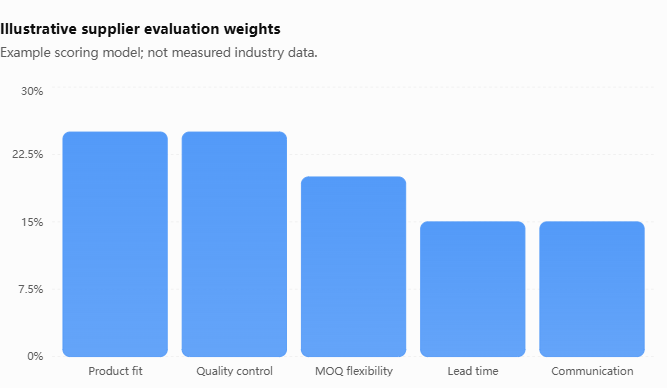
A weighted score can help prioritize suppliers, but the weights should reflect your business model.
For example, a premium fashion brand may prioritize sample accuracy and quality control, while a promotional merchandise buyer may emphasize price, repeatability, and delivery schedule.
Do not treat an unverified claim as a confirmed score. If a manufacturer has not supplied the required evidence, mark the criterion as unverified rather than assuming it performs well.
Not every supplier operates in the same way. Before comparing individual companies, determine which supplier model fits your project.
| Supplier type | Typical strengths | Potential limitations | Best fit |
|---|---|---|---|
| Direct garment factory | Direct production coordination and process visibility | May specialize in a limited number of product categories | Brands with clear product specifications |
| OEM manufacturer | Produces garments according to the buyer’s designs and requirements | The buyer may need to provide detailed technical specifications | Established brands and product developers |
| ODM manufacturer | May provide existing designs or product-development support | Available customization and design ownership must be clarified | Startups and brands developing new products |
| Trading company | Can consolidate products and coordinate multiple suppliers | Production is handled by third-party factories | Buyers sourcing across multiple product categories |
| Sourcing company | Can help identify suppliers, coordinate sampling, and manage procurement | Adds a coordination layer and may charge service fees | Buyers needing broader sourcing support |
OEM and ODM are not guarantees of quality. These labels describe different approaches to product development and manufacturing, and the exact service scope varies by supplier.
Ask who actually manufactures the garments, who owns the technical specifications, who approves substitutions, and who is responsible for quality problems.
Do not compare quotations unless the underlying requirements are equivalent.
For a meaningful comparison, provide each shortlisted supplier with the same:
Otherwise, a lower quotation may simply reflect different fabric, construction, packaging, or quality assumptions.
A reliable supplier evaluation should go beyond the first quotation.
Use these questions during your initial discussions.
A professional manufacturer should be able to explain its process, identify information it still needs, and clarify which commitments can be confirmed only after reviewing the order specifications.
Here is a practical way to turn your shortlist into a defensible purchasing decision.
Describe the garment, target market, fabric, measurements, customization, quantity, target cost, and delivery requirements.
The more consistent your brief, the easier it is to compare the responses from different Chinese apparel manufacturers.
Request quotations from at least three suitable candidates where practical. This is a suggested screening approach, not a universal industry benchmark.
Ask each supplier to identify assumptions, exclusions, and unresolved questions instead of accepting an incomplete price as final.
Record unit price, sampling fees, MOQ, included services, estimated lead time, payment terms, and inspection arrangements.
A spreadsheet is usually sufficient. The important part is to use the same comparison fields for every candidate.
Assess fabric hand feel, measurements, fit, stitching, print or embroidery accuracy, labels, and finishing against the approved specifications.
Where the product or order value justifies it, compare samples from multiple shortlisted suppliers.
Before issuing a bulk purchase order, confirm the final specification, approved sample, quantity breakdown, production schedule, quality requirements, and agreed remedies for nonconforming goods.
The result should be a documented decision based on evidence, not an impression formed during a sales conversation.
A credible supplier comparison should make its evidence visible.
For this reason, we recommend recording actual supplier data rather than publishing an unsupported ranking of the best Chinese garment manufacturers.
Use the following template when assessing shortlisted suppliers.
| Evaluation field | Supplier A | Supplier B | Supplier C |
|---|---|---|---|
| Product specialization | To verify | To verify | To verify |
| MOQ | Record quotation | Record quotation | Record quotation |
| Sample cost | Record quotation | Record quotation | Record quotation |
| Sample lead time | Confirm in writing | Confirm in writing | Confirm in writing |
| Bulk lead time | Confirm in writing | Confirm in writing | Confirm in writing |
| Quality-control process | Review evidence | Review evidence | Review evidence |
| Quotation completeness | Score against checklist | Score against checklist | Score against checklist |
| Final weighted score | Calculate from evidence | Calculate from evidence | Calculate from evidence |
This table is a working research template, not a report of completed supplier testing.
Once the data is collected, the results can be converted into a bar chart comparing weighted scores, a table showing quotation differences, or a chart showing the percentage of suppliers that meet each requirement.
Any published chart should identify the number of suppliers assessed, the evaluation period, the scoring rules, and the source of the underlying data.
A manufacturer should be judged against your actual purchasing needs rather than a generic ranking.
For a startup, a supplier with suitable development support and a manageable MOQ may be more useful than a large factory that only accepts high-volume orders.
For an established brand, documented quality controls, reliable repeat production, and capacity planning may be more important than the lowest initial quotation.
For a sourcing manager, transparent pricing and clear production accountability can matter more than a supplier’s promotional claims.
At Liantao Apparel, our recommended approach is to begin with product fit, then verify commercial terms and production capability. This gives both the buyer and manufacturer a clearer basis for deciding whether a project is suitable.
Any specific capabilities, minimum quantities, certifications, lead times, and production volumes should be confirmed directly before they are advertised as Liantao Apparel’s verified services.
If you are comparing apparel manufacturers in China, the next step is to prepare a clear manufacturing brief.
Include:
The more specific your brief, the easier it is to determine whether a supplier is suitable for your project.
Looking for an apparel manufacturing partner in China?
Contact Liantao Apparel with your product specifications and estimated order quantity to discuss your project and determine the next steps.
A successful manufacturing partnership starts with a clear product brief, realistic commercial expectations, and a transparent evaluation process.
Start with product-specific searches, industry directories, referrals, and trade shows. Verify the supplier’s legal identity, production capabilities, relevant documentation, sample quality, and quality-control procedures before placing a bulk order.
An OEM manufacturer generally produces according to a buyer’s designs and specifications. An ODM manufacturer may also provide existing designs or product-development support. Confirm the precise scope of services and design ownership with each supplier.
There is no single MOQ for all Chinese garment manufacturers. It depends on the garment, fabric, customization, production process, and supplier. Ask for minimum quantities by style, color, and size rather than relying on a general industry estimate.
Not automatically. Compare equivalent specifications and consider sampling, quality, production reliability, communication, payment terms, and total landed cost. A lower unit price may not represent a lower overall purchasing cost.
Request its registered business details, manufacturing address, production evidence, and relevant audit documentation. Arrange a video walkthrough or independent factory audit when appropriate. Confirm whether production is performed in-house or outsourced.
Provide a technical pack or detailed product brief, estimated quantities, fabric specifications, customization requirements, packaging details, quality standards, and delivery destination. These inputs make quotations easier to compare.
About Liantao Apparel
Liantao Apparel helps prospective buyers evaluate apparel manufacturing requirements and explore suitable production arrangements. Contact us with your garment specifications and order expectations to discuss whether we are a good fit for your project.
If you have any questions or require a quote, please leave
us a message. Our experts will get back to you within 24 hours to help you choose the ideal fashion products tailored to your needs.
Hi, I’m Lucy Cai, the founder of liantaoapparel.com. I’ve been managing a women’s clothing factory in China for over 16 years. With extensive experience in garment production and OEM services, I’m passionate about sharing insights into women’s fashion, apparel manufacturing, and global sourcing.
If you have any questions or need a quote, please contact us.
Please add us WhatsApp:+86 189 4809 3145
Provide us with detailed information about your requirements, supply design drawings or tech packs,
reference images, and share your ideas.
We will customize the best solution based on your needs and drawings, and provide a specific quote within 24 hours.
Once we receive your confirmation and deposit,we will commence mass production and take care of the subsequent shipping arrangements.


