


🏭 Looking for a Custom Apparel Manufacturer?
We are a leading OEM/ODM clothing factory with 20+ years of export experience. Custom styles, flexible MOQs, and retail-ready quality.
Choosing the right fabric is important when developing a clothing collection. Fabric selection affects a garment’s feel, drape, durability, and performance after washing. Lyocell fabric is a popular option for apparel brands seeking a soft, smooth material with good moisture-management properties.
With its versatile characteristics, lyocell works well for T-shirts, shirts, dresses, trousers, and sleepwear. Blending it with cotton or elastane can also create different fabric properties.
Before selecting this material, buyers should consider its composition, weight, construction, shrinkage, pilling, and colorfastness. This guide explores how lyocell fabric is made, compares it with other materials, and explains how to check its quality before bulk production.
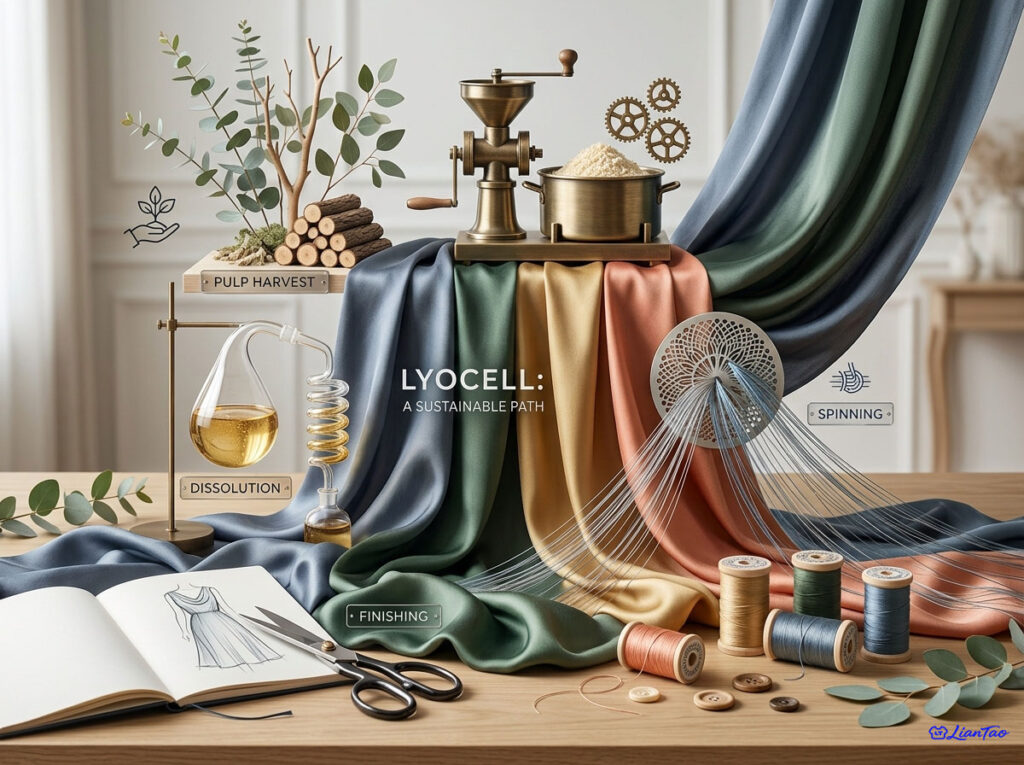
Lyocell is a manufactured cellulosic fiber made from cellulose, commonly sourced from wood pulp. It belongs to the broader family of regenerated cellulose fibers.
Unlike cotton, which is a natural seed fiber, lyocell is produced by dissolving and regenerating cellulose into textile fibers.
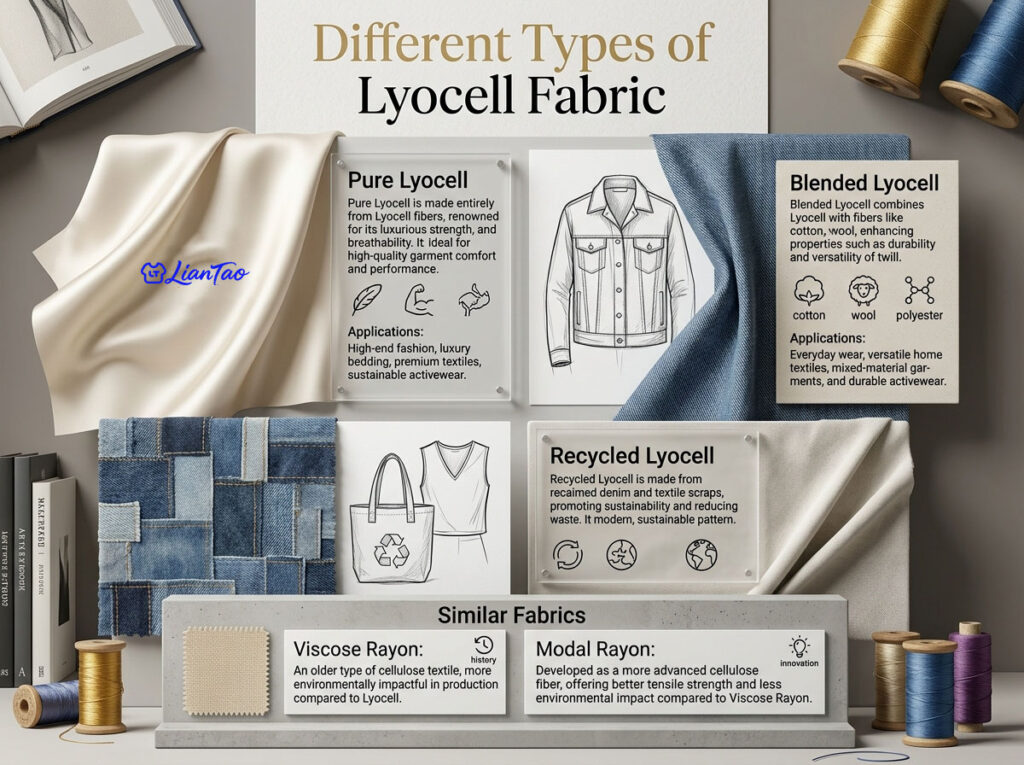
The name lyocell refers to the generic fiber type. TENCEL™ Lyocell is a branded lyocell fiber produced by Lenzing, so the two terms should not be treated as interchangeable in product claims.
The general production process involves several stages:
Lyocell production is associated with a solvent-recovery process. For branded TENCEL™ Lyocell, Lenzing describes a closed-loop production system. Buyers should still verify the actual fiber brand, sourcing documentation, and claims associated with the specific fabric being purchased.
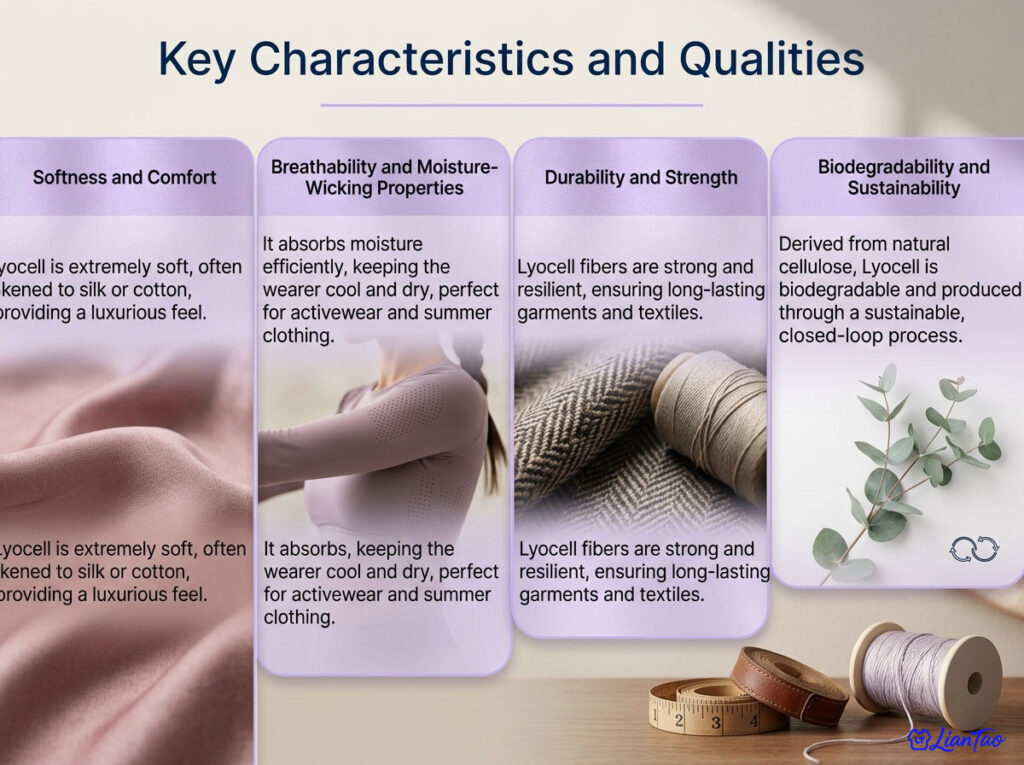
Lyocell is used in apparel because of its combination of softness, moisture-related performance, drape, and textile versatility.
However, finished fabric performance depends on more than fiber content. Yarn structure, fabric construction, weight, finishing, and garment design can all change the final result.
| Property | Typical Lyocell Characteristic | What It Means for Apparel Buyers |
|---|---|---|
| Softness | Often has a smooth, soft hand feel | Suitable for skin-contact clothing and premium casualwear |
| Moisture management | Can absorb and manage moisture effectively | Worth considering for shirts, tops, and lightweight clothing |
| Drape | Can produce fluid fabric structures | Useful for dresses, shirts, and relaxed silhouettes |
| Breathability | Depends on fabric construction and weight | Lightweight constructions may suit warm-weather apparel |
| Strength | Lyocell fibers can offer good tenacity | Fabric strength should still be tested in the finished construction |
| Surface appearance | Can have a smooth, refined appearance | Suitable for clean, minimal apparel designs |
| Dimensional stability | Depends on yarn, construction, and finishing | Shrinkage and growth should be tested before bulk production |
| Pilling resistance | Varies by fabric structure and finishing | Must be checked for products exposed to repeated friction |
Lyocell can be useful when a brand wants a soft hand feel and a fluid drape without relying exclusively on conventional cotton or polyester.
For example:
The right fabric should be selected based on the intended garment and its performance requirements, not just the fiber name.
Lyocell, cotton, and modal are often considered when developing soft everyday apparel. Although they may be used in similar products, they are not identical fibers.
| Comparison Factor | Lyocell | Cotton | Modal |
|---|---|---|---|
| Fiber category | Regenerated cellulose | Natural cellulose | Regenerated cellulose |
| Raw material | Commonly wood pulp | Cotton plant | Commonly wood pulp |
| Hand feel | Often smooth and soft | Depends on cotton type and finishing | Often soft and smooth |
| Drape | Often fluid | Depends on yarn and construction | Often fluid |
| Moisture behavior | Good moisture uptake characteristics | Absorbs moisture | Good moisture uptake characteristics |
| Fabric strength | Depends on fiber and construction | Depends on cotton quality and construction | Depends on fiber and construction |
| Common apparel uses | Shirts, tops, dresses, casualwear | T-shirts, sweatshirts, shirts, denim | Underwear, loungewear, tops |
| Key buyer consideration | Construction, finishing, and care | Cotton quality, shrinkage, and finishing | Fiber source and fabric performance |
Choose lyocell when: You want to explore a smooth hand feel, fluid drape, and a regenerated-cellulose fabric option for premium casualwear.
Choose cotton when: Your product needs the familiar feel and versatility of cotton, particularly for T-shirts, sweatshirts, and everyday basics.
Choose modal when: You are developing soft, lightweight products such as underwear, loungewear, and skin-contact garments.
There is no universally best fiber. A fabric comparison should use actual samples with similar weight, construction, and finishing wherever possible.
Lyocell is frequently discussed in connection with more responsible textile production, but sustainability claims should be evaluated carefully.
The environmental profile of a finished garment depends on multiple factors, including raw material sourcing, chemical management, energy use, water use, dyeing, finishing, transportation, garment durability, and end-of-life treatment.
Several characteristics make lyocell worth investigating:
Textile Exchange describes lyocell as a regenerated cellulose fiber and explains the sourcing and production considerations behind preferred man-made cellulosic fibers.
No. A fiber name alone does not establish the environmental performance of the complete textile product.
When evaluating a supplier, ask for:
| Information to Verify | Why It Matters |
|---|---|
| Fiber producer and brand | Confirms whether the material is generic lyocell or a specific branded fiber |
| Raw material sourcing | Helps assess wood sourcing and traceability |
| Chain-of-custody documents | Supports relevant sourcing claims |
| Chemical management information | Helps assess manufacturing controls |
| Dyeing and finishing process | These stages also contribute to environmental impacts |
| Third-party certificates or documentation | Provides evidence for specific claims within the certificate’s scope |
Brands should avoid describing every lyocell product as automatically sustainable, eco-friendly, or biodegradable without evidence covering the relevant product and production stages.
Lyocell can be blended with other fibers to adjust fabric characteristics and meet different product requirements.
The ideal blend depends on whether the brand prioritizes softness, stretch, durability, dimensional stability, cost, or a particular surface appearance.
| Fabric Blend | Potential Characteristics | Suitable Apparel | Buyer Considerations |
|---|---|---|---|
| 100% Lyocell | Smooth hand feel and fluid drape | Shirts, dresses, lightweight tops | Check shrinkage, seam behavior, and care requirements |
| Lyocell / Cotton | Combines regenerated cellulose and cotton characteristics | T-shirts, casual shirts, everyday basics | Confirm the actual blend ratio and compare hand feel |
| Lyocell / Elastane | Adds stretch and recovery potential | Fitted tops, leggings, close-fitting garments | Test stretch recovery and dimensional stability |
| Lyocell / Polyester | Can combine cellulose-based comfort characteristics with polyester’s performance properties | Casualwear, selected active-inspired products | Assess moisture behavior, pilling, and fiber composition |
| Lyocell / Modal | Combines two regenerated-cellulose fiber types | Loungewear, underwear, soft tops | Compare drape, weight, and surface appearance |
For T-shirts, a lyocell-cotton blend may be worth sampling if the brand wants to compare the smoothness and drape of lyocell with the familiar hand feel of cotton.
For fitted T-shirts, a lyocell-elastane blend may be considered when stretch and recovery are important.
The correct blend ratio should be established through sample development. Do not assume that a particular percentage will guarantee a specific result across different yarns and fabric constructions.
Lyocell is not automatically the best choice for every hoodie. Traditional fleece hoodies often prioritize body, warmth, surface stability, and a specific brushed hand feel.
A lyocell blend may be more suitable for lightweight sweatshirts, relaxed tops, or softer casualwear concepts than for heavyweight brushed fleece.
For hoodie development, compare:
Lyocell is versatile, but the fabric construction must match the garment’s intended use.
| Clothing Category | Recommended Fabric Direction | Main Development Focus |
|---|---|---|
| T-shirts | Lightweight lyocell jersey or lyocell blend | Softness, opacity, shrinkage, and pilling |
| Casual shirts | Lyocell woven fabric | Drape, seam stability, and appearance |
| Dresses | Lightweight woven or knitted lyocell | Fluid movement and dimensional stability |
| Trousers | Medium-weight woven lyocell or blend | Strength, seam slippage, and fit retention |
| Loungewear | Soft knitted lyocell blends | Comfort, wash performance, and shape retention |
| Sleepwear | Lightweight lyocell fabric | Skin-contact comfort, colorfastness, and care |
| Lightweight sweatshirts | Suitable lyocell blend or knit construction | Fabric body, surface stability, and recovery |
Lyocell can be considered for selected casual and low-impact apparel applications, but it should not automatically be treated as a technical performance fabric.
For high-intensity sportswear, buyers should evaluate moisture transport, drying behavior, stretch recovery, abrasion resistance, and long-term durability against the intended performance specification.
A fiber’s moisture absorption alone does not prove that a finished garment will dry quickly or outperform other materials.
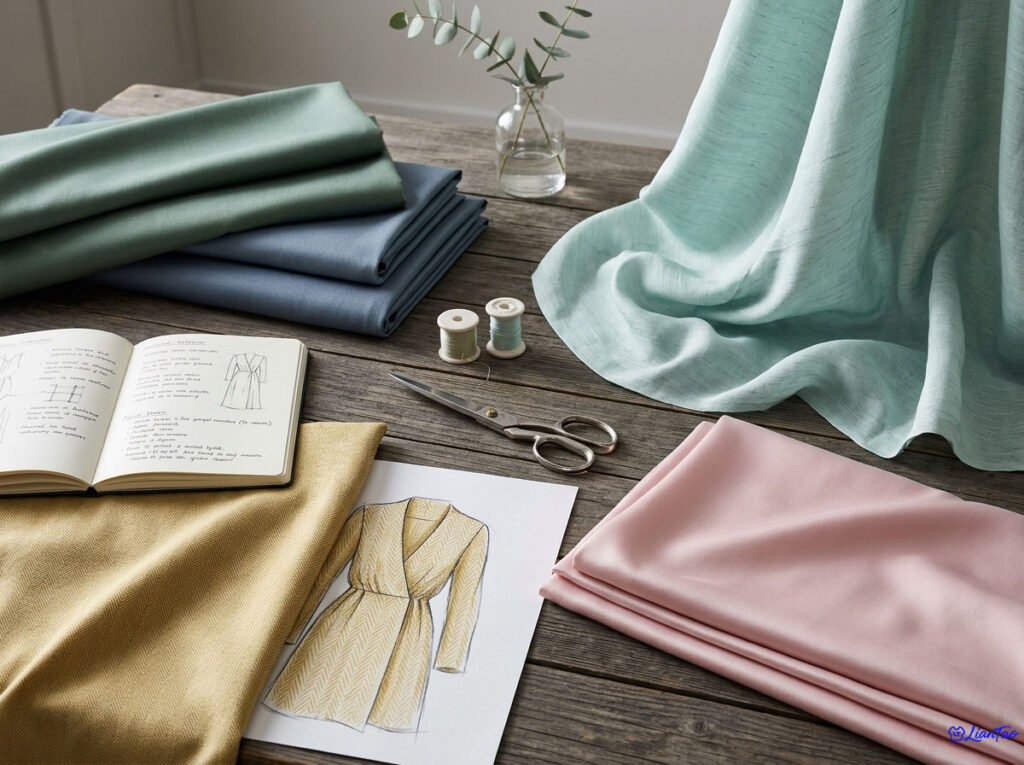
One of the most important steps in sourcing lyocell fabric is checking its performance before approving bulk production.
A fabric may look and feel excellent during sampling but behave differently after repeated washing, drying, sewing, or wearing.
For this reason, apparel brands should use a structured testing process.
Test 1: Fabric weight and construction
Measure the fabric’s GSM (grams per square meter) and confirm that it matches the approved specification.
A difference in weight can affect garment drape, thickness, opacity, and the overall fit.
Test 2: Dimensional stability after washing
Measure the fabric before and after washing to determine whether it shrinks or grows.
ISO 6330:2021 specifies domestic washing and drying procedures for textile testing. The actual wash and drying conditions should match the agreed testing protocol and care instructions.
Test 3: Pilling and surface appearance
Evaluate whether the fabric develops pills, fuzzing, or surface changes after repeated friction.
This is particularly relevant for T-shirts, loungewear, and garments exposed to frequent rubbing.
Test 4: Colorfastness
Test whether the fabric loses color or transfers dye during washing and rubbing.
This is especially important for dark colors, bright colors, and garments that may be washed with other clothing.
Test 5: Tensile strength and seam performance
Evaluate the fabric’s resistance to breaking and check whether garment seams remain secure under the intended use conditions.
Fabric strength and seam strength are separate performance considerations.
A useful way to compare fabrics is to prepare several candidate materials and test them under the same conditions.
For example, a brand developing a premium T-shirt could compare:
The samples should have comparable GSM, knit construction, finishing, and color wherever possible. Otherwise, differences may result from fabric construction rather than fiber composition alone.
The following is a proposed pilot-test framework, not a completed experiment.
| Test Item | Sample A: 100% Lyocell | Sample B: Lyocell-Cotton | Sample C: 100% Cotton |
|---|---|---|---|
| GSM | Record actual result | Record actual result | Record actual result |
| Length change after washing | Record actual result | Record actual result | Record actual result |
| Width change after washing | Record actual result | Record actual result | Record actual result |
| Pilling rating | Record actual result | Record actual result | Record actual result |
| Colorfastness to washing | Record actual result | Record actual result | Record actual result |
| Tensile strength | Record actual result | Record actual result | Record actual result |
| Hand feel assessment | Record panel assessment | Record panel assessment | Record panel assessment |
| Final suitability | Evaluate against product specification | Evaluate against product specification | Evaluate against product specification |
Use the following formula:
Shrinkage (%) = (Original measurement − Measurement after washing) ÷ Original measurement × 100
For example, if a fabric sample measures 100 cm before washing and 97 cm after washing:
(100 − 97) ÷ 100 × 100 = 3% shrinkage.
This is an illustrative calculation, not a measured result for lyocell.
For a more useful comparison, use a documented test protocol:
| Protocol Item | Suggested Procedure |
|---|---|
| Sample quantity | At least three specimens per candidate fabric for an initial screening |
| Fabric conditioning | Use consistent conditioning conditions before measurement |
| Initial measurements | Record GSM, length, width, and appearance |
| Washing procedure | Select an appropriate ISO 6330 procedure |
| Post-wash measurements | Record dimensional change and appearance |
| Surface evaluation | Assess pilling and fuzzing using the agreed method |
| Color evaluation | Record color change and staining using the specified test method |
| Reporting | Document method, equipment, conditions, sample count, and actual results |
The exact number of specimens, washing cycles, acceptance limits, and testing standards should be agreed with the buyer or testing laboratory.
A sample test is evidence about the tested specimens. It does not automatically guarantee that every subsequent production lot will perform identically.
Lyocell fabric can shrink, pill, or wrinkle depending on its construction, finishing, washing conditions, and garment design.
These issues should be evaluated on the actual fabric and finished garment rather than assumed from the fiber name.
Lyocell garments may experience dimensional changes after washing.
The level of shrinkage depends on yarn structure, knit or woven construction, finishing, and drying conditions.
To reduce uncertainty:
Lyocell fabrics can develop pilling under friction, although the level varies with yarn construction, fabric structure, and finishing.
A smoother fabric appearance during sampling does not guarantee long-term pilling resistance.
For products that will experience repeated friction, include a pilling test in the fabric approval process.
Lyocell garments can develop wrinkles during wearing, storage, and washing.
The degree of wrinkling depends on fabric weight, construction, finishing, and garment design.
If a brand requires easy-care performance, test the finished garment after washing and drying instead of relying only on the fiber composition.
Care instructions should always be based on the actual garment, its fabric blend, dyeing, finishing, and construction.
A 100% lyocell woven shirt may require different care from a lyocell-cotton knitted T-shirt.
General care considerations include:
For brands, care instructions should be confirmed through garment testing before bulk labels are approved.
When sourcing lyocell fabric for a private label collection, the most important step is translating the product concept into a clear material specification.
A supplier should understand not only the requested fiber composition but also the finished garment’s weight, structure, hand feel, color, and performance requirements.
| Specification | Information to Provide | Why It Matters |
|---|---|---|
| Fiber composition | 100% lyocell or the required blend ratio | Defines the material composition |
| Fiber brand | Generic lyocell or specified branded fiber | Prevents unsupported brand claims |
| Fabric construction | Jersey, rib, interlock, twill, plain weave, etc. | Determines fabric structure and use |
| GSM | Target fabric weight and tolerance | Controls garment weight and drape |
| Color | Pantone reference or approved physical swatch | Helps align color development |
| Finish | Desired softness, surface, or functional finish | Defines the intended fabric appearance and performance |
| Testing requirements | Shrinkage, pilling, colorfastness, strength, etc. | Establishes quality expectations |
| Intended garment | T-shirt, shirt, dress, trousers, or loungewear | Connects fabric selection with product use |
| Order quantity | Estimated development and bulk quantity | Helps assess sourcing feasibility |
Before confirming a fabric, ask:
These questions help brands distinguish between a fabric that looks suitable in a sample and one that can meet the requirements of a repeatable production order.
A clothing manufacturer needs to understand how the fabric behaves during cutting, sewing, finishing, and garment inspection.
This is particularly important for lyocell products because fabric weight, drape, dimensional stability, and handling can influence the final garment.
Use the following checklist when evaluating a potential OEM or ODM manufacturing partner.
| Evaluation Area | What to Confirm | Why It Matters |
|---|---|---|
| Fabric sourcing | Whether the manufacturer can source or work with the specified lyocell material | Ensures material suitability |
| Sample development | Whether the factory can develop samples based on your tech pack | Confirms design and construction feasibility |
| Fabric inspection | Whether fabric composition, GSM, color, and visible defects can be checked | Reduces material-related uncertainty |
| Pattern and cutting | Whether the production team can handle the selected fabric construction | Supports cutting accuracy |
| Sewing quality | Whether seams and stitching are suitable for the material | Helps maintain garment durability |
| Finishing | Whether the finished garment can meet the required appearance and measurements | Controls the final product |
| Quality control | Whether inspection criteria are documented | Supports consistent bulk production |
| Bulk production planning | Whether the factory can confirm material availability and production arrangements | Reduces avoidable delays |
A fabric swatch alone is not enough to approve a finished garment.
The brand should evaluate a sewn sample to confirm fit, drape, stitching, construction, and appearance.
Once approved, the sample should become a reference for bulk production inspection.
Lyocell is a manufactured regenerated-cellulose fiber. It is made from cellulose, commonly sourced from wood pulp, but it is not a natural fiber in the same category as cotton.
Neither fiber is universally better. Lyocell may be preferred for certain soft, fluid fabric constructions, while cotton is widely used for versatile everyday apparel. The best choice depends on garment design, performance requirements, cost, and customer expectations.
No. Lyocell is a generic fiber name, while TENCEL™ is a registered brand of Lenzing. TENCEL™ Lyocell is a branded lyocell fiber. Product claims should accurately identify the material used.
Yes, lyocell can be used for T-shirts, particularly when the brand wants to explore a soft hand feel and fluid drape. Fabric weight, knit construction, opacity, shrinkage, and pilling should be checked before bulk production.
Yes. Lyocell-cotton blends can be developed for different apparel applications. The actual blend ratio should be selected through sampling and performance testing.
Lyocell can be considered for selected lightweight sweatshirts and casualwear. For heavyweight or brushed fleece hoodies, the brand should compare fabric body, warmth, surface stability, and durability with other suitable constructions.
Lyocell garments can experience dimensional changes after washing. The actual shrinkage depends on the fabric construction, finishing, and washing conditions. Test the fabric or garment before approving bulk production.
Lyocell fiber is commonly described as biodegradable under appropriate conditions. However, the behavior of a finished garment depends on dyes, finishes, blends, and other components. Avoid making broad biodegradability claims without evidence for the specific product.
 Conclusion
Lyocell is a versatile material worth considering for brands developing premium casualwear, T-shirts, shirts, dresses, and lightweight apparel.
Its softness, drape, and moisture-related characteristics can support a range of product concepts, but the finished fabric’s performance depends on its construction, blend ratio, and finishing.
Before starting bulk production, compare fabric samples, confirm fiber composition, test dimensional stability, evaluate pilling and colorfastness, and approve a finished garment sample.
If you are planning a private label clothing collection, work with a manufacturing partner who can review your fabric specification, sample requirements, and quality expectations before production.
Developing custom T-shirts, shirts, or casualwear with lyocell fabric? Contact Liantao Apparel to discuss your product specifications, OEM/ODM requirements, and apparel manufacturing project.
If you have any questions or require a quote, please leave
us a message. Our experts will get back to you within 24 hours to help you choose the ideal fashion products tailored to your needs.
Hi, I’m Lucy Cai, the founder of liantaoapparel.com. I’ve been managing a women’s clothing factory in China for over 16 years. With extensive experience in garment production and OEM services, I’m passionate about sharing insights into women’s fashion, apparel manufacturing, and global sourcing.
If you have any questions or need a quote, please contact us.
Please add us WhatsApp:+86 189 4809 3145
Provide us with detailed information about your requirements, supply design drawings or tech packs,
reference images, and share your ideas.
We will customize the best solution based on your needs and drawings, and provide a specific quote within 24 hours.
Once we receive your confirmation and deposit,we will commence mass production and take care of the subsequent shipping arrangements.


