


🏭 Looking for a Custom Apparel Manufacturer?
We are a leading OEM/ODM clothing factory with 20+ years of export experience. Custom styles, flexible MOQs, and retail-ready quality.
Knowing how to measure inseam is essential when buying pants online, choosing the right jeans length, or developing a clothing collection. Even a small difference in inseam length can change how trousers fall over shoes, whether jeans bunch at the ankles, and how comfortable pants feel when walking or sitting.
For clothing brands, accurate inseam measurement is equally important. It helps establish reliable size charts, communicate product specifications, evaluate samples, and maintain consistency during bulk production.
In this guide, we explain two practical ways to measure inseam, compare inseam with outseam and rise, and show how apparel brands can use a repeatable measurement test to improve garment fit.
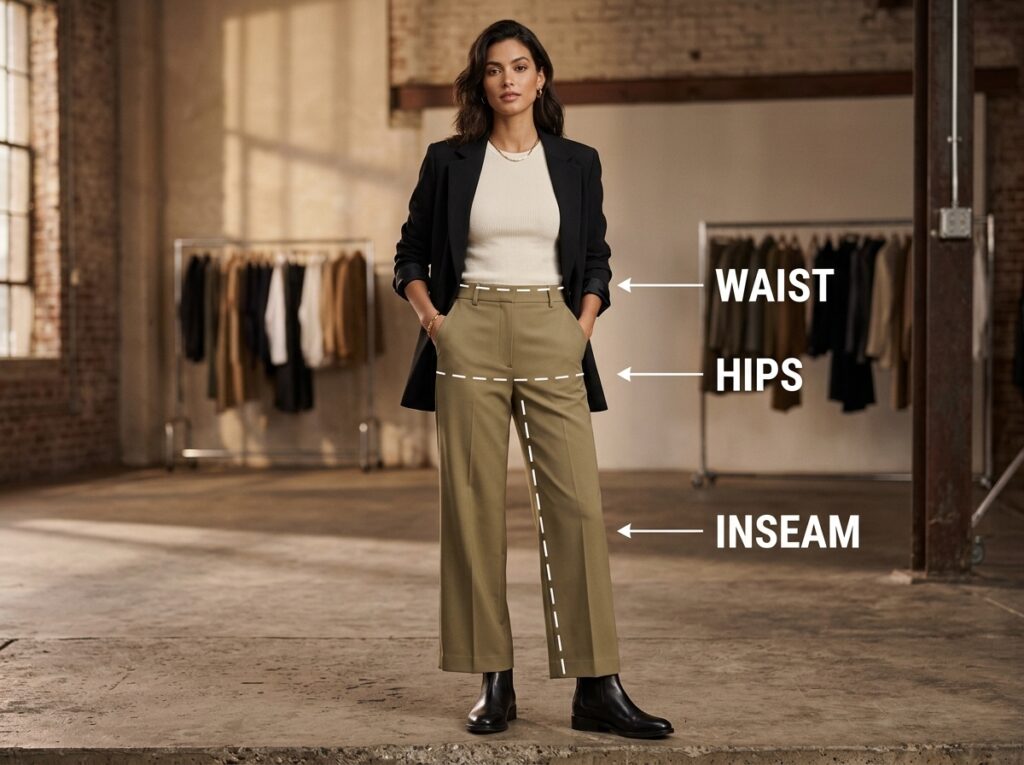
An inseam is the length of the inside leg of a pair of pants. It is measured from the crotch seam, where the inner leg seams meet, down to the bottom edge of the leg opening.
Inseam is commonly used to describe the length of jeans, trousers, leggings, joggers, and shorts. It helps determine where a garment will end on the leg.
For example, a pair of jeans labeled 32 × 30 typically uses the first number for the waist measurement and the second for the inseam, both in inches. Always check the specific brand’s size guide because labeling conventions can vary.
An accurate inseam helps you choose pants that match your preferred fit and footwear.
Measuring a pair of pants that already fits well is usually the easiest starting point. This method is especially useful if you want to buy a similar style or provide a reference measurement for a custom clothing order.
Step 1: Lay the pants flat.
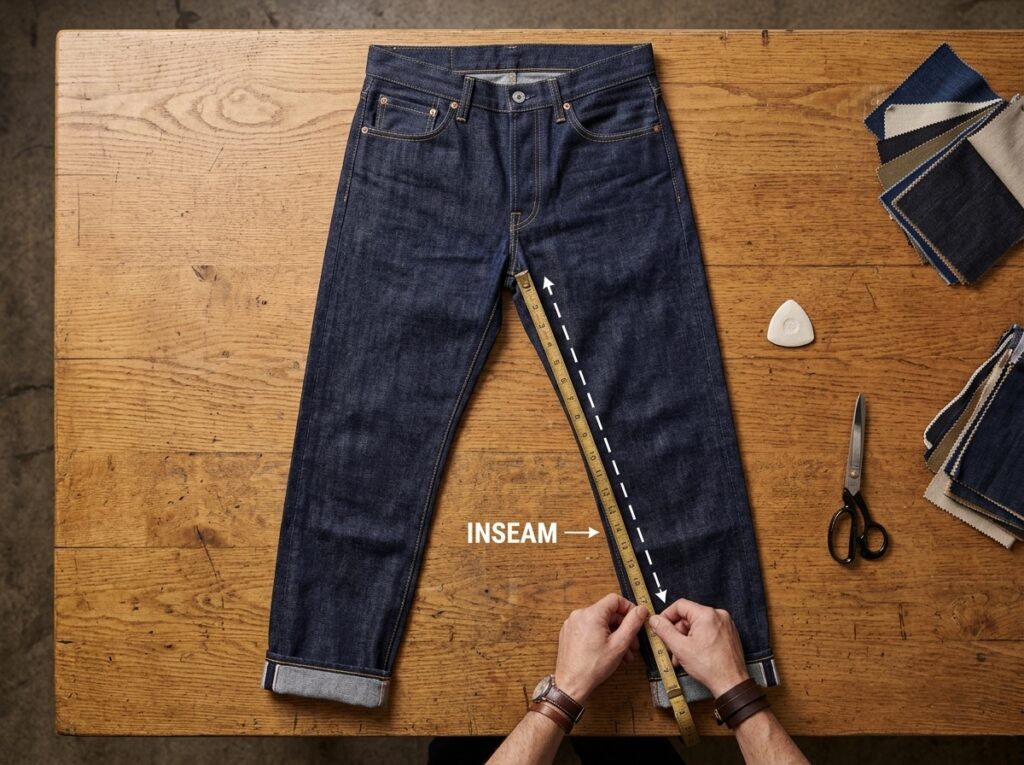
Place the pants on a clean, flat surface. Smooth out wrinkles without stretching the fabric. Align the waistband and leg seams as naturally as possible.
Step 2: Locate the crotch seam.
Find the point where the inseam stitching meets at the crotch. This is the starting point of the measurement.
Step 3: Position the measuring tape.
Place the beginning of the tape at the crotch seam. Make sure it starts at the actual seam junction rather than at the waistband.
Step 4: Follow the inside leg seam.
Run the tape down the inside seam toward the bottom hem. If the seam curves, follow its path rather than measuring a straight shortcut through the fabric.
Step 5: Record the measurement.
Read the measurement at the bottom edge of the hem. Record it in inches or centimeters and note which unit you used.
Step 6: Repeat the measurement.
Measure again to check consistency. If the two readings differ, realign the garment and repeat the process.
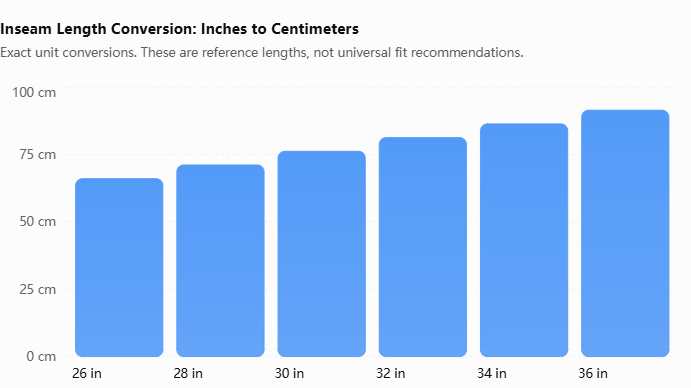
The following table shows common inseam lengths and their approximate centimeter equivalents. These are conversion examples, not recommended lengths for every person or brand.
| Inseam (inches) | Inseam (cm) | Common use |
|---|---|---|
| 26″ | 66.0 cm | Shorter trouser or cropped fit |
| 28″ | 71.1 cm | Shorter standard-length styles |
| 30″ | 76.2 cm | Common regular-length reference |
| 32″ | 81.3 cm | Longer regular-length reference |
| 34″ | 86.4 cm | Long-length styles |
| 36″ | 91.4 cm | Extra-long styles |
Actual fit depends on rise, garment design, body proportions, and footwear. A 30-inch inseam does not guarantee the same visual result across different brands.
If you do not own a pair of pants with the fit you want, you can measure your inseam directly on your body.
This method is useful when shopping for pants for the first time, comparing size charts, or establishing an initial body measurement for a custom garment.
Step 1: Stand naturally.
Stand upright with your feet approximately hip-width apart. Keep your weight balanced and avoid bending your knees.
Step 2: Position the tape at the crotch.
Place the beginning of the measuring tape at the top of the inner thigh, where the crotch seam of pants would normally sit. A helper can make this measurement easier and more consistent.
Step 3: Measure down the inside leg.
Run the tape along the inside of your leg toward the desired trouser hem position.
Step 4: Consider your footwear.
Wear the shoes you expect to use most often with the pants. This helps you choose a more practical finishing length.
Step 5: Record and repeat.
Write down the measurement and repeat it to check that the result is consistent.
These methods measure related but different things. A body inseam describes a measurement taken on the person, while a garment inseam describes the actual inside seam length of a finished pair of pants.
| Measurement method | Starting point | Ending point | Best used for |
|---|---|---|---|
| Body inseam | Top of the inner thigh at the crotch | Desired hem position | Initial size selection and body measurement |
| Garment inseam | Crotch seam junction | Bottom edge of the hem | Comparing existing pants and checking garment specifications |
Do not assume that a body measurement and a finished garment measurement should always be identical. Garment construction, crotch shape, fabric behavior, and the intended fit can affect the final specification.
The basic measurement principle is the same: start at the crotch area and follow the inside leg to the hem. However, different garment designs may require slightly different handling.
Lay the jeans flat and identify the crotch seam junction. Follow the inside leg seam down to the hem, keeping the denim smooth but not stretched.
Jeans may have different seam constructions, including flat-felled or overlocked finishes. If the crotch seam is difficult to identify, follow the inside stitching carefully.
For tailored trousers, make sure the fabric is relaxed and the legs are aligned. Follow the inside seam from the crotch seam to the hem.
If the trousers have a center crease, do not use the crease as the measurement path. The inseam follows the inside leg construction, not the front crease.
Use the same starting point at the crotch seam, but stop at the bottom hem of the shorts.
Shorts may have inseams such as 5, 7, or 9 inches, depending on the intended style. These numbers describe the inside leg length, not the total side length of the shorts.
| Garment type | Measurement path | Important detail | Common fit consideration |
|---|---|---|---|
| Jeans | Crotch seam to bottom hem | Check the actual inseam stitching | Leg opening and footwear |
| Tailored trousers | Crotch seam to bottom hem | Keep the fabric relaxed and aligned | Break, drape, and shoe coverage |
| Joggers | Crotch seam to bottom hem | Consider elastic or ribbed cuffs | Cuff position and fabric stretch |
| Leggings | Crotch seam to bottom hem | Avoid stretching the fabric during measurement | Fabric recovery and ankle coverage |
| Shorts | Crotch seam to bottom hem | Stop at the actual short hem | Desired coverage and mobility |
For apparel developers, these differences should be reflected in the measurement specifications for each product category. A single inseam rule may not be sufficient for every style.
Inseam, outseam, and rise are three different garment measurements. Confusing them can lead to inaccurate size comparisons and production specifications.
Inseam measures the inside leg from the crotch seam to the bottom hem. It indicates the length of the inner leg section.
Outseam measures the outside length of the garment, generally from the top of the waistband down to the bottom hem along the side seam.
Rise measures the distance from the crotch seam to the top of the waistband. Front rise and back rise are usually recorded separately because their measurements and construction differ.
| Measurement | Where to measure | What it describes | Why it matters |
|---|---|---|---|
| Inseam | Crotch seam to inside hem | Inside leg length | Determines where the pants finish on the leg |
| Outseam | Waistband to outside hem | Full outside leg length | Helps define overall garment length |
| Front rise | Front crotch seam to top of waistband | Front waist-to-crotch depth | Influences front fit and waist position |
| Back rise | Back crotch seam to top of waistband | Back waist-to-crotch depth | Influences seat coverage and back fit |
A useful relationship is that outseam is influenced by both rise and leg length, but the measurements should not be treated as a simple interchangeable formula. The waistband shape, crotch construction, and measurement endpoints matter.
For clothing manufacturers, clearly identifying each point of measurement in a technical specification sheet helps prevent confusion during sample development and production.
The right inseam depends on your body proportions, the pants’ rise, the garment silhouette, and the shoes you plan to wear.
A straight-leg jean and a wide-leg trouser can look different even when they have the same inseam measurement. Fabric weight and drape also affect where the hem falls.
| Desired style | Possible inseam approach | Styling consideration |
|---|---|---|
| Cropped pants | Shorter than a full-length style | Leaves more ankle visible |
| Ankle-length trousers | Hem ends around the ankle | Works with flats and sneakers |
| Full-length straight jeans | Hem reaches the shoe area | Creates a classic denim silhouette |
| Wide-leg trousers | Often designed to fall lower over footwear | Requires attention to hem width and drape |
| Joggers | Ends around the ankle or at the cuff | Elastic cuffs influence the finished appearance |
These are styling references, not universal size recommendations. Compare actual garment measurements with the brand’s fit guide before selecting a size.
Even a simple measurement can become inaccurate when the garment is not prepared properly or the measuring tape is positioned incorrectly.
Avoid these common mistakes:
For clothing brands, these errors can become more serious when they are repeated across multiple sizes or production batches. A clear measurement method and documented tolerance are essential.
For apparel brands, inseam measurement is not just a shopping measurement. It is a key point of measurement, often abbreviated as POM, in a garment technical specification.
A clear inseam specification helps designers, product developers, manufacturers, and quality-control teams work toward the same finished measurement.
ISO 18890:2018, Clothing — Standard method of garment measurement, provides a reference for defining garment measurement points and methods. It identifies uses including measurement tables, prototype development, sample approval, production control, garment inspection, and dimensional-change testing. The standard should be consulted for the applicable garment and measurement method rather than replaced with an informal measuring instruction.
Specify exactly where the inseam measurement begins and ends.
For standard trousers, this is generally the crotch seam junction to the bottom edge of the inside leg hem. If a design uses unusual construction, document the agreed measurement method in the technical pack.
Lay the garment flat on a clean, even surface. Close fasteners, align the seams, and remove folds without stretching the fabric.
For knit garments, record whether the measurement is taken in a relaxed state or under a defined tension condition.
Use a flexible, non-stretch measuring tape with clearly readable graduations. Keep the same measurement unit and method across sample reviews.
Record the sample’s actual inseam next to the target measurement. Include the garment size, sample version, date, and any relevant fabric information.
Review the measured result against the approved technical pack and the agreed tolerance. If the sample falls outside the approved range, document the difference and determine whether a pattern or construction adjustment is needed.
The table below is an example of how a brand can organize a measurement record. The target and tolerance must be established by the buyer and manufacturer for the specific product; the example values are placeholders, not universal industry tolerances.
| Measurement point | Target measurement | Sample measurement | Agreed tolerance | Result |
|---|---|---|---|---|
| Inseam – Size S | [Enter target] | [Enter result] | [Enter agreed range] | Pass / Review |
| Inseam – Size M | [Enter target] | [Enter result] | [Enter agreed range] | Pass / Review |
| Inseam – Size L | [Enter target] | [Enter result] | [Enter agreed range] | Pass / Review |
| Inseam – Size XL | [Enter target] | [Enter result] | [Enter agreed range] | Pass / Review |
A measurement that is correct on one sample does not automatically guarantee that every production unit will be identical. Brands should define measurement methods, tolerances, sample approval requirements, and inspection procedures before bulk production begins.
Consistent documentation helps teams:
A useful way to improve measurement quality is to test whether different measurements of the same garment produce consistent results.
This section provides a practical test protocol for brands and apparel production teams. It is a proposed experiment design, not a claim that a laboratory study has already been completed.
Evaluate whether the inseam measurement method produces repeatable results when the same garment is measured multiple times.
Use the following table to capture real results from your own test.
| Garment | Measurer | Reading 1 | Reading 2 | Reading 3 | Range |
|---|---|---|---|---|---|
| Denim jeans | A | Record | Record | Record | Max – Min |
| Denim jeans | B | Record | Record | Record | Max – Min |
| Woven trousers | A | Record | Record | Record | Max – Min |
| Woven trousers | B | Record | Record | Record | Max – Min |
| Knit joggers | A | Record | Record | Record | Max – Min |
| Knit joggers | B | Record | Record | Record | Max – Min |
A smaller range between repeated readings indicates better repeatability under the test conditions. Larger differences suggest that the method or measurement points need clarification.
For a more complete production study, calculate the average reading, range, and difference between measurers. If the brand uses formal measurement-system analysis, it can also evaluate repeatability and reproducibility using an agreed statistical method.
Do not set a universal pass/fail limit without considering the garment type, fabric, measurement point, and buyer’s approved tolerance.
Once real readings have been collected, visualize the range for each garment. A chart should show actual results from the test, not invented sample data.
For example, the chart can compare:
This approach turns a simple measuring guide into a repeatable quality-control process that can support apparel product development.
No. Inseam measures the inside leg from the crotch seam to the hem. Overall pant length may refer to the outside leg or another garment measurement, so always check the size chart’s terminology.
You can use a piece of string to follow the inside leg measurement, then place the string next to a ruler to determine its length. Keep the string relaxed and follow the same starting and ending points.
Lay the jeans flat, locate the crotch seam junction, and measure down the inside leg seam to the bottom hem. Do not measure from the waistband.
A 30-inch inseam is a common reference length, but whether it is long or short depends on body proportions, rise, footwear, and the intended garment fit.
It can, but not always. Some brands increase inseam length across sizes, while others keep the same inseam for several waist sizes. Check the brand’s size chart or product specification.
For body measurement, you can measure without shoes and then consider your preferred footwear when deciding where you want the hem to finish. When measuring an existing garment, measure the actual inside seam rather than wearing the pants.

Inseam usually refers to the inside leg measurement. Leg length can be used more broadly and may refer to body length, garment length, or inseam depending on the size guide.
Learning how to measure inseam helps you choose better-fitting jeans, trousers, shorts, and other bottoms. The simplest method is to measure a pair of pants that already fits well, starting at the crotch seam and following the inside leg to the hem.
If you do not have a suitable reference garment, you can measure your body from the top of the inner thigh to your desired hem position. Remember that body measurements and finished garment measurements are not always identical.
For apparel brands, accurate inseam measurement should be part of a wider product-development process. Define measurement points, document target measurements, agree on tolerances, review samples, and use consistent inspection methods before bulk production.
A well-fitting pair of pants starts with clear product specifications, suitable fabric, accurate pattern development, and consistent garment construction.
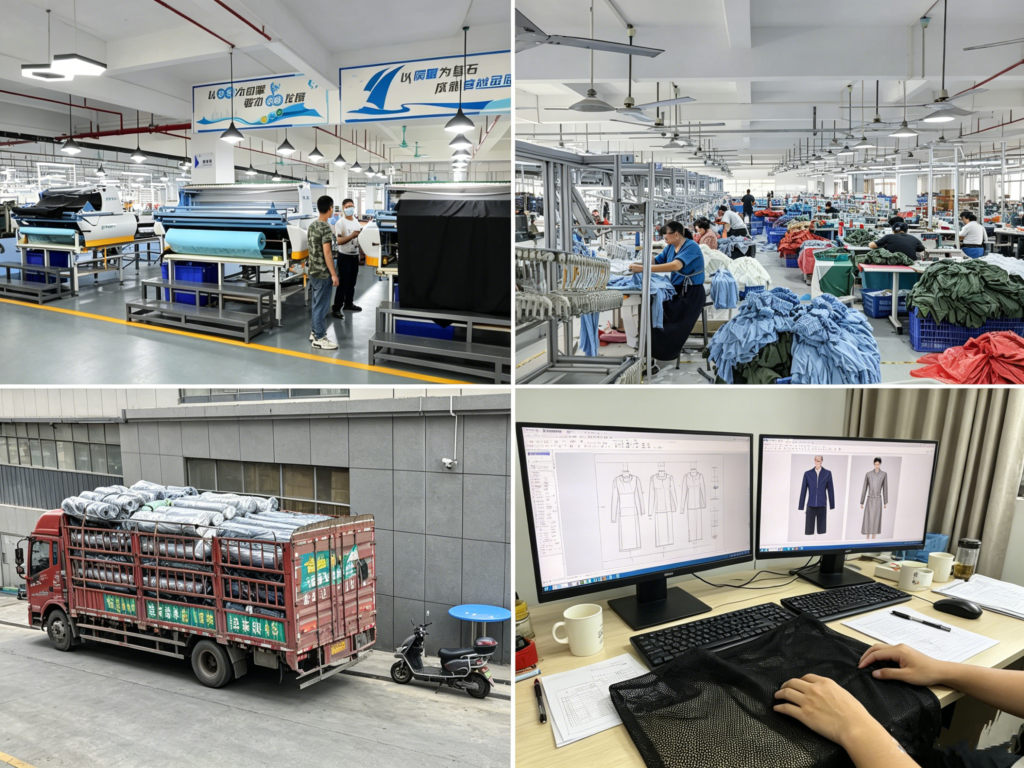
For brands developing private-label apparel or sourcing custom clothing, choosing a manufacturing partner that understands product requirements is an important part of building a reliable collection.
Liantao Apparel can be introduced as a manufacturing contact for businesses exploring custom apparel production, including T-shirts, hoodies, and other clothing products. For brands planning pants or other bottomwear collections, discuss the specific product category and confirm the manufacturer’s available capabilities before proceeding.
When contacting a clothing manufacturer, prepare:
Developing a new clothing collection? Contact Liantao Apparel to discuss your product specifications and explore suitable apparel manufacturing options.
Before publishing, confirm Liantao Apparel’s actual product range, bottomwear capabilities, OEM/ODM services, minimum order quantities, lead times, and quality-control procedures.
If you have any questions or require a quote, please leave
us a message. Our experts will get back to you within 24 hours to help you choose the ideal fashion products tailored to your needs.
Hi, I’m Lucy Cai, the founder of liantaoapparel.com. I’ve been managing a women’s clothing factory in China for over 16 years. With extensive experience in garment production and OEM services, I’m passionate about sharing insights into women’s fashion, apparel manufacturing, and global sourcing.
If you have any questions or need a quote, please contact us.
Please add us WhatsApp:+86 189 4809 3145
Provide us with detailed information about your requirements, supply design drawings or tech packs,
reference images, and share your ideas.
We will customize the best solution based on your needs and drawings, and provide a specific quote within 24 hours.
Once we receive your confirmation and deposit,we will commence mass production and take care of the subsequent shipping arrangements.


