


🏭 Looking for a Custom Apparel Manufacturer?
We are a leading OEM/ODM clothing factory with 20+ years of export experience. Custom styles, flexible MOQs, and retail-ready quality.
How much does it cost to have custom clothes made? The answer depends on what you want to produce, how many pieces you order, which fabrics you choose, and how much customization your brand needs.
A basic custom T-shirt may cost significantly less to manufacture than a heavyweight embroidered hoodie or a technical performance jacket. Small production runs also tend to have higher per-unit costs because sampling, setup, and other fixed expenses are spread across fewer garments.
For clothing brands, startups, and private label businesses, understanding these costs before requesting a quote helps prevent budget surprises and makes supplier comparisons more meaningful.
In this guide, Liantao Apparel Manufacturer explains the main factors behind custom clothing manufacturing costs, provides indicative public price benchmarks, and outlines a practical quote-comparison test you can use before committing to bulk production.
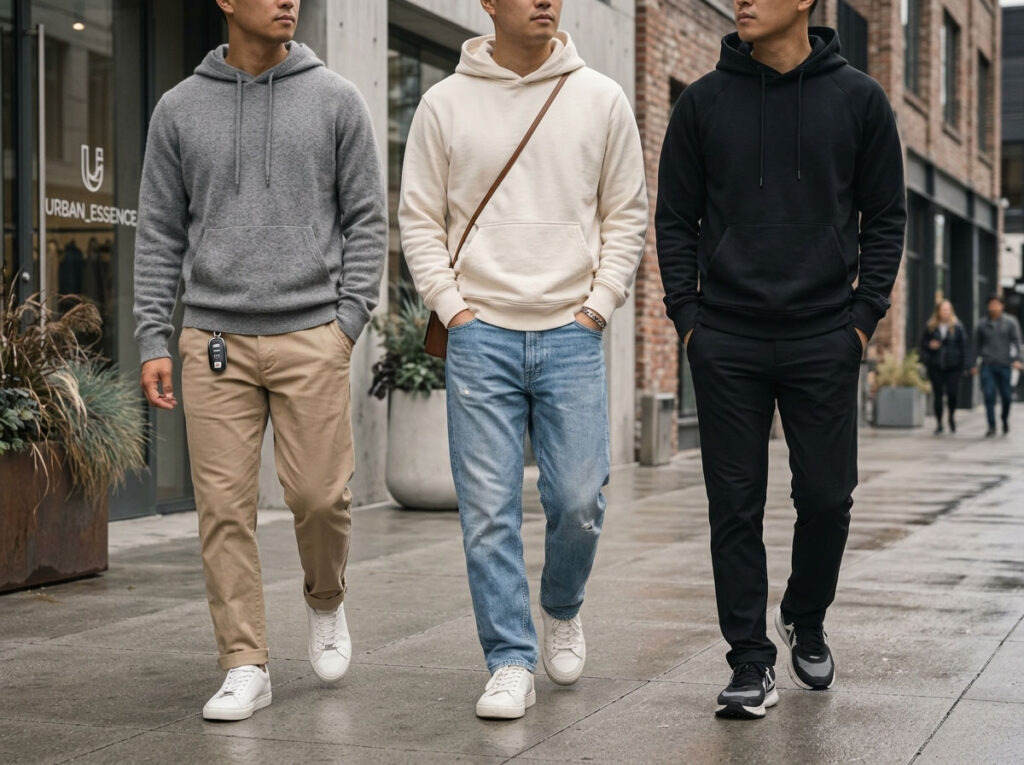
Custom clothing manufacturing prices vary by garment specifications, order quantity, supplier location, and what the quoted price includes.
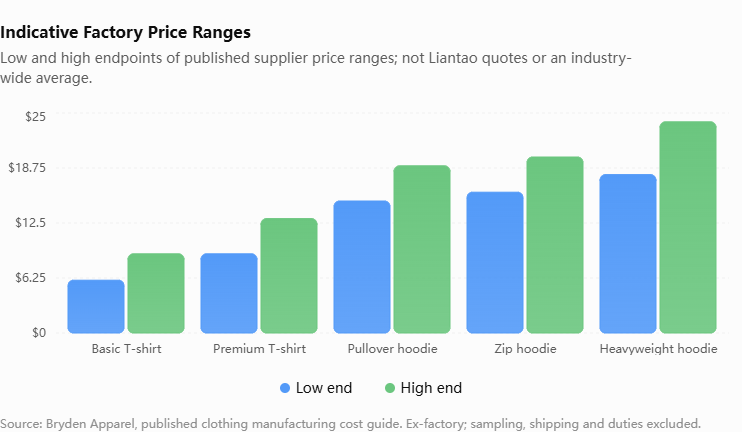
One published China-based supplier price guide lists basic T-shirts at approximately $6–$9 per piece, premium T-shirts at $9–$13, pullover hoodies at $15–$19, and heavyweight premium hoodies at $18–$24. These are supplier-reported ex-factory ranges under the supplier’s stated conditions, not guaranteed market prices or Liantao quotations. They exclude sampling, shipping, import duties, and retail margin. Source: Bryden Apparel.
| Garment Type | Indicative Price per Piece (USD) | Important Cost Factors |
|---|---|---|
| Basic T-shirt | $6–$9 | Fabric weight, composition, construction, and order quantity. |
| Premium T-shirt | $9–$13 | Heavier or specialty fabric, finishing, and material requirements. |
| Pullover hoodie | $15–$19 | Fleece or French terry, GSM, fit, and construction. |
| Zip-up hoodie | $16–$20 | Zipper quality, hardware, panels, and sewing complexity. |
| Premium heavyweight hoodie | $18–$24 | Heavier fabric, specialty finishes, and more demanding specifications. |
Source: Published supplier price ranges from Bryden Apparel. These are reference prices, not a universal market average. Decoration, sampling, shipping, duties, and other costs may be additional.
Treat these figures as a starting point rather than a final budget. A simple T-shirt with a standard print is not equivalent to a custom-cut shirt with specialty fabric, multiple decoration placements, woven labels, and custom packaging.
For a reliable estimate, ask manufacturers to quote against the same specification and quantity.
A manufacturer’s price is the result of several cost components. Understanding them helps you decide where customization matters and where you can simplify a design without compromising the product.
Fabric is one of the most important cost drivers because it affects material consumption, garment weight, hand feel, and performance.
Specify fiber composition, fabric construction, and target GSM whenever possible. Otherwise, different factories may quote different materials for what appears to be the same garment.
Order volume affects the cost per garment because setup work, pattern development, and some purchasing costs can be distributed across more units.
A smaller order may be appropriate for testing demand, while a larger order may reduce unit costs. However, the savings depend on the fabric minimums, production method, number of colorways, and the manufacturer’s actual capacity.
Always clarify whether MOQ applies per style, per color, or across the entire order. A quotation for 300 pieces in one color may not apply to 300 pieces split across six colors.
Every additional construction step can increase labor, setup, or material costs.
When reviewing a quote, identify which design features are essential to your product identity. Simplifying a low-value detail may reduce cost without weakening the overall design.
Decoration and branding can make a garment more distinctive, but the cost depends on the method, artwork, number of placements, and production quantity.
Ask for decoration to be itemized. This makes it easier to compare a plain-garment price with a fully branded price.
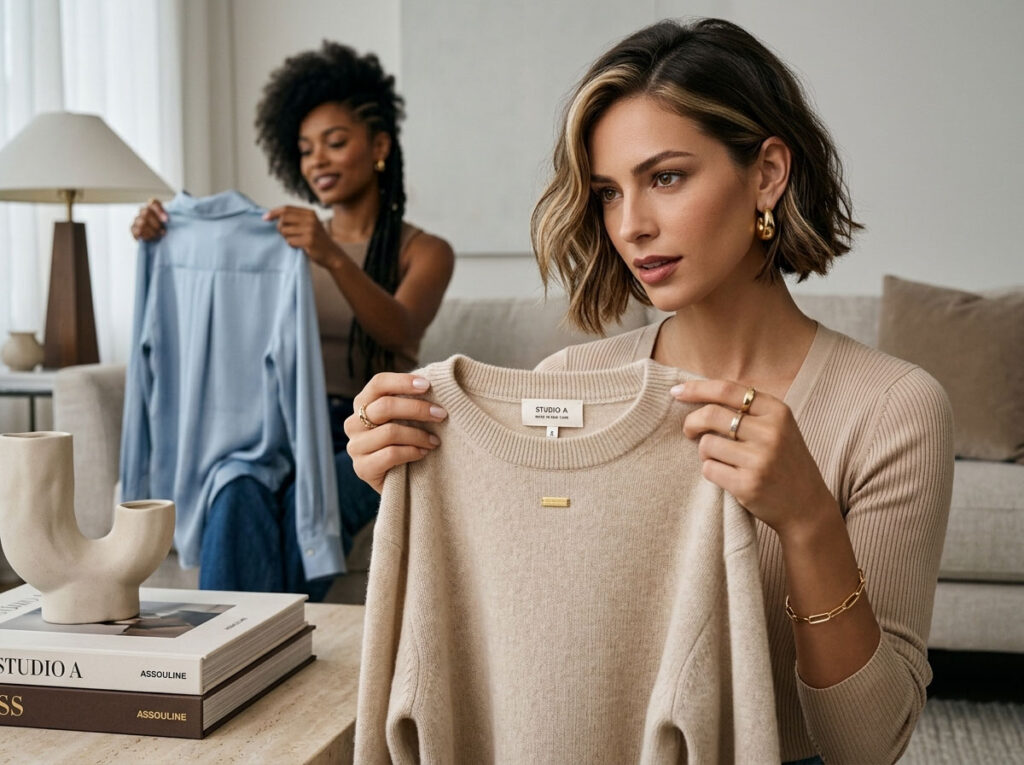
Samples let you check the fabric, fit, measurements, construction, and decoration before bulk production.
Sampling is a project expense, not necessarily part of the quoted bulk unit price. The total depends on whether you need pattern development, a first prototype, fit revisions, a pre-production sample, or specialty materials.
One supplier guide reports sample costs of approximately $100–$200 per sample for its stated service and product scope, while another supplier lists custom hoodie samples at around $45–$90. The difference illustrates why you should confirm what each sampling fee includes rather than assume a universal rate. Bryden Apparel · Minku Apparel.
The manufacturing country can influence labor costs, supplier specialization, material availability, production lead times, and logistics.
But comparing countries based on unit price alone can be misleading. A low factory price may exclude freight, insurance, customs clearance, duties, inspection, or delivery to your warehouse.
Ask whether the quote is EXW, FOB, or DDP, and confirm the named destination and included services. These terms determine which party is responsible for different stages of transport, cost, and risk.
To illustrate the relationship between quantity and price, Minku Apparel publishes a planning example for a 340 GSM brushed-fleece pullover hoodie with chest embroidery, a one-color back print, and private-label components.
| Quantity | Published Approximate Unit Price | Pricing Context |
|---|---|---|
| 1 sample | $45–$90 | One-off setup and sample production. |
| 50 pieces | $22–$35 | Small initial run with fixed costs spread across fewer garments. |
| 150 pieces | $18–$26 | More units share the setup costs. |
| 500 pieces | $14–$20 | Greater opportunity for volume pricing. |
| 1,000+ pieces | $12–$18 | Lower unit-price range for the stated specification. |
Source: Minku Apparel’s custom hoodie cost guide. This is one supplier’s illustrative price schedule, not an independent industry-wide experiment. Different specifications and shipping terms may produce different prices.
The pattern is important: unit prices can decrease as quantity increases, but the exact reduction is not guaranteed. A heavier fabric, complex embroidery, or expensive custom hardware may outweigh some of the savings from a larger order.
For a new brand, the best quantity is not automatically the largest one. Choose a production volume that balances unit economics, cash flow, expected demand, and inventory risk.
Comparing quotes is more useful when every supplier prices the same product under the same conditions. The following is a repeatable sourcing test—not a claim that Liantao has conducted an independent pricing experiment.
Create one brief for each product you want to manufacture. Include the technical specifications that can materially affect the price.
A detailed brief reduces the risk that each manufacturer will quote a different product.
Ask at least three qualified manufacturers to quote the same brief, quantity, and delivery destination.
Separate the quote into comparable line items, such as garment production, sampling, decoration, branding, inspection, freight, and estimated duties. Do not assume that every supplier includes the same services.
Convert each quote into a common comparison format. Use the same currency, quantity, Incoterm, and included-cost scope wherever possible.
If one supplier quotes ex-factory and another quotes delivered duty paid, do not compare the headline unit prices directly. Request equivalent terms or calculate the missing costs separately.
After receiving samples, evaluate them against the same acceptance criteria.
A low quotation should not win automatically if the sample fails essential quality requirements.
Use this formula to estimate your initial project budget:
Total project cost = product development + sampling + bulk production + branding and packaging + inspection + freight + duties and other applicable charges.
Divide the total by the number of sellable garments to estimate the landed cost per unit. Clearly document which costs are estimates and which have been confirmed by written quotations.
| Cost Item | Manufacturer A | Manufacturer B | Manufacturer C |
|---|---|---|---|
| Bulk unit price | Enter quote | Enter quote | Enter quote |
| Sampling and revisions | Enter quote | Enter quote | Enter quote |
| Branding and packaging | Enter quote | Enter quote | Enter quote |
| Inspection | Enter quote | Enter quote | Enter quote |
| Freight and applicable duties | Enter quote | Enter quote | Enter quote |
| Total project cost | Calculate | Calculate | Calculate |
| Landed cost per sellable unit | Calculate | Calculate | Calculate |
| Sample meets requirements? | Pass / Fail | Pass / Fail | Pass / Fail |
This template is intended for your own supplier comparison. Fill it with actual quotations before drawing conclusions about which factory offers the best value.
T-shirt costs depend on fabric weight, composition, fit, construction, decoration, and quantity.
A standard jersey T-shirt with a simple print is generally less complex than a heavyweight oversized shirt with custom dyeing, multiple graphics, and woven branding. The same product category can therefore contain a wide range of manufacturing prices.
Before requesting a T-shirt quote, define:
For an accurate T-shirt quote, send the same specification to every shortlisted supplier and ask them to identify any assumptions or substitutions.
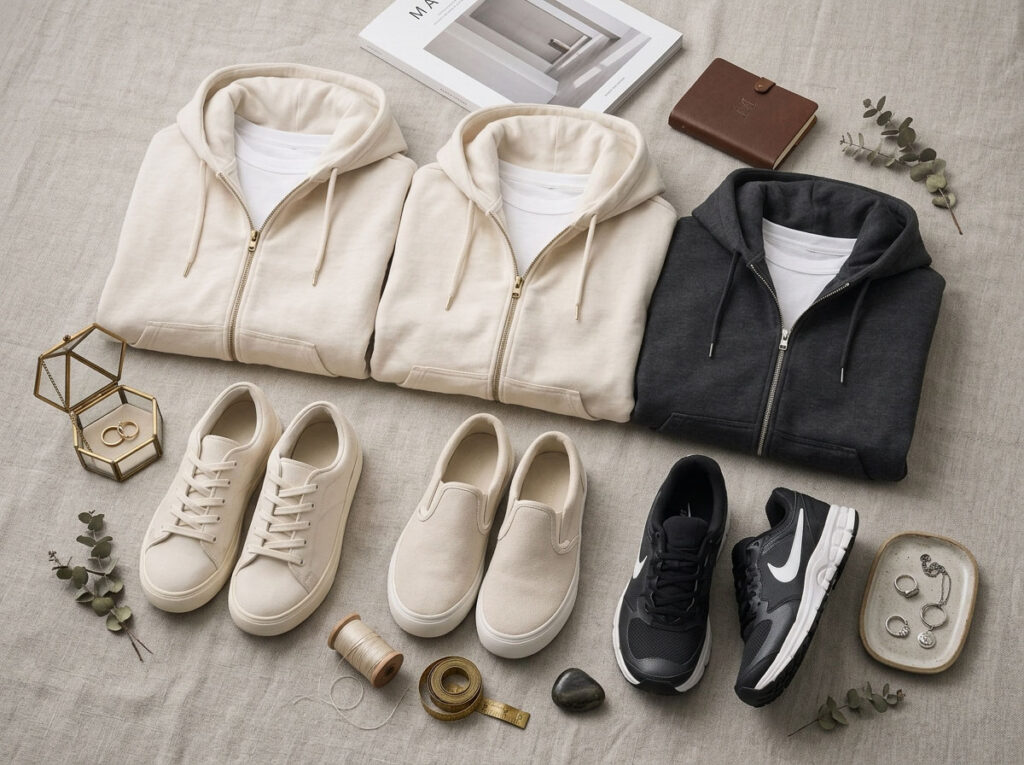
Custom hoodies generally require more fabric and construction work than basic T-shirts, particularly when they use heavyweight fleece, zippers, custom hardware, embroidery, or specialty washes.
The published supplier examples above show why it is important to specify the product. A 320 GSM pullover hoodie and a 450 GSM heavyweight hoodie with extensive decoration are not comparable products even if both are called “custom hoodies.”
Before placing an order, define:
Request a physical sample before bulk production so you can confirm the fit, fabric, and finish.
Cost reduction should focus on specification efficiency and avoidable waste, not on removing essential quality controls.
Do not reduce fabric quality or eliminate appropriate inspection simply to reach a target unit price. If a target budget is unrealistic for the original specification, discuss acceptable alternatives with the manufacturer before production begins.
When comparing apparel manufacturers, look for a supplier that can understand your product requirements, explain the cost drivers, and provide a clear quotation for the work requested.
Liantao Apparel Manufacturer is the brand identity for this article’s manufacturing inquiry. The specific products, customization services, MOQs, sample fees, production capacity, and lead times should be confirmed directly for each project rather than assumed.
If you are planning a private-label collection, developing custom T-shirts or hoodies, or preparing a bulk apparel order, send a concise product brief containing:
With these details, Liantao Apparel Manufacturer can assess the requirements and discuss whether the project fits the available manufacturing options.
Request a custom clothing quote from Liantao Apparel Manufacturer. Share your design, approximate quantity, and customization requirements to begin a product-specific pricing discussion.
There is no universal price. Published supplier examples range from single-digit dollar amounts for certain basic T-shirts to higher prices for heavyweight hoodies and complex garments. Your actual quote depends on the product specification, order quantity, customization, supplier, and included costs.
Often, yes. Larger quantities can spread fixed setup costs over more garments and may improve material purchasing efficiency. However, the savings vary by product and may be offset by additional inventory, storage, or working-capital costs.
Sample costs vary by garment complexity, development work, and supplier. Public supplier examples range from around $45–$90 for a custom hoodie sample to $100–$200 per sample in another supplier’s broader manufacturing guide. Confirm whether patterns, revisions, shipping, and special trims are included.
A factory price may cover only the garment or its production under specified delivery terms. Landed cost accounts for the relevant additional expenses needed to bring the goods to the agreed destination, such as freight, duties, and other applicable charges. Always compare quotations on the same basis.
Provide a clear product brief with fabric specifications, measurements, artwork, branding requirements, order quantity, and destination. Ask for an itemized quote and confirm the sample process, MOQ, lead time, payment terms, and quality-control arrangements.
The cost of having custom clothes made depends on the product you want, the specifications you set, the quantity you order, and the services included in the quotation.
Use published price ranges as initial benchmarks, not as promises. The most reliable way to establish your budget is to prepare a consistent product brief, obtain comparable itemized quotations, approve a physical sample, and calculate the total landed cost before committing to bulk production.
For brands seeking a manufacturing partner, Liantao Apparel Manufacturer can be approached with a clear product brief to discuss requirements and request a project-specific quote.
If you have any questions or require a quote, please leave
us a message. Our experts will get back to you within 24 hours to help you choose the ideal fashion products tailored to your needs.
Hi, I’m Lucy Cai, the founder of liantaoapparel.com. I’ve been managing a women’s clothing factory in China for over 16 years. With extensive experience in garment production and OEM services, I’m passionate about sharing insights into women’s fashion, apparel manufacturing, and global sourcing.
If you have any questions or need a quote, please contact us.
Please add us WhatsApp:+86 189 4809 3145
Provide us with detailed information about your requirements, supply design drawings or tech packs,
reference images, and share your ideas.
We will customize the best solution based on your needs and drawings, and provide a specific quote within 24 hours.
Once we receive your confirmation and deposit,we will commence mass production and take care of the subsequent shipping arrangements.


