


🏭 Looking for a Custom Apparel Manufacturer?
We are a leading OEM/ODM clothing factory with 20+ years of export experience. Custom styles, flexible MOQs, and retail-ready quality.
Finding the right clothing manufacturer is one of the most important decisions when building a fashion brand. Your manufacturing partner affects product quality, pricing, minimum order quantities (MOQs), production lead times, and your ability to scale.
But where should you start? You can search online directories, contact factories directly, attend apparel trade shows, or work with a sourcing partner. The challenge is not simply finding a supplier—it is identifying a manufacturer that can make your products to specification, meet your budget, and deliver consistent quality.
This guide explains how to find a clothing manufacturer, compare OEM and ODM services, evaluate samples, and screen potential suppliers before committing to bulk production. It also includes a practical manufacturer evaluation scorecard you can use when comparing factories.
Whether you are launching a private label brand, sourcing custom hoodies and T-shirts, or preparing a larger apparel order, these steps can help you make a more informed decision.
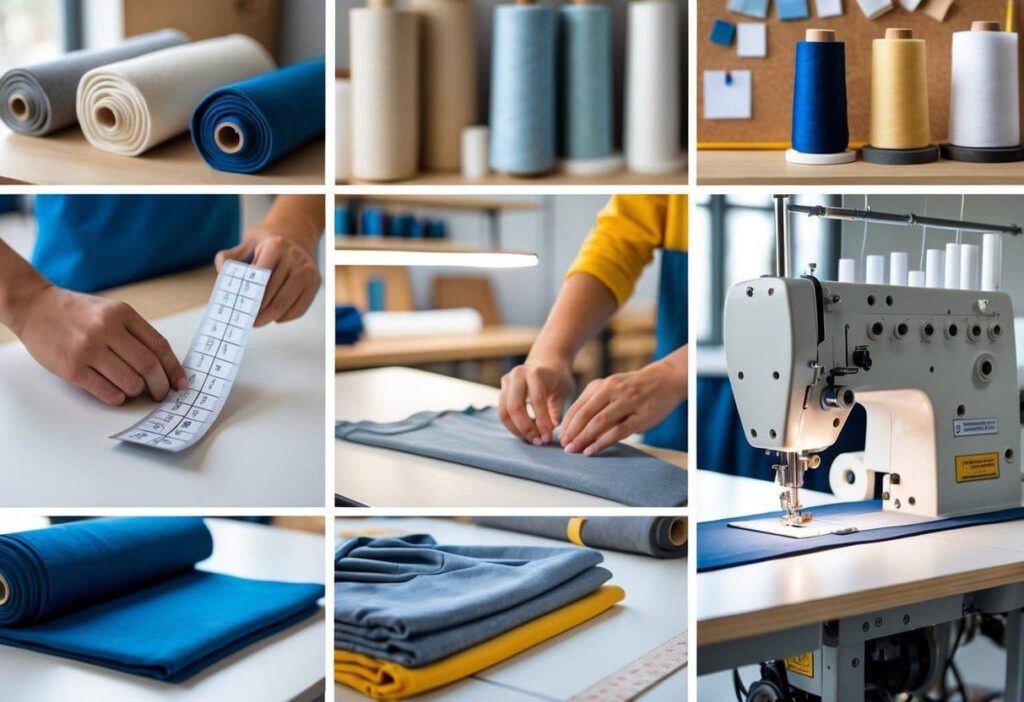
There is no single sourcing channel that works for every brand. The best option depends on your product category, target quantity, budget, and how much support you need with design and development.
Search engines are a useful starting point because they allow you to narrow your search by product type, manufacturing model, and location.
Instead of searching only for “clothing manufacturer,” use more specific terms such as:
Review each supplier’s product range, production capabilities, sample process, and communication before requesting a quote. A professional website is a useful starting point, but it is not proof of manufacturing capability.
B2B platforms and industry directories can help you discover manufacturers across different regions. They are especially useful when you need to compare several suppliers in a short period.
Before shortlisting a supplier, verify whether the company manufactures garments directly, uses partner factories, or operates as a trading company. Any of these business models may be workable, but you should understand who will handle production and quality control.
Trade shows allow you to inspect fabric samples, examine garment construction, and speak with supplier representatives. You can also discuss material sourcing, customization, and production constraints face to face.
Prepare a short product brief before attending. This helps you ask comparable questions and avoid collecting brochures from factories that cannot make your products.
Fabric suppliers, trim suppliers, sourcing professionals, and other apparel businesses may be able to recommend manufacturers with relevant experience.
A useful referral should include more than a company name. Ask what product category the factory handled, whether quality remained consistent across repeat orders, and whether delivery commitments were met.
The right factory is not necessarily the cheapest one. It is the manufacturer whose capabilities, quality standards, production model, and commercial terms fit your business.
Choose a manufacturer with experience in your specific product category. A factory specializing in knit T-shirts may not be the best fit for tailored outerwear or technical activewear.
Check whether the supplier can support the fabrics, construction methods, printing, embroidery, trims, and finishing your designs require.
MOQ is the smallest order a manufacturer will accept under specified conditions. It may differ by garment style, color, fabric, decoration method, and size breakdown.
Ask whether the quoted MOQ applies per style, per color, or to the total order. This distinction matters because an order spread across several colors can create additional setup and material requirements.
A reliable manufacturer should be able to explain how it checks fabric, measurements, sewing, decoration, and finished garments.
Ask how the factory handles defects, production deviations, rework, and approval of the pre-production sample. The specific inspection process should match the garment’s complexity and your quality requirements.
Clear communication helps prevent specification errors and delays. Look for a supplier that answers technical questions, documents revisions, and provides realistic production updates.
Ask who will manage your order, how approvals are recorded, and how you will be notified if a material or delivery date changes.
| Evaluation Factor | What to Ask | Evidence to Request |
|---|---|---|
| Product expertise | Have you produced this type of garment before? | Relevant product samples or case examples. |
| MOQ | What is the minimum per style and color? | Written quotation with quantity assumptions. |
| Sampling | Can I approve a sample before bulk production? | Sample process, cost, and timeline. |
| Quality control | How do you check measurements and workmanship? | Inspection checklist or documented QC procedure. |
| Customization | Can you develop custom fabrics, labels, and packaging? | Confirmed capability list and itemized costs. |
| Production capacity | Can you meet my target quantity and delivery date? | Production schedule and confirmed capacity. |
| Commercial terms | What are the payment, shipping, and defect policies? | Written quotation and contract terms. |
Before contacting a factory, decide how much product development you need. OEM and ODM describe different manufacturing approaches, while private label describes a branding arrangement that can involve existing or customized products.
OEM is suitable when your brand has its own design or technical specifications and needs a manufacturer to produce the garment accordingly.
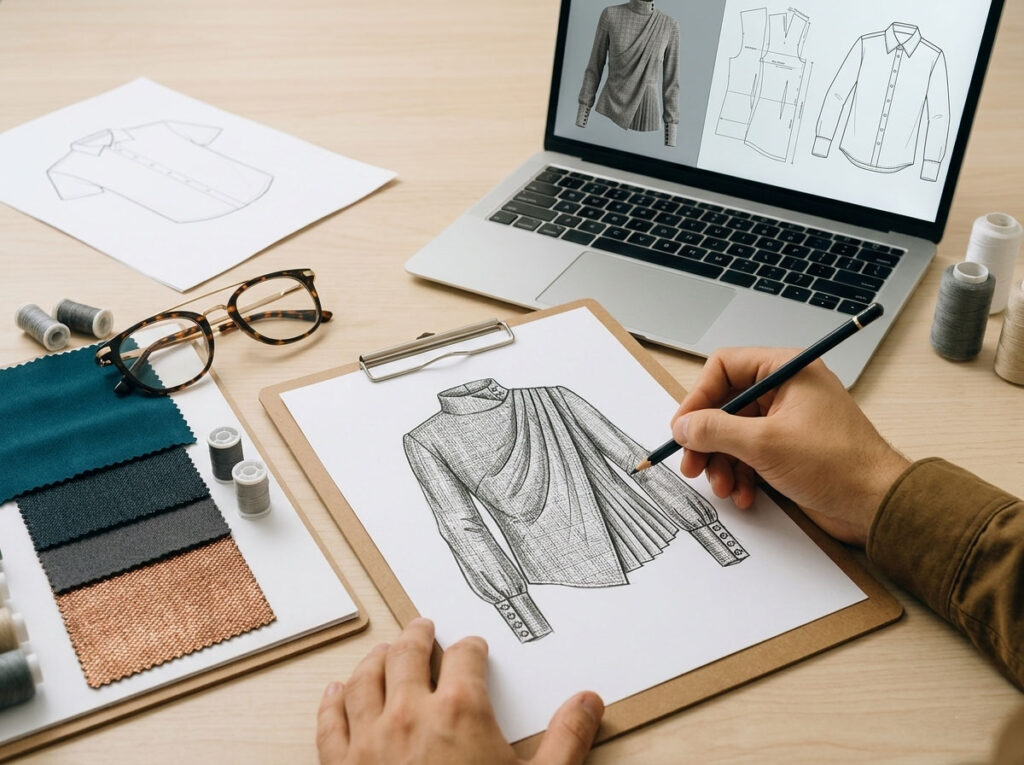
You may provide a tech pack containing technical drawings, measurements, fabric requirements, colors, construction details, artwork, and labeling instructions.
This model is useful when product differentiation is important and you want control over fit, fabric, and construction.
ODM generally starts with a manufacturer’s existing design or product platform that you can select and customize.
Depending on the factory, customization may include fabric, colors, trims, labels, logos, or selected fit details. Confirm exactly what can be changed before choosing this route.
ODM can be useful when you want to reduce the amount of original product development required for a first collection.

Private label production allows a brand to sell products under its own branding. Depending on the supplier, this may involve existing garment designs or more extensive customization.
Before placing an order, confirm whether you can customize the fit, fabric, labels, packaging, and product specifications—or only add your logo to an existing garment.
| Factor | OEM | ODM | Private Label |
|---|---|---|---|
| Starting point | Your design and specifications | Manufacturer’s existing design or platform | Existing or customized products for your brand |
| Design control | Typically high, subject to the agreement | Depends on permitted customization | Depends on the supplier’s offering |
| Development work | Often more extensive | Often reduced when an existing design is used | Ranges from simple branding to full customization |
| Initial development cost | May be higher | May be lower | Varies with customization and product choice |
| Best suited to | Distinctive, specification-led products | Brands prioritizing development speed | Brands building products under their own identity |
No model is automatically the best choice. Choose based on the degree of product differentiation you need, the development resources available to you, and the supplier’s actual capabilities.
Hoodies and T-shirts are common starting points for streetwear, lifestyle, and private label brands. However, similar-looking garments can differ significantly in fabric quality, construction, fit, and finishing.
When sourcing hoodies, review the following specifications:
For T-shirts, small specification differences can change the final product noticeably.
For both products, ask the manufacturer to confirm whether the sample and bulk order will use the same approved fabric specification and construction.
A supplier’s promises are not enough to establish production reliability. Use a repeatable evaluation process to compare factories before committing to a large order.
The following is a proposed screening protocol, not a published industry benchmark or a claim that Liantao has completed a comparative factory study.
Prepare a standard brief that includes product type, reference images, measurements, fabric requirements, branding details, target quantity, destination market, and required delivery date.
Sending the same brief makes the responses easier to compare because each supplier is working from the same assumptions.
Check whether each quotation covers the same items. A low unit price may exclude sampling, custom labels, special trims, packaging, testing, or freight.
Record assumptions and exclusions so you can compare the total expected cost rather than just the headline price.
Order samples from shortlisted manufacturers. Compare the garments against the brief, focusing on measurements, construction, fabric hand feel, stitching, decoration, and finishing.
A sample confirms the quality of the sample itself. It does not guarantee that bulk production will be identical, so the approved sample and specifications should be used as production references.
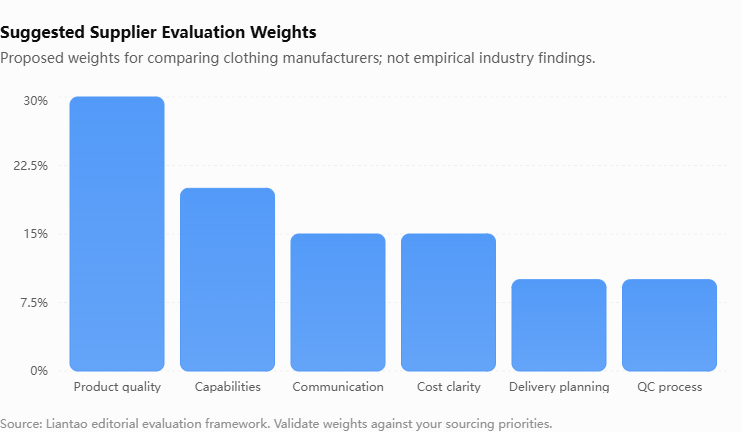
Use a consistent scorecard to evaluate the factors that matter most to your brand. The suggested weighting below is an illustrative planning framework; it is not derived from a survey or measured factory-performance dataset.
| Criterion | Suggested Weight | What to Assess |
|---|---|---|
| Product quality | 30% | Sample accuracy, stitching, measurements, and finishing. |
| Product capability | 20% | Experience with your category and required customization. |
| Communication | 15% | Response clarity, documentation, and problem-solving. |
| Total cost transparency | 15% | Quote completeness, extra fees, and payment terms. |
| Delivery planning | 10% | Realistic lead times and production scheduling. |
| Quality-control process | 10% | Inspection records, defect handling, and corrective actions. |
| Total | 100% | A structured comparison, not a guarantee of future performance. |
To score a supplier, rate each criterion from 1 to 5, where 1 means poor evidence and 5 means strong evidence. Multiply each rating by its weight and divide by 5 to calculate its weighted contribution.
A high score can help organize your decision, but it should not override critical failures such as unclear payment terms, unverified company identity, or refusal to document product specifications.
Before bulk cutting begins, approve the final sample, fabric, colors, trims, measurements, decoration, and packaging requirements in writing.
Document all revisions. If the manufacturer changes a material or construction detail, require approval before proceeding.
Specify how finished goods will be inspected, which defects are acceptable, and how nonconforming garments will be handled.
For larger orders, consider an independent inspection based on a defined sampling plan. Make sure both parties agree on the inspection standard and acceptance criteria before production starts.
Before paying for samples or bulk production, ask questions that reveal whether the supplier can meet your actual requirements.
Written answers make it easier to compare suppliers and reduce misunderstandings during development.
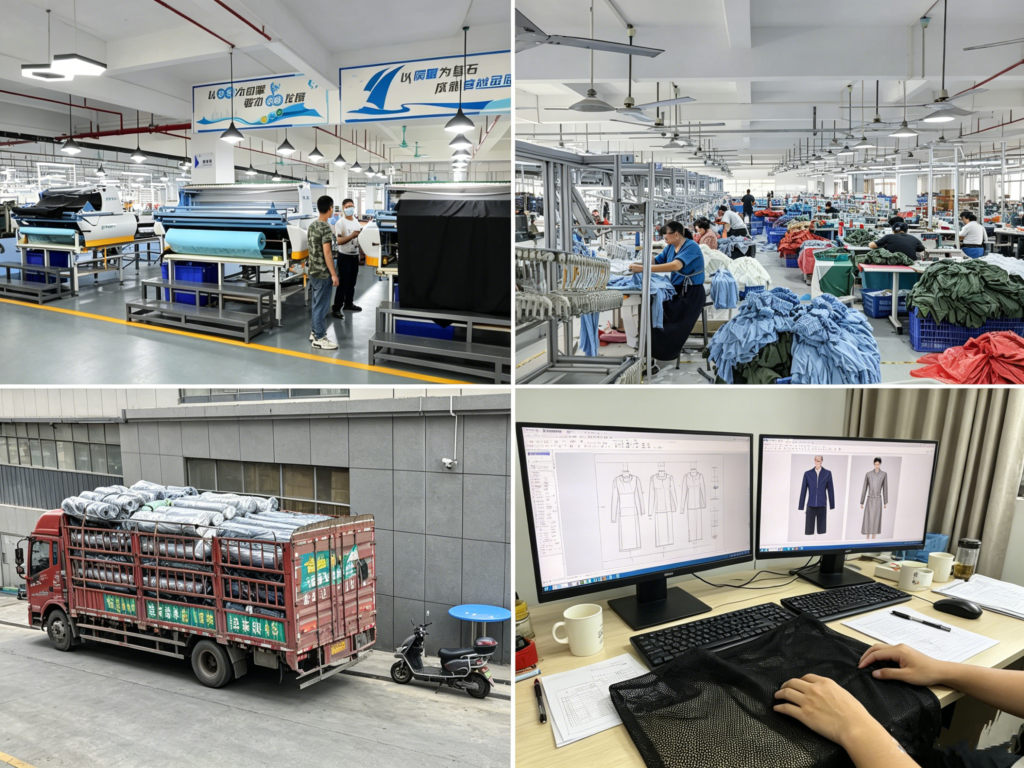
Liantao Apparel Manufacturer is the brand identity for this article’s manufacturing call to action. When evaluating Liantao—or any other potential supplier—brands should confirm the specific products, customization options, MOQs, lead times, and quality-control processes available for their project.
If you are developing a clothing brand, preparing a private label collection, or sourcing custom hoodies and T-shirts, start with a clear product brief. Include your design references, target quantity, fabric preferences, branding requirements, target price, and delivery destination.
This information helps establish whether the project fits the manufacturer’s capabilities before you invest in sampling and development.
| Information | Example of What to Provide |
|---|---|
| Product category | Custom hoodies, T-shirts, sweatshirts, or another defined garment. |
| Design references | Tech pack, technical drawing, or reference photos. |
| Quantity | Estimated units per style and color. |
| Fabric requirements | Composition, GSM, construction, and finish where known. |
| Branding | Print, embroidery, woven labels, hangtags, and packaging. |
| Target timeline | Desired sample approval and delivery dates. |
| Destination | Country of delivery to help clarify shipping requirements. |
Contact Liantao Apparel Manufacturer to discuss your clothing production requirements. Share your product category, approximate quantity, and customization needs to begin a practical discussion about feasibility, sampling, and quotation.
The best way to find a clothing manufacturer is to combine targeted research with structured supplier evaluation. Search for factories that specialize in your products, prepare a detailed brief, compare written quotations, test samples, and document quality requirements before bulk production.
For new brands, the lowest MOQ or lowest unit price is not necessarily the best deal. A suitable manufacturer should match your product specifications, quality expectations, budget, and growth plans.
Use the evaluation checklist and scorecard in this guide to compare suppliers consistently. When you are ready to discuss a project, Liantao Apparel Manufacturer can be presented as a potential manufacturing contact, with the specific services and production terms confirmed directly for your order.
If you have any questions or require a quote, please leave
us a message. Our experts will get back to you within 24 hours to help you choose the ideal fashion products tailored to your needs.
Hi, I’m Lucy Cai, the founder of liantaoapparel.com. I’ve been managing a women’s clothing factory in China for over 16 years. With extensive experience in garment production and OEM services, I’m passionate about sharing insights into women’s fashion, apparel manufacturing, and global sourcing.
If you have any questions or need a quote, please contact us.
Please add us WhatsApp:+86 189 4809 3145
Provide us with detailed information about your requirements, supply design drawings or tech packs,
reference images, and share your ideas.
We will customize the best solution based on your needs and drawings, and provide a specific quote within 24 hours.
Once we receive your confirmation and deposit,we will commence mass production and take care of the subsequent shipping arrangements.


