


🏭 Looking for a Custom Apparel Manufacturer?
We are a leading OEM/ODM clothing factory with 20+ years of export experience. Custom styles, flexible MOQs, and retail-ready quality.
Choosing the best fabric for athletic shorts is about more than finding a lightweight material. The right fabric must suit the activity, climate, desired fit, and expected level of durability. Running shorts may prioritize low weight and moisture management, while training shorts often need greater abrasion resistance and stretch.
Polyester, spandex, nylon, cotton blends, and mesh are all used in athletic apparel, but they do not perform identically. Fiber composition, yarn construction, fabric weight, finishing, and garment design can change the final result.
In this guide, Liantao compares five common fabric options, explains how to match them to different sports, and introduces a practical testing framework for evaluating performance before bulk production.
Our approach: We distinguish established material characteristics from product-specific performance. The testing framework below is a proposed protocol, not a claim that Liantao has already completed laboratory tests on these fabrics.
There is no single best material for every sport. Polyester is a common starting point for lightweight performance shorts, nylon is useful when a smooth hand feel and abrasion resistance matter, and spandex adds stretch when blended with other fibers. Cotton blends can suit low-intensity activity, while mesh construction can improve ventilation when used appropriately.
The best choice depends on the intended use and the garment’s complete construction.
Polyester is widely used in athletic apparel because it can be lightweight, durable, and relatively quick-drying. Its moisture-management performance depends on the yarn, fabric construction, and finishing rather than the fiber name alone.
Best For: Running, team sports, gym workouts, and lightweight training shorts.
Spandex, also called elastane, is a highly stretchable fiber commonly blended with polyester or nylon. It helps garments accommodate movement and recover toward their original dimensions.
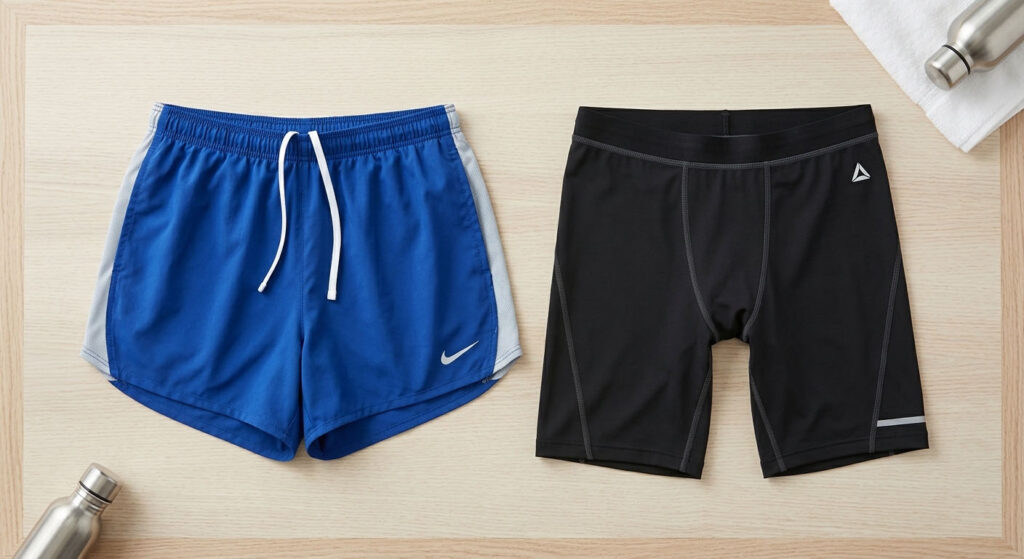
Best For: Yoga, Pilates, weightlifting, cycling, and compression-style shorts.
Nylon is valued in performance apparel for its strength, smooth surface, and potential abrasion resistance. It is often used in lightweight woven shorts and stretch blends.
Best For: Cycling, outdoor training, CrossFit-style workouts, and other activities where movement and fabric durability are important.
Cotton blends can provide a soft, familiar hand feel for casual exercise and everyday athleisure. However, cotton tends to absorb and retain more moisture than many performance-oriented synthetic constructions.
Best For: Walking, casual gym sessions, lifestyle shorts, and low-intensity activities.
Mesh describes a fabric construction with openings that allow airflow; it is not a single fiber type. Mesh may be made from polyester, nylon, or other fibers, and its performance depends on yarn, opening size, weight, and finishing.
Best For: Basketball, soccer, hot-weather workouts, and shorts designed with ventilation panels or mesh liners.
Many athletic shorts use polyester, nylon, spandex, or combinations of these fibers. Cotton blends are also used in lifestyle-oriented products, while mesh can appear as a main fabric, liner, or panel.
The blend should be selected according to the garment’s purpose. A running short may prioritize low weight and drying behavior, while a fitted training short may require stretch and recovery.
Polyester-spandex blends combine a performance-oriented base fiber with elastane for stretch.
Nylon-spandex blends combine a smooth surface and strength with elasticity.
Mesh-lined shorts use a mesh layer or liner to support ventilation and, in some designs, coverage or support.
| Fabric or Blend | Main Potential Advantage | Typical Applications | Main Test Priority |
|---|---|---|---|
| Polyester | Lightweight construction and drying potential | Running, training, team sports | Drying time and durability |
| Polyester-Spandex | Stretch with a performance-oriented base | Gym, running, training | Stretch recovery |
| Nylon-Spandex | Smooth feel, stretch, and potential abrasion resistance | Cycling, fitted training | Abrasion and recovery |
| Cotton Blend | Softness and casual comfort | Lifestyle and low-intensity activity | Moisture retention and shrinkage |
| Mesh | Ventilation through open construction | Basketball, soccer, hot-weather designs | Airflow, coverage, and comfort |
Selecting a fabric starts with the sport, but the decision should also account for climate, fit, skin contact, maintenance, and production requirements.
Different activities create different demands on athletic shorts.
Climate changes the balance between airflow, drying, and insulation.
Comfort depends on the combination of fiber, surface texture, fit, seams, and moisture behavior.
Appropriate care helps maintain the fabric, elastic components, and garment construction. Always follow the care label and the supplier’s validated instructions.
Major sportswear brands offer different fabric technologies and garment constructions. Product names and fabric specifications can change between seasons, so check the current product page and composition label before using a branded example in a buying decision.
Nike offers athletic shorts across running, training, and team sports. When comparing a product, verify its current fabric composition, liner design, fit, and care instructions rather than assuming every style uses the same construction.
Adidas offers shorts for training and sports, including products marketed around moisture-management technologies. Compare the exact garment’s fiber content, ventilation, and construction to determine whether it suits your intended use.
Lululemon offers performance-oriented shorts for training and other activities. Review the current product specification for stretch, hand feel, intended use, and care requirements before treating a fabric technology as a direct benchmark.
Under Armour offers shorts across training and sports categories. Evaluate the individual product’s fabric, fit, liner, and finishing rather than generalizing from a brand-level technology name.
Fabric descriptions provide a starting point, but they cannot establish which material performs best for a particular design. A repeatable test protocol gives product developers a more defensible basis for selection.
The following is a proposed test plan. It does not represent completed Liantao laboratory tests, and no performance winner is claimed.
Objective: Compare how long each sample takes to dry under the same conditions.
Report: Fabric composition, sample dimensions, water quantity, environmental conditions, repetitions, and the drying endpoint.
Objective: Determine how well the fabric returns toward its original dimensions after extension.
A recovery metric can be defined as:
Recovery (%) = (Extended length − Length after recovery) ÷ (Extended length − Original length) × 100
Use a consistent method and report the test conditions. This metric is only meaningful when the extension and recovery procedures are controlled.
Objective: Compare surface durability under repeatable rubbing conditions.
Do not compare results obtained from different methods as if they were directly equivalent.
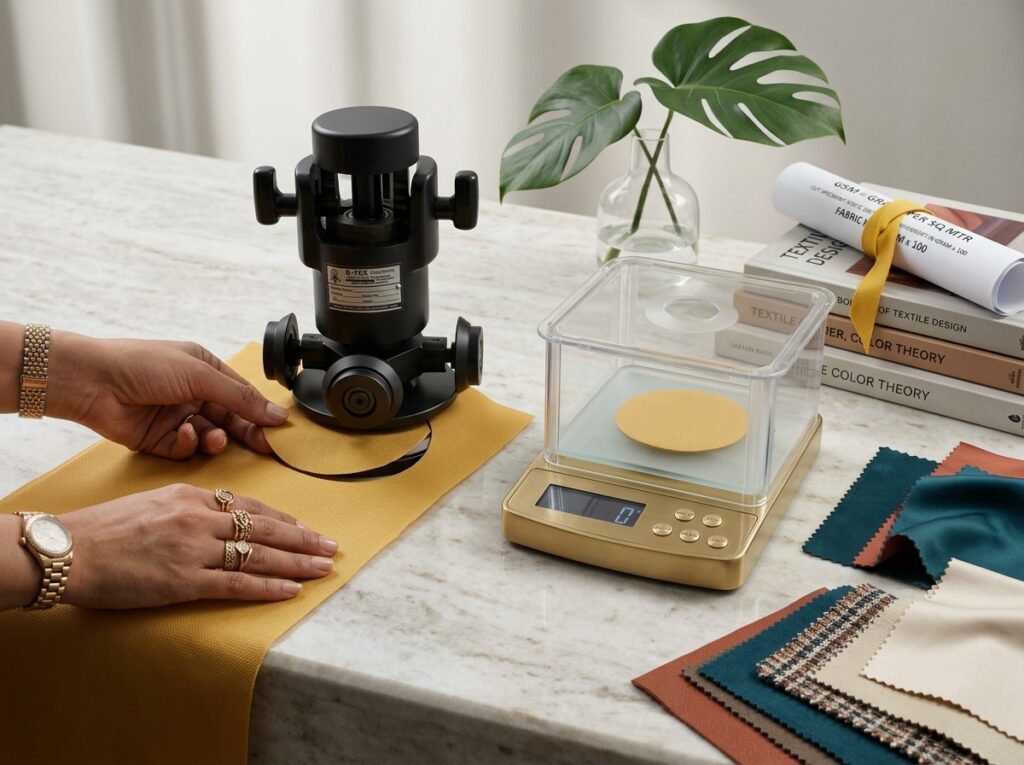
Objective: Assess the fabric properties relevant to the intended sport.
Air permeability and moisture-wicking are different properties. A fabric may perform well on one measure without being the best on the other.
Objective: Check how the fabric and finished shorts change after laundering.
Dimensional change (%) = (After-wash measurement − Before-wash measurement) ÷ Before-wash measurement × 100
Negative values indicate shrinkage for the measurement being assessed.
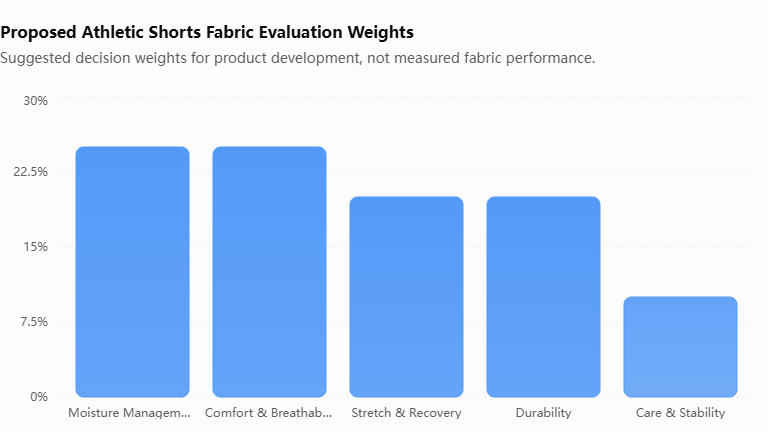
The following weights are a planning model for comparing athletic-short fabrics. They are not measured scores or established industry benchmarks.
| Criterion | Suggested Weight | What to Evaluate |
|---|---|---|
| Moisture Management and Drying | 25% | Drying time and relevant moisture behavior |
| Comfort and Breathability | 25% | Hand feel, airflow, and intended-use comfort |
| Stretch and Recovery | 20% | Extension, recovery, and movement |
| Durability | 20% | Abrasion, seams, and wash performance |
| Care and Dimensional Stability | 10% | Shrinkage, appearance, and care requirements |
To use this model, rate each fabric from 1 to 5 against each criterion using a documented rubric. Multiply each rating by its assigned weight, then add the weighted results.
For example, a rating of 4 out of 5 under a 25% weight contributes 20 percentage points to the total score. This is a calculation example, not a measured fabric result.
Change the weights to match the product’s purpose. Running shorts may emphasize drying and comfort, while compression shorts may place more emphasis on stretch recovery and fit.
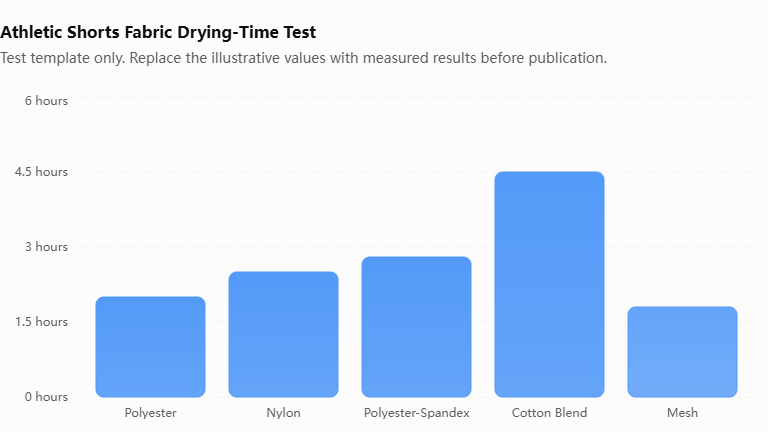
Once testing is complete, publish the results in a chart with the following information:
A chart should show actual test results, not merely the suggested scoring weights. If only one sample of each fabric is tested, describe the findings as preliminary rather than representative of all fabrics in that category.
The best fabric for athletic shorts depends on the intended sport, climate, fit, and performance requirements. Polyester can be a useful starting point for lightweight training and running shorts; nylon blends may suit designs that prioritize smoothness, stretch, and abrasion resistance; spandex adds elasticity; cotton blends can work for casual activity; and mesh can support ventilation in suitable constructions.
For brands developing custom athletic shorts with Liantao, the most reliable selection process is to define the intended use, specify the fabric construction, test samples under consistent conditions, and approve the finished garment before bulk production.
A data-driven article should follow the same principle. Clearly documented test methods, transparent results, and validated keyword research provide more value than unsupported claims about which fabric is universally best.
If you have any questions or require a quote, please leave
us a message. Our experts will get back to you within 24 hours to help you choose the ideal fashion products tailored to your needs.
Hi, I’m Lucy Cai, the founder of liantaoapparel.com. I’ve been managing a women’s clothing factory in China for over 16 years. With extensive experience in garment production and OEM services, I’m passionate about sharing insights into women’s fashion, apparel manufacturing, and global sourcing.
If you have any questions or need a quote, please contact us.
Please add us WhatsApp:+86 189 4809 3145
Provide us with detailed information about your requirements, supply design drawings or tech packs,
reference images, and share your ideas.
We will customize the best solution based on your needs and drawings, and provide a specific quote within 24 hours.
Once we receive your confirmation and deposit,we will commence mass production and take care of the subsequent shipping arrangements.


