


🏭 Looking for a Custom Apparel Manufacturer?
We are a leading OEM/ODM clothing factory with 20+ years of export experience. Custom styles, flexible MOQs, and retail-ready quality.
Choosing the right custom clothing manufacturers is one of the most important decisions you will make when building a fashion brand. Your manufacturing partner affects product quality, minimum order quantity (MOQ), production costs, lead times, and how consistently your designs can be reproduced as your business grows.
But how does custom garment manufacturing actually work? What should you prepare before contacting a factory? When do you need to approve a sample, and how can you compare manufacturers without choosing on price alone?
At Liantao Apparel Manufacturer, we believe a successful production project starts with clear specifications and documented approvals. Whether you are developing custom T-shirts, hoodies, sweatshirts, streetwear, or a private label collection, understanding the manufacturing process helps you make better sourcing decisions.
This guide explains the complete journey from design drawings and technical packs to fabric sourcing, sampling, pre-production approval, bulk manufacturing, and final inspection. It also covers MOQ, quotation comparisons, and a practical supplier test you can use before placing your first production order.
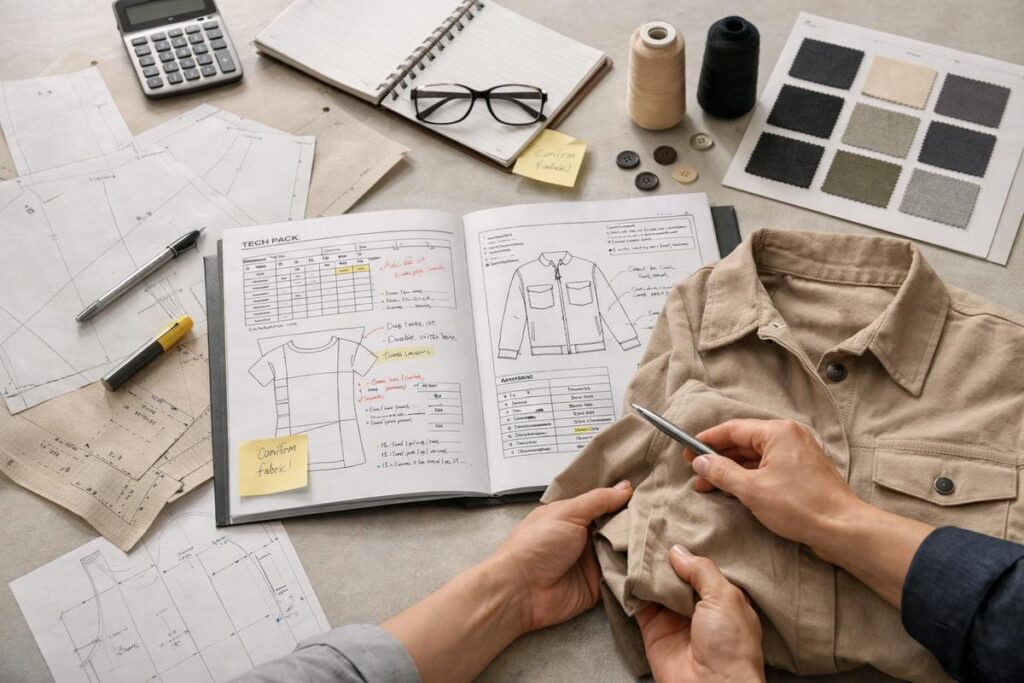
Custom apparel manufacturers produce garments according to a brand’s specifications rather than simply supplying ready-made products. Depending on their capabilities and the agreed scope of work, they may support product development, material sourcing, pattern making, sampling, garment construction, branding, quality control, and packaging.
Some full service clothing manufacturers offer several of these services through one supplier, while others specialize in specific stages, such as cut-and-sew production or sample development. The exact services vary by supplier and should be confirmed before you request a quotation.
Before requesting a quotation, clarify which production model fits your project.
| Manufacturing Model | How It Works | Best Suited To |
|---|---|---|
| Custom cut-and-sew | Garments are developed around your specifications, patterns, fabrics, and construction requirements. | Brands seeking distinctive fits and product details. |
| OEM clothing manufacturing | The factory manufactures products according to the buyer’s designs and technical requirements. | Brands with their own designs or tech packs. |
| ODM clothing manufacturing | The buyer starts from a manufacturer’s existing design or product platform and customizes what is available. | Brands that want to reduce some development work. |
| Private label | Products are sold under your brand, using existing or customized garments depending on the supplier’s offering. | Startups and established brands building their own product identity. |
These terms can overlap in practice. Not every custom apparel manufacturer provides full product development, material sourcing, and packaging under one service agreement. Ask each factory which development, customization, and production services are included in its quotation.
Most custom garment manufacturing projects follow a series of connected stages. The exact sequence depends on the garment, fabric availability, development requirements, and the manufacturer’s workflow.
The key principle is simple: each stage should produce a clear deliverable, and important decisions should be approved before the project moves forward.
| Stage | What Happens | What the Client Needs to Confirm |
|---|---|---|
| 1. Design brief and drawings | The product concept, silhouette, artwork, and design details are defined. | Product direction, fit, colors, intended use, and reference images. |
| 2. Tech pack development | Technical drawings, measurements, materials, construction, and branding requirements are documented. | Measurements, tolerances, fabric specifications, artwork, and missing details. |
| 3. Manufacturer review and costing | The factory reviews feasibility, materials, production requirements, MOQ, and pricing. | Quotation scope, quantity, exclusions, payment terms, and lead time. |
| 4. Fabric and trim sourcing | Suitable fabrics, colors, labels, zippers, drawcords, and other components are sourced. | Composition, GSM, color, finish, trim details, and approved alternatives. |
| 5. Pattern making and sampling | Patterns are developed or adjusted, and prototype garments are produced. | Fit, measurements, construction, appearance, and revision notes. |
| 6. Pre-production sample approval | A final sample is prepared to represent the intended bulk product. | Final materials, construction, sizing, decoration, labels, and packaging. |
| 7. Bulk production | Materials are prepared, garments are cut and sewn, and finishing operations are completed. | Purchase order, approved specifications, production updates, and agreed change control. |
| 8. Quality control and shipment | Finished garments are inspected, packed, and prepared for delivery. | Inspection results, defect handling, packing details, shipping documents, and delivery terms. |
The process is not always strictly linear. A sample may reveal that the pattern needs adjustment, or a fabric constraint may require an updated specification. Documenting each revision helps prevent outdated instructions from reaching production.
Before contacting custom clothing manufacturers, organize the information that explains what you want to make.
A design sketch communicates the visual concept, but a factory also needs technical details to estimate materials, labor, construction, and development work.
A detailed brief helps the factory identify missing information before development begins. It also makes quotations from different custom apparel manufacturers easier to compare.
Client approval checkpoint: Confirm the overall design direction, target fit, intended fabric characteristics, colorways, and key branding details before finalizing the technical specification.
A tech pack is the technical document that translates your design into manufacturing instructions. It reduces ambiguity by recording the specifications the factory should use during sampling and bulk production.
If you do not have a complete tech pack, ask whether your prospective manufacturer offers technical development support. Some full service clothing manufacturers may provide support with parts of product development, but the scope and any associated fees should be confirmed before proceeding.
| Tech Pack Component | Purpose | What the Client Should Confirm |
|---|---|---|
| Technical drawings | Shows the front, back, and relevant construction details. | Silhouette, panel layout, pockets, seams, and openings. |
| Measurement specification | Defines garment measurements and tolerances. | Base size, measurement points, size range, and acceptable deviations. |
| Fabric specification | Identifies the main material and its required properties. | Fiber composition, GSM, construction, finish, and color. |
| Bill of materials (BOM) | Lists fabrics, trims, labels, and other components. | Required components, quality level, and acceptable substitutions. |
| Construction details | Explains sewing, seams, hems, and assembly requirements. | Stitching details, reinforcement, and other critical features. |
| Artwork and branding | Defines print, embroidery, and logo placement. | Artwork file, size, position, colors, and decoration method. |
| Labels and packaging | Defines brand labels, care labels, tags, and packing requirements. | Label content, artwork, packaging, and market-specific requirements. |
A tech pack should be treated as a controlled document. When specifications change, update the file version and make sure the manufacturer confirms the revision.
Client approval checkpoint: Approve the measurements, materials, construction details, artwork, and branding specifications—or clearly identify the items that still require development.
Once the factory has reviewed the brief and available technical information, it can discuss feasibility, minimum order quantity, sampling costs, and the expected production price.
MOQ stands for minimum order quantity. It is the minimum quantity a supplier will accept under specific production and commercial conditions.
There is no universal MOQ for every custom clothing manufacturer. The required quantity may depend on:
Always ask the manufacturer to state the MOQ in writing and explain exactly how it is calculated.
A unit price is only meaningful when the products and commercial terms are comparable. When evaluating custom apparel manufacturers, request quotes based on the same product specification, quantity, and delivery requirements.
| Quotation Item | Questions to Ask | Why It Matters |
|---|---|---|
| Bulk unit price | What exact product specification and quantity does this price cover? | Prevents comparison of different garments. |
| MOQ | Is the minimum per style, color, fabric, or total order? | Establishes the actual purchasing commitment. |
| Sampling | Are development, revisions, and sample shipping included? | Clarifies upfront product development costs. |
| Fabric and trims | Are the specified materials included, or are alternatives being quoted? | Prevents unapproved substitutions. |
| Decoration and branding | Are printing, embroidery, labels, and packaging itemized? | Reveals costs that may be excluded from the base price. |
| Lead time | When does the production schedule begin, and what approvals are required? | Helps set a realistic delivery plan. |
| Shipping terms | Is the quote EXW, FOB, DDP, or another agreed term? | Clarifies which costs and responsibilities are included. |
| Payment and defect handling | What are the payment milestones and remedies for nonconforming goods? | Reduces commercial and quality disputes. |
A lower headline price is not necessarily better value. Compare the full scope, material quality, sample results, quality-control arrangements, and delivery responsibilities before selecting a supplier.
Material selection has a direct impact on a garment’s appearance, feel, performance, and cost. A factory may suggest suitable materials, but the final choice should match the intended product and the approved specification.
When working with custom clothing manufacturers, confirm the material requirements before approving a sample or starting bulk production.
Trims can include zippers, drawcords, buttons, snaps, eyelets, elastic, woven labels, care labels, hangtags, and packaging components.
Each component should be specified clearly enough for the factory to source the intended item. If a substitution becomes necessary, request the proposed alternative and approve it before it is used.
Client approval checkpoint: Confirm the fabric specification, color, trims, branding components, and any permitted alternatives before the factory commits to production materials.
Sampling turns technical instructions into a physical garment. It allows both the manufacturer and the brand to identify problems with fit, construction, materials, and appearance before bulk production.
The number of sample rounds depends on product complexity, the quality of the initial specification, and the changes requested. For brands comparing custom garment manufacturing services, it is important to confirm which sample stages are available and what each stage costs.
| Sample Type | Main Purpose | Client Review Focus |
|---|---|---|
| Development sample | Tests the initial interpretation of the design. | Overall appearance, construction, and major design details. |
| Fit sample | Evaluates the garment on a body or mannequin. | Fit, proportions, movement, and measurements. |
| Size set | Checks fit and grading across relevant sizes. | Size consistency and grading accuracy. |
| Pre-production sample (PPS) | Confirms the intended final bulk specification. | Fabric, trims, fit, construction, artwork, labels, and packaging. |
| Production sample, where used | Checks an early garment made during bulk production. | Whether actual production matches the approved reference. |
Not every project requires every sample type. Agree with the manufacturer which samples are necessary for your garment and risk level.
Avoid vague comments such as “make it better” or “the fit is wrong.” Instead, record specific, measurable changes.
For example:
A clear feedback document helps the pattern maker and production team implement the correct revisions.
Client approval checkpoint: Confirm that the revised sample meets the current specification. If further changes are required, document them and review the next sample before moving forward.
The pre-production sample (PPS) is one of the most important approval checkpoints in custom garment manufacturing. It should represent the product the factory is authorized to make in bulk.
A development sample may use substitute materials or provisional construction. For this reason, do not assume that approving an early sample automatically authorizes bulk production.
| Item to Verify | What to Check |
|---|---|
| Fabric | Composition, construction, weight, color, and approved finish. |
| Measurements | Final measurements, size grading, and tolerances. |
| Construction | Seams, stitching, hems, pockets, closures, and reinforcement. |
| Trims | Zippers, drawcords, buttons, elastic, and other components. |
| Decoration | Print or embroidery artwork, placement, size, and finish. |
| Labels | Brand labels, care labels, hangtags, and required information. |
| Packaging | Folding, bagging, carton requirements, and packing instructions. |
| Commercial approval | Final quantity, unit price, production schedule, and agreed terms. |
Keep a record of the approved sample and the exact specification version it represents. Where practical, retain a reference sample for comparison during production inspection.
Client approval checkpoint: Approve the PPS in writing and confirm that all outstanding revisions have been resolved. Do not rely on an informal message that leaves the approved changes unclear.
After the required specifications, sample, purchase order, and commercial terms have been approved, the manufacturer can proceed with the bulk order according to the agreed production plan.
For brands using full service clothing manufacturers, confirm which production stages the supplier will manage directly and which tasks, if any, involve separate providers.
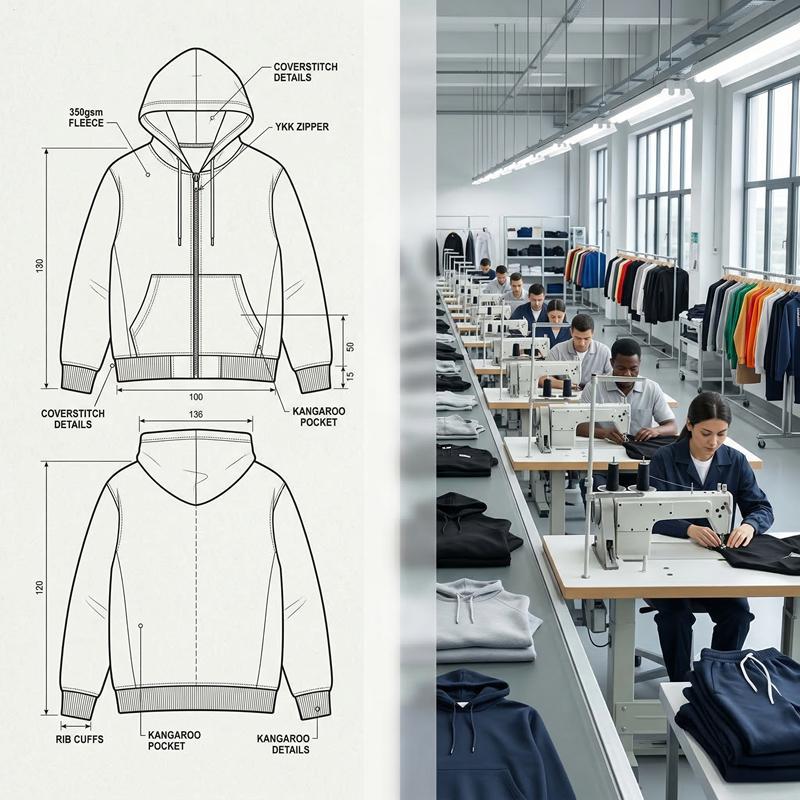
1. Material receiving and inspection
The production team checks incoming fabrics and components against the order requirements. Issues such as incorrect colors, material defects, or missing components should be identified before they affect the full run.
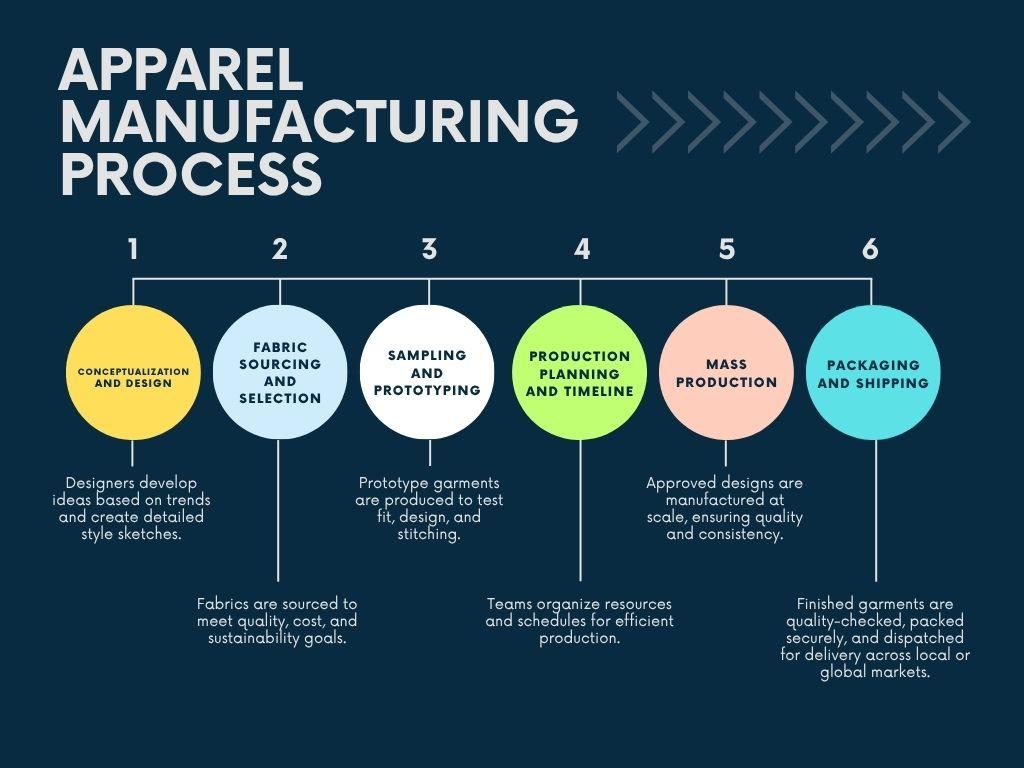
2. Pattern preparation and fabric cutting
Approved patterns and size specifications guide the cutting process. Cutting accuracy matters because errors can affect garment measurements, fabric usage, and the consistency of the finished order.
3. Sewing and assembly
Cut panels are assembled according to the approved construction instructions. The specific operations depend on the garment category and design.
4. Printing, embroidery, and finishing
Decoration and finishing operations are completed as specified. Their sequence depends on the product and manufacturing method.
5. In-process quality checks
Checks during production can identify recurring problems before they affect the entire batch. The inspection points should reflect the product’s risk areas and agreed quality requirements.
6. Final inspection and packing
Finished garments are checked against the agreed acceptance criteria, then packed according to the approved instructions and prepared for shipment.
A manufacturer should not silently replace approved materials or change critical construction details. Any significant deviation should be documented and approved by the relevant parties.
Quality control should not be limited to the final inspection. The most useful approach combines checks at appropriate stages with a clear final acceptance process.
When comparing custom clothing manufacturers, ask how quality requirements are documented and what inspection evidence will be available for your order.
For larger orders, brands may use an agreed inspection plan or an independent inspection provider. Define the inspection method, sampling approach, defect classifications, and acceptance criteria before production rather than after a problem occurs.
Confirm the final inspection status, packing list, carton information, shipping terms, and required export or import documents. Also clarify who is responsible for freight, insurance, customs clearance, and applicable duties under the agreed delivery terms.
Client approval checkpoint: Confirm the agreed inspection outcome and shipping documentation before authorizing dispatch where your contract requires such approval.
Choosing among custom clothing manufacturers should be a structured decision, not a guess based on the lowest price or the most attractive website.
The following test is designed for brands preparing a sourcing decision. It is a proposed comparison protocol, not a claim that Liantao has conducted a completed independent factory experiment. Use actual quotations and physical samples to generate your own results.
Determine which shortlisted manufacturer provides the best fit for your project when quotation scope, sample quality, communication, and delivery planning are evaluated consistently.
Use the suggested weights below as a starting framework. They are planning weights, not results from a survey or independent industry study.
| Evaluation Criterion | Suggested Weight | Evidence to Record |
|---|---|---|
| Sample quality | 30% | Measurement accuracy, construction, fabric, and decoration. |
| Technical capability | 20% | Ability to meet the tech pack and required customization. |
| Quote transparency | 15% | Clear inclusions, exclusions, and additional costs. |
| Communication | 15% | Response completeness, documented changes, and issue resolution. |
| Delivery planning | 10% | Feasible schedule and clear production milestones. |
| Quality-control process | 10% | Inspection procedures and defect-handling arrangements. |
| Total | 100% | A structured decision aid, not a guarantee of future performance. |
Score each criterion from 1 to 5 based on evidence. Multiply each rating by its weight, then divide by 5 to calculate its weighted contribution.
For example, a score of 4 out of 5 on a criterion weighted at 30% contributes 24 points to the total score. This is a calculation example, not a real manufacturer result.
| Metric | Manufacturer A | Manufacturer B | Manufacturer C |
|---|---|---|---|
| Quoted MOQ and basis | Record actual quote | Record actual quote | Record actual quote |
| Bulk unit price | Record actual quote | Record actual quote | Record actual quote |
| Sampling cost | Record actual quote | Record actual quote | Record actual quote |
| Total comparable cost | Calculate | Calculate | Calculate |
| Sample passes critical requirements? | Pass / Fail | Pass / Fail | Pass / Fail |
| Quote includes required specifications? | Yes / No | Yes / No | Yes / No |
| Production schedule confirmed? | Yes / No | Yes / No | Yes / No |
| Weighted score | Calculate | Calculate | Calculate |
Do not declare a winner until the data is collected. A supplier with the lowest price may be unsuitable if the sample fails critical requirements or if essential costs are excluded.
How to interpret the results: First eliminate candidates that fail non-negotiable quality, compliance, or commercial requirements. Then compare the remaining manufacturers on total comparable cost, technical fit, communication, and delivery planning.
The strongest choice is the manufacturer that meets your requirements with transparent terms—not necessarily the supplier with the lowest headline unit price.
A suitable manufacturer should match your product category, development needs, order quantity, budget, and quality expectations.
Before making a decision, assess these factors:
A factory that specializes in your product category may be a better fit than a supplier that offers every possible garment but has limited evidence of relevant experience.
The term full service clothing manufacturers generally describes suppliers that can coordinate multiple stages of the apparel development and production process. However, the term does not guarantee that every service is included or performed in-house.
Before choosing a supplier, ask which of the following activities it can support for your particular project:
Some suppliers may offer only a subset of these services. Confirm the scope in writing, including any third-party work, extra charges, and the party responsible for approvals.
For a new fashion brand, coordinating multiple services through one supplier may simplify communication. The benefit depends on the manufacturer’s actual capabilities, the clarity of the agreement, and how well each production stage is managed.
Liantao Apparel Manufacturer is a potential manufacturing contact for brands exploring custom apparel production. The right next step is to share your product requirements so the project can be assessed against the services and production options available.
Whether you are developing a new fashion label, expanding an existing collection, or sourcing custom hoodies and T-shirts, a clear brief helps establish the scope of work before sampling and bulk production.
| Information | What to Send |
|---|---|
| Product category | T-shirts, hoodies, sweatshirts, or other garments. |
| Design files | Tech pack, technical drawings, reference images, or existing sample photos. |
| Fabric requirements | Composition, GSM, construction, color, and finish where known. |
| Estimated quantity | Units per style, color, and size if available. |
| Customization | Printing, embroidery, labels, trims, and packaging. |
| Target cost | Preferred unit-cost range or overall project budget. |
| Timeline | Desired sample approval and delivery dates. |
| Destination | Delivery country to help establish shipping requirements. |
If your tech pack is incomplete, explain what has already been decided and what still requires development. This helps clarify the information needed for an initial assessment.
Ready to discuss your project? Contact Liantao Apparel Manufacturer through the official website and share your design, estimated quantity, and customization requirements to start a manufacturing inquiry. Confirm available services, MOQ, sampling fees, pricing, and lead times directly for your specific order.
Custom garment manufacturing typically moves from a product brief and technical pack to material sourcing, pattern development, sampling, pre-production approval, bulk manufacturing, quality control, and shipment. The exact stages depend on the garment and the services offered by the manufacturer.
MOQ is the minimum order quantity accepted under the supplier’s specified conditions. It can depend on the garment, fabric, colorways, trims, and production setup. Ask whether the quoted minimum applies per style, per color, per fabric, or to the overall order.
A complete tech pack is strongly recommended for original designs because it documents measurements, materials, construction, and branding requirements. If you do not have one, ask whether the manufacturer can support technical development and clarify the associated costs.
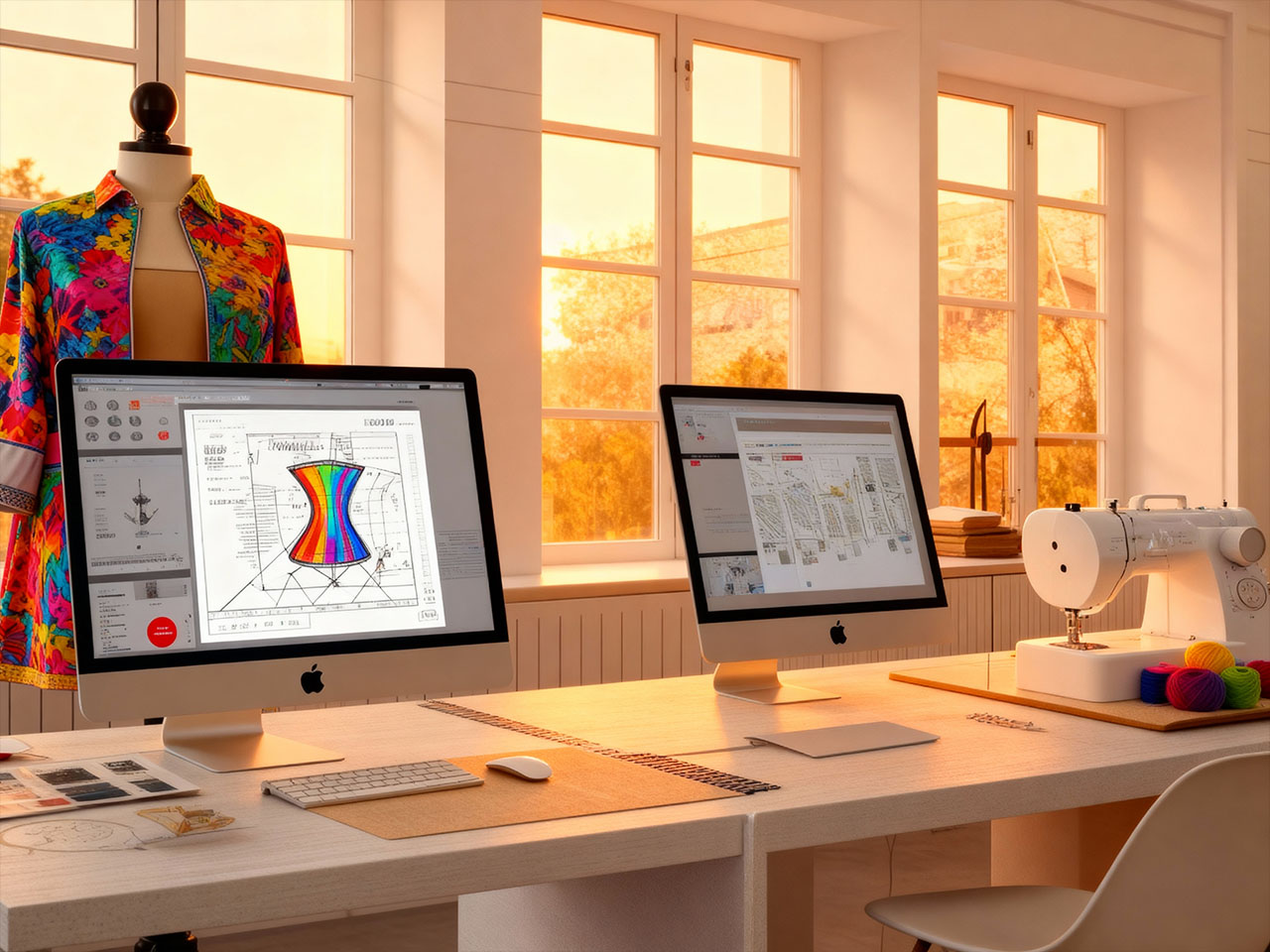
A development sample tests the initial design interpretation and may use provisional materials or construction. A pre-production sample should represent the final specifications intended for bulk manufacturing and is used to confirm the product before the main production run.
Send the same specification and quantity to each shortlisted factory. Compare the unit price alongside sampling, branding, packaging, inspection, shipping, duties where applicable, and other relevant costs. Confirm the delivery terms and exclusions before deciding which quote offers the best value.
Some full service clothing manufacturers provide fabric and trim sourcing, while others expect the buyer to nominate or supply specific materials. Confirm which services are available, what sourcing fees apply, and how materials will be approved before production.
Confirm the final tech pack, approved pre-production sample, fabric and trims, measurements and tolerances, artwork, labels, packaging, quantity, price, production schedule, and quality-control requirements. Record critical approvals in writing.
Use a controlled tech pack, provide specific sample feedback, document revisions, approve the pre-production sample, and agree on quality-control criteria before production. During manufacturing, require approval for significant changes to materials or construction.
Choosing among custom clothing manufacturers involves more than finding a factory with an attractive unit price. It requires clear specifications, a realistic MOQ, comparable quotations, controlled sampling, and documented quality approvals.
The most reliable custom garment manufacturing process connects every stage—from the first design drawing and tech pack to fabric sourcing, sampling, the pre-production sample, bulk manufacturing, and shipment—with a clear decision that the client can review and approve.
Use the checklists and supplier comparison test in this guide to evaluate potential partners using actual evidence. When you are ready to discuss a project, contact Liantao Apparel Manufacturer with your product brief and estimated quantity to begin a project-specific manufacturing inquiry.
If you have any questions or require a quote, please leave
us a message. Our experts will get back to you within 24 hours to help you choose the ideal fashion products tailored to your needs.
Hi, I’m Lucy Cai, the founder of liantaoapparel.com. I’ve been managing a women’s clothing factory in China for over 16 years. With extensive experience in garment production and OEM services, I’m passionate about sharing insights into women’s fashion, apparel manufacturing, and global sourcing.
If you have any questions or need a quote, please contact us.
Please add us WhatsApp:+86 189 4809 3145
Provide us with detailed information about your requirements, supply design drawings or tech packs,
reference images, and share your ideas.
We will customize the best solution based on your needs and drawings, and provide a specific quote within 24 hours.
Once we receive your confirmation and deposit,we will commence mass production and take care of the subsequent shipping arrangements.


