


🏭 Looking for a Custom Apparel Manufacturer?
We are a leading OEM/ODM clothing factory with 20+ years of export experience. Custom styles, flexible MOQs, and retail-ready quality.
Choosing the right fabric is one of the most important decisions in apparel manufacturing. Fabric selection affects not only how a garment looks and feels, but also its durability, breathability, production cost, care requirements, and environmental profile.
Among natural textile fibers, ramie fabric has attracted increasing attention because of its strength, crisp texture, natural luster, and potential role in sustainable apparel.
Ramie is a plant-based fiber with a long history in textile production. Today, improvements in fiber processing, spinning, blending, weaving, knitting, and finishing have expanded its applications beyond traditional textiles.
But what exactly is ramie fabric? How is it produced? What types are available? How much does ramie fabric cost, and is it really a sustainable textile?
In this comprehensive guide, Liantao explores the essential facts about ramie fabric, from its origin and production process to its applications, pricing, environmental considerations, quality standards, and certifications.
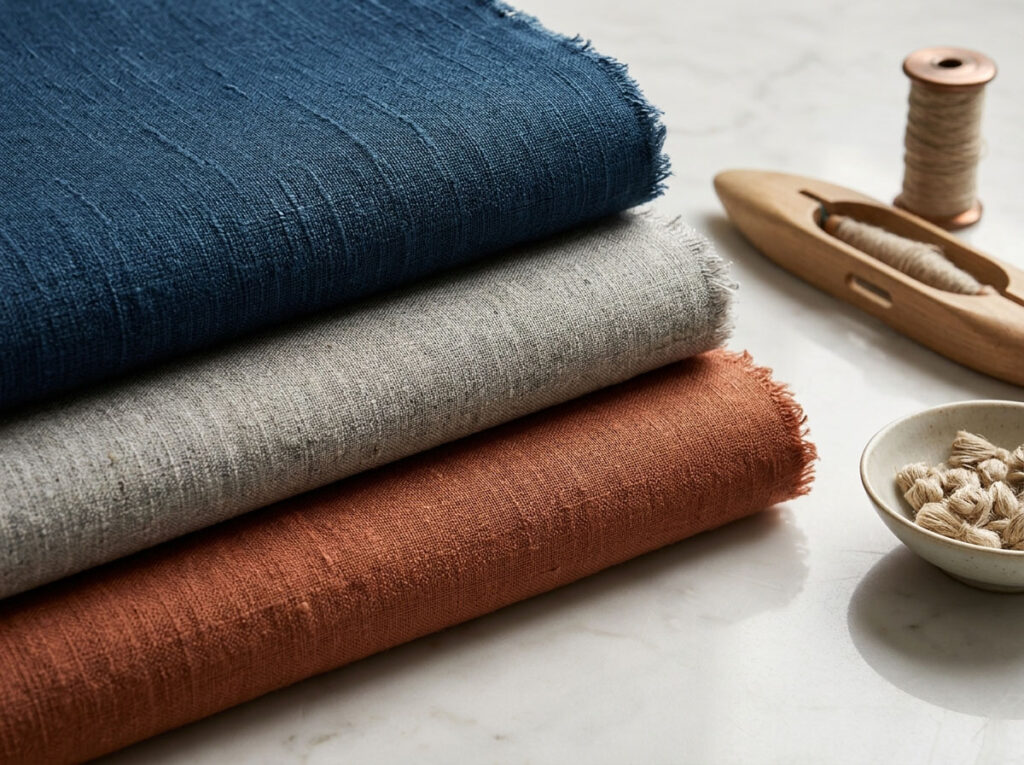
Ramie fabric is a natural textile made from the fibers of the Boehmeria nivea plant, commonly known as ramie or Chinese nettle.
Ramie is classified as a bast fiber because the usable textile fibers are obtained from the inner bark of the plant stem. The fiber is naturally strong and has a distinctive smooth appearance and subtle luster.
Compared with many conventional textile fibers, ramie is particularly recognized for its dimensional stability, durability, breathability, and ability to absorb and release moisture.
Ramie has traditionally been cultivated in warm and humid regions, particularly across East Asia. China has historically been one of the most important areas for ramie cultivation and processing, while other Asian countries have also contributed to its production and textile development.
The ramie plant grows from stalks that contain long bast fibers. After harvesting, these stalks must be processed to separate the valuable textile fibers from the woody material.
This process typically involves several stages:
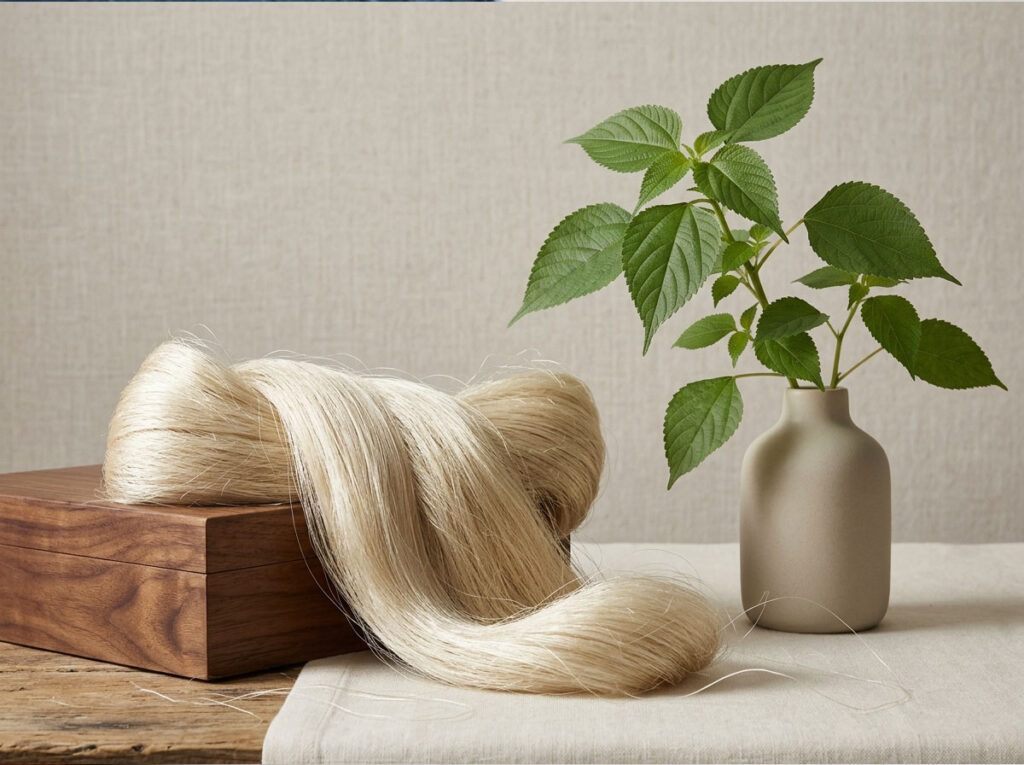
Ramie has been used as a textile fiber for centuries, particularly in Asian cultures. Its natural strength made it useful for clothing, household textiles, and other durable textile products.
Historically, ramie was valued for its ability to produce strong and relatively lightweight fabrics. Its natural luster also gave finished textiles a distinctive appearance.
Today, ramie has found renewed interest in the fashion and textile industries because designers and consumers are increasingly interested in natural fibers and alternative materials.
Modern textile processing can also combine ramie with other fibers such as cotton, linen, viscose, or silk. These blends can modify the hand feel, flexibility, drape, strength, and overall performance of the finished fabric.
Modern ramie fabric is available in a much wider range of constructions and finishes than traditional ramie textiles.
Manufacturers can produce woven ramie fabrics with different weights, textures, and surface finishes. Ramie can also be blended with other fibers to improve softness and comfort.
For apparel brands, this creates opportunities to use ramie in:
At Liantao, ramie can be considered as part of a broader natural-fiber strategy for brands seeking distinctive textures, breathable summer apparel, and more material options for sustainable-oriented collections.
Ramie fabric has several characteristics that distinguish it from common textile materials.
Its combination of natural origin, fiber strength, breathability, appearance, and compatibility with blending makes it an interesting material for modern apparel manufacturing.
Cotton is widely recognized for its softness, comfort, versatility, and broad availability. Ramie, by comparison, is generally valued more for its fiber strength, crisp texture, and natural luster.
For brands choosing between the two, the decision depends on the desired garment characteristics.
Cotton may be preferred when softness and familiar everyday comfort are the main priorities, while ramie may be attractive when strength, texture, breathability, and a more distinctive natural appearance are important.
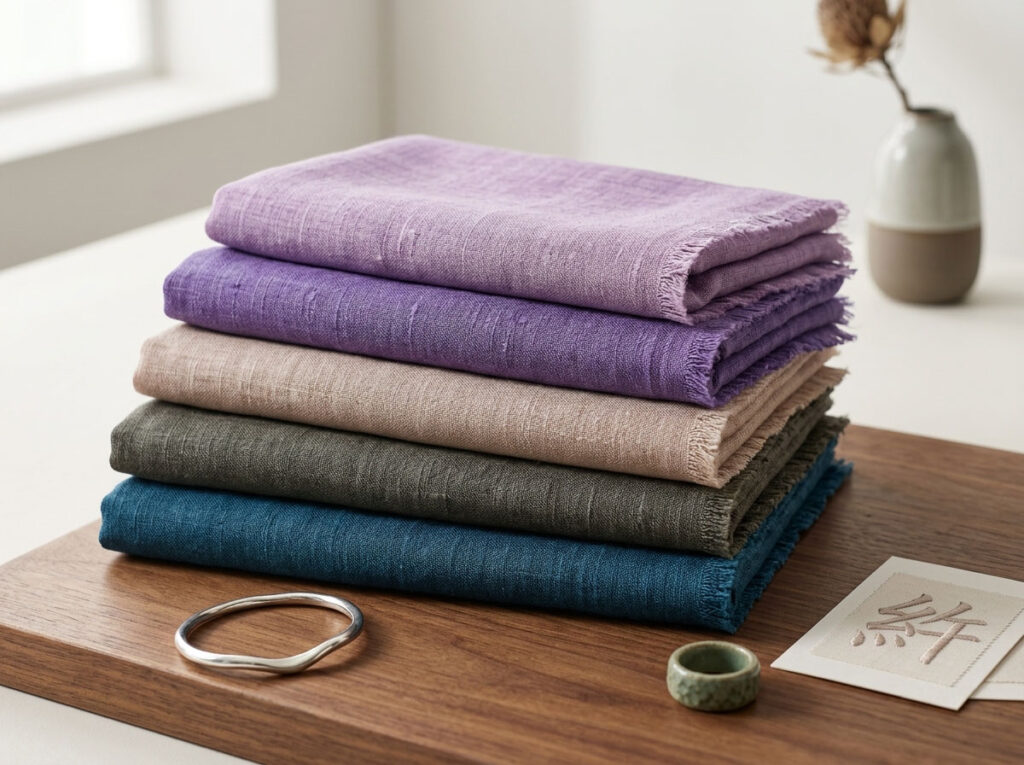
Ramie and linen are both plant-based fibers commonly associated with warm-weather apparel.
Both can offer breathability and a natural visual character. However, their fiber structures and fabric constructions are different, so the final hand feel and performance depend heavily on yarn, weave, weight, finishing, and blending.
Ramie can provide a comparatively crisp and strong textile, while linen is widely recognized for its characteristic texture and relaxed drape.
For summer apparel, the better choice depends on the garment design, fabric weight, desired appearance, and target price.
Polyester is a synthetic fiber known for affordability, durability, easy care, and fast drying. It is widely used throughout the global apparel industry.
Ramie is a plant-derived natural fiber with a different performance profile.
The choice between them depends on the application:
Therefore, ramie should not automatically be considered a replacement for polyester. Each material has different technical and commercial advantages.
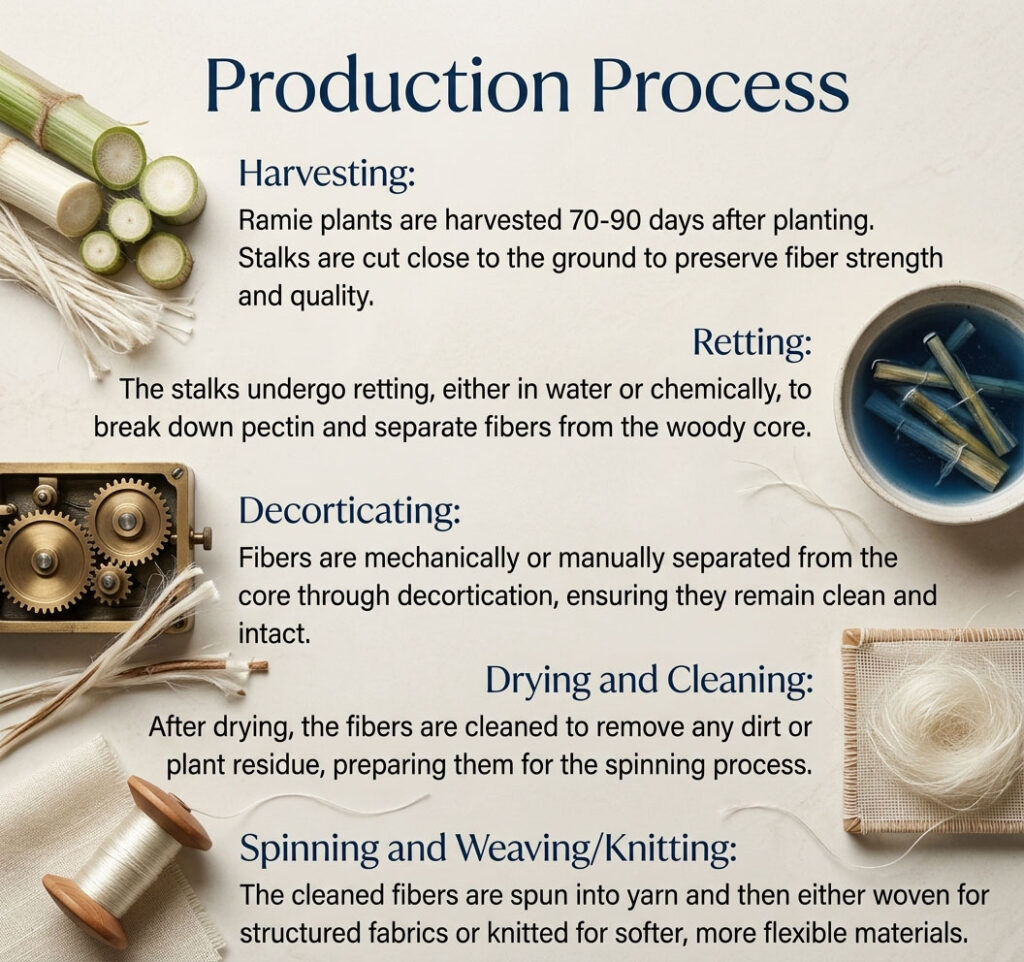
Producing ramie fabric requires multiple processing stages because the raw plant stalk cannot be directly converted into a finished textile.
The objective of processing is to separate the valuable bast fibers, remove unwanted plant materials and gums, prepare the fibers for spinning, and then convert the yarn into a usable fabric.
The actual origin of a finished ramie fabric should always be verified through supplier documentation rather than assumed from the fiber itself.
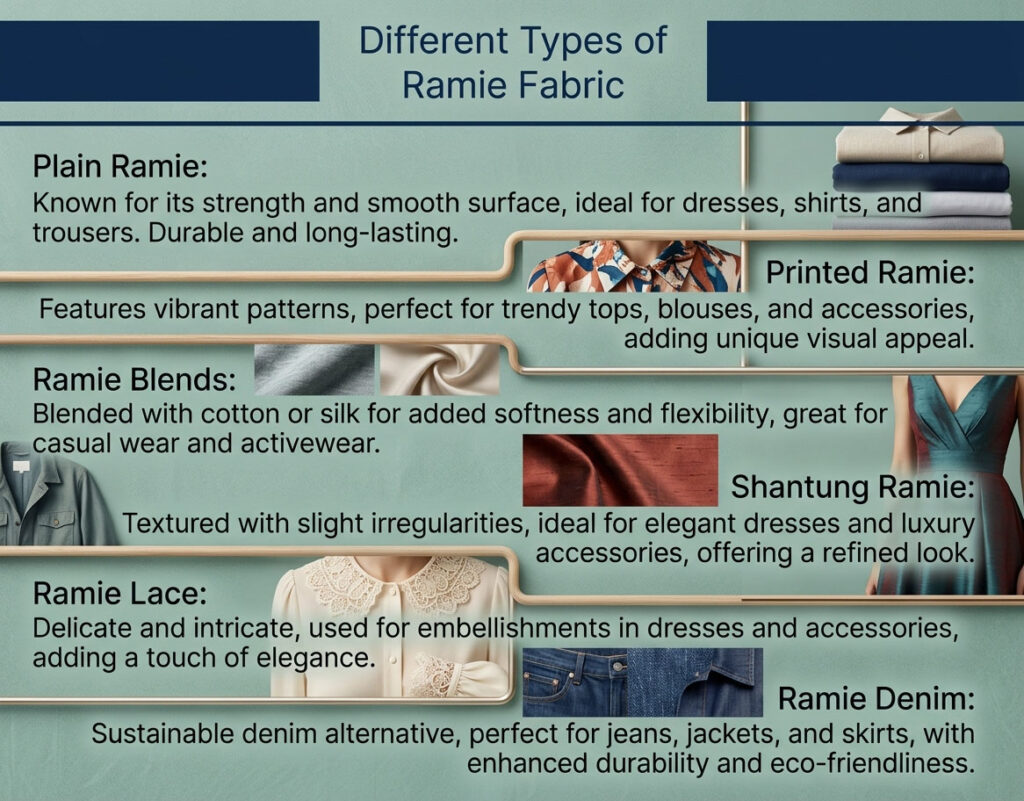
Ramie is not a single standardized fabric construction. Different yarns, blends, weaving methods, printing techniques, and finishing processes can create significantly different ramie textiles.
The best type depends on the garment’s construction, target market, desired hand feel, performance requirements, and production budget.
Ramie can be used in both apparel and selected home-textile applications.
Its strength, breathability, texture, and natural appearance make it particularly relevant to lightweight and warm-weather products.
Ramie works well in casual clothing where breathability and natural texture are important.
Shirts, tops, dresses, and lightweight trousers can benefit from the crisp appearance of ramie. Ramie blends can also provide a softer hand feel for everyday products.
The natural luster of ramie can contribute to a refined appearance.
Depending on fabric construction and finishing, ramie can be used for blouses, dresses, tailored garments, and fashion collections where designers want a natural but distinctive surface.
Heavier ramie or ramie-blend fabrics can be considered for lightweight jackets, overshirts, structured coats, and other outer layers.
The suitability depends heavily on fabric weight and construction, since ramie itself is not primarily a cold-weather insulation fiber.
Ramie can also be incorporated into accessories such as:
Ramie can also appear in selected home-textile products where texture and durability are valued.
Potential applications include curtains, decorative fabrics, table textiles, and certain upholstery or bedding products, depending on the construction and performance specifications.
Pure ramie is not automatically the best choice for high-intensity sportswear because performance requirements can be more demanding.
However, ramie blends may be explored for casual active-inspired garments where natural fiber content, breathability, and comfort are desired.
For technical activewear, fabric testing should always verify stretch, recovery, abrasion resistance, moisture management, and wash durability before production.
The price of ramie fabric can vary considerably.
Unlike a standardized commodity with one fixed price, textile pricing depends on fiber quality, yarn specifications, fabric construction, finishing, dyeing, printing, certification, order quantity, and production location.
Therefore, the figures below should be treated as general sourcing references rather than fixed market quotations.
Imported and domestically available ramie fabrics can occupy different price ranges depending on quality and supplier.
Basic ramie fabrics may be positioned as mid-range natural textiles, while premium blends, specialty constructions, printed materials, and certified fabrics can command significantly higher prices.
For an apparel brand, the most useful approach is to request a current quotation based on the exact fabric specification rather than relying on a generic price-per-yard estimate.
China has a mature textile manufacturing ecosystem and established experience with natural-fiber processing.
This can provide brands with a broad range of ramie fabric options, from basic constructions to premium blends and specialty finishes.
However, lower manufacturing cost should not automatically be equated with lower quality. Fabric quality depends on the selected mill, raw materials, specifications, testing, and quality-control procedures.
When comparing suppliers, brands should evaluate more than the quoted unit price.
A useful sourcing comparison should include:
| Cost Factor | What to Check | Why It Matters |
|---|---|---|
| Fiber composition | Pure ramie or blend percentage | Composition directly affects performance and price |
| Fabric weight | GSM or oz | Heavier fabrics generally use more material |
| Width | Finished fabric width | Affects garment yield and production efficiency |
| Yarn specification | Yarn count and quality | Influences appearance and hand feel |
| Dyeing | Standard or specialty dyeing | Special colors may increase processing cost |
| Finishing | Softening, washing, coating, etc. | Finishing changes performance and appearance |
| Certification | OEKO-TEX, GOTS, or other documentation | May increase sourcing and compliance costs |
| MOQ | Minimum order quantity | Influences inventory and unit economics |
| Testing | Required laboratory tests | Important for quality and market compliance |
The original article provides historical price ranges for ramie fabric in the U.S. and China, but those figures should not be treated as current quotations. Textile prices change with raw-material costs, exchange rates, labor, energy, freight, order volume, and supplier conditions.
For current sourcing, Liantao recommends requesting a quote against a specific fabric specification, including composition, GSM, width, color, finish, quantity, and certification requirements.
Ramie is often discussed as an environmentally friendly natural fiber, but the environmental profile of a textile depends on the entire supply chain, not simply the plant from which the fiber originates.
Cultivation, harvesting, fiber extraction, degumming, dyeing, finishing, transportation, garment production, use, and end-of-life treatment can all influence the overall environmental impact.
Ramie should not be described as automatically impact-free.
The most important point is that “natural” does not automatically mean “zero environmental impact.” Brands should evaluate the complete production chain when making sustainability claims.
Selecting a good ramie fabric requires more than checking the fiber name.
For apparel manufacturers and fashion brands, fabric quality should be evaluated against the actual product requirements.
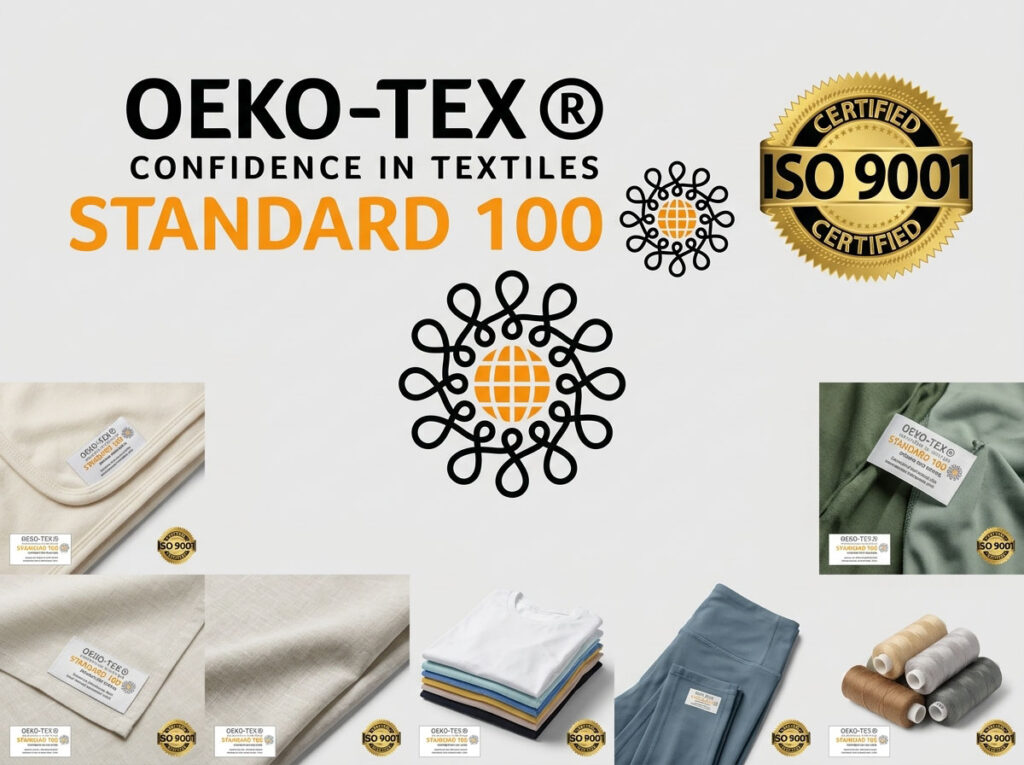
Depending on the target market and product requirements, brands may consider certifications such as OEKO-TEX® Standard 100, GOTS, and relevant ISO standards.
However, certifications should not be treated as interchangeable.
Before purchasing certified ramie fabric, brands should request the supplier’s current certificate, certificate scope, validity information, and relevant transaction or supply-chain documentation.
At Liantao, fabric selection should be based on the complete product specification rather than simply choosing a material because it is labeled “ramie” or “sustainable.”
A reliable sourcing process should consider fiber composition, GSM, width, construction, color, finishing, testing requirements, certification, MOQ, lead time, and target price.
For brands developing new apparel collections, these details make it easier to determine whether ramie is suitable for the intended garment and target customer.
Ramie fabric combines several characteristics that make it interesting for modern apparel manufacturing: natural plant origin, strong fibers, breathability, distinctive texture, and versatility in fabric construction.
It can be used for shirts, dresses, trousers, blouses, accessories, home textiles, and selected ramie-blend products.At the same time, ramie is not automatically the right fabric for every application. Its relatively crisp hand feel, processing requirements, cost, care characteristics, and supply-chain considerations should all be evaluated before production.
For fashion brands considering ramie, the best approach is to start with the intended garment and define the required specifications first. From there, the appropriate ramie construction, blend, weight, finishing method, certification, and manufacturing process can be selected.
With the right specification and quality-control process, ramie fabric can be a valuable option for brands looking to develop distinctive, breathable, durable, and natural-fiber apparel collections.
For more information about ramie fabrics, fabric sourcing, or apparel manufacturing, Liantao can help brands evaluate fabric specifications and develop products according to their design, quality, quantity, and target-market requirements.
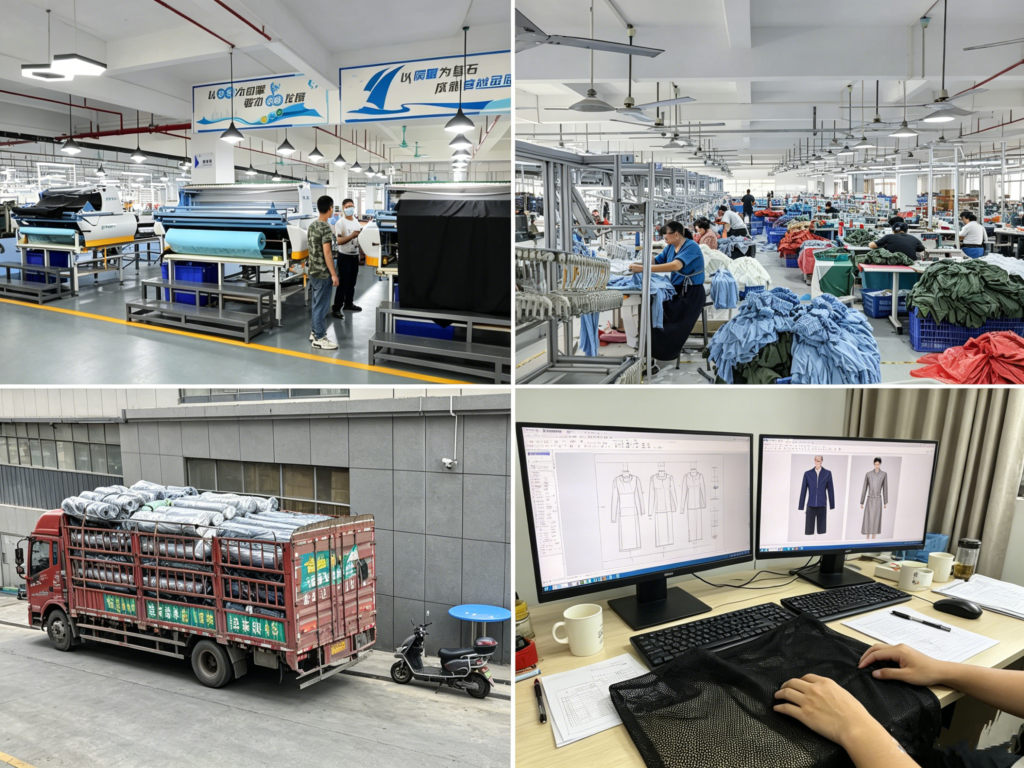
If you have any questions or require a quote, please leave
us a message. Our experts will get back to you within 24 hours to help you choose the ideal fashion products tailored to your needs.
Hi, I’m Lucy Cai, the founder of liantaoapparel.com. I’ve been managing a women’s clothing factory in China for over 16 years. With extensive experience in garment production and OEM services, I’m passionate about sharing insights into women’s fashion, apparel manufacturing, and global sourcing.
If you have any questions or need a quote, please contact us.
Please add us WhatsApp:+86 189 4809 3145
Provide us with detailed information about your requirements, supply design drawings or tech packs,
reference images, and share your ideas.
We will customize the best solution based on your needs and drawings, and provide a specific quote within 24 hours.
Once we receive your confirmation and deposit,we will commence mass production and take care of the subsequent shipping arrangements.


