🏭 Looking for a Custom Apparel Manufacturer?
We are a leading OEM/ODM clothing factory with 20+ years of export experience. Custom styles, flexible MOQs, and retail-ready quality.
If you’ve ever wondered whether a garment should be called a T-shirt, jersey, or sports jersey, you’re not alone. The terminology can be confusing because the word “jersey” has two different meanings in apparel. It can describe a type of knitted fabric, or it can refer to a sports shirt designed for athletic performance and team identity.
A T-shirt, by comparison, is a specific type of casual top usually recognized by its collarless neckline, simple construction, and comfortable knit fabric. While the two garments can look similar, their purpose, fabric, fit, construction, and customization options can be very different. In this guide, we’ll explain the difference between a T-shirt and a jersey, clarify what jersey fabric means, and help you understand when each type of garment is the better choice.
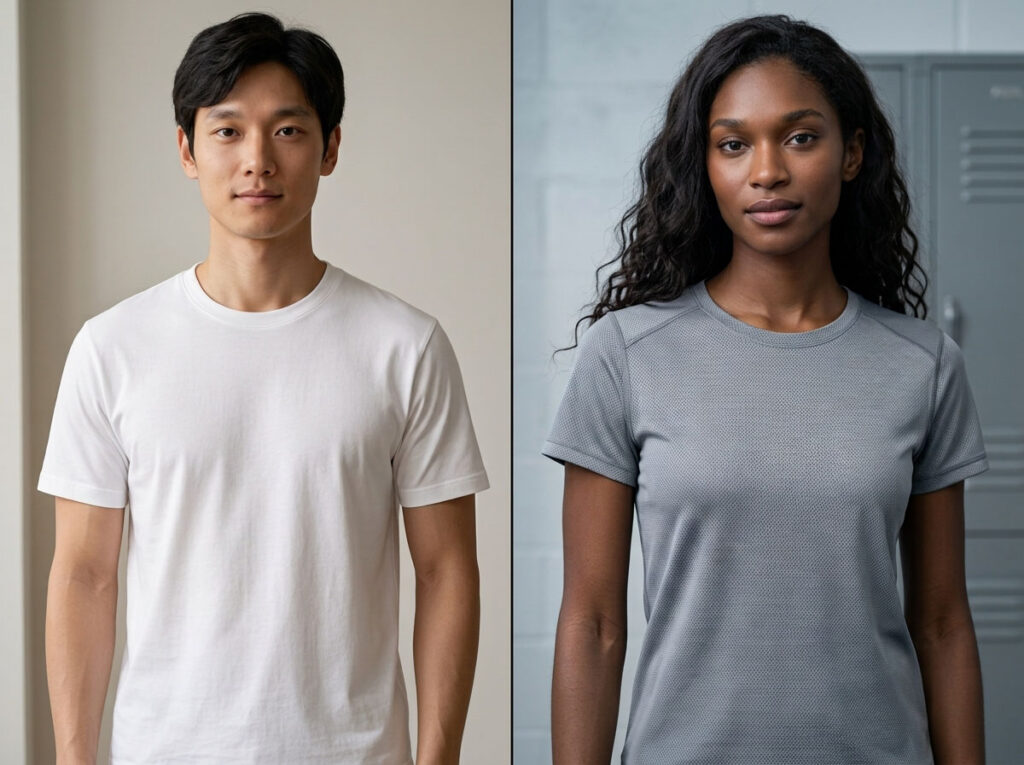
To understand the difference between a T-shirt and a jersey, it is important to first clarify what each term actually means.
A T-shirt is a specific garment designed primarily for casual and everyday wear. A jersey, however, can refer either to a sports uniform or to a type of knitted fabric used in many different garments.
This distinction is especially important for clothing brands because “jersey” does not automatically mean “sports shirt.”
A T-shirt is one of the most widely used casual garments worldwide. Its simple construction makes it suitable for everyday wear, layering, branding, and customization.
Typical characteristics include:
For apparel brands, this versatility makes T-shirts one of the easiest products to develop across different price points and market segments.
The word jersey has two common meanings in the clothing industry.
A sports jersey is a specialized garment designed for athletic activities, team representation, or sports-related fashion.
Typical features include:
Jersey can also describe a knitted fabric construction rather than a particular garment.
Jersey fabric is generally:
Therefore, a T-shirt can actually be made from jersey fabric, while a sports jersey is a completely different concept.
Although both garments can have short sleeves and a casual appearance, they are designed for different purposes.
A T-shirt prioritizes everyday comfort, versatility, and casual styling, while a sports jersey focuses more heavily on performance, breathability, durability, and team identity.
| Feature | T-Shirt | Sports Jersey |
|---|---|---|
| Primary Purpose | Casual and everyday wear | Sports, athletic activities, and team identity |
| Typical Fabric | Cotton, cotton blends, jersey knit | Polyester, mesh, performance or moisture-wicking fabrics |
| Fit | Regular, slim, relaxed, or oversized | Athletic, loose, body-contoured, or sport-specific |
| Design | Solid colors, graphics, logos, or minimalist details | Team logos, player names, numbers, graphics, and ventilation panels |
| Breathability | Depends on fabric weight and construction | Usually prioritized for active movement |
| Durability | Designed for regular daily use | Designed to withstand sports activity and repeated movement |
| Customization | Screen printing, DTG, embroidery, patches, labels | Sublimation, heat-transfer names/numbers, embroidery, team graphics |
| Typical Market | Casualwear, streetwear, promotional apparel | Sportswear, teamwear, fanwear, athletic fashion |
The biggest difference is therefore intended function. A T-shirt is primarily an everyday fashion garment, while a sports jersey is designed around athletic performance and team representation.
The simplest way to understand this difference is:
Jersey fabric is a material; a jersey shirt is a garment.
This distinction is often overlooked when consumers search for “jersey.”
Jersey knit is a type of knitted textile used across many clothing categories.
Its characteristics include:
A sports jersey is a finished garment rather than a fabric category.
Sports jerseys are typically:
In other words, jersey fabric can be used to make a T-shirt, but a sports jersey is a complete garment designed for athletic or team-related use.
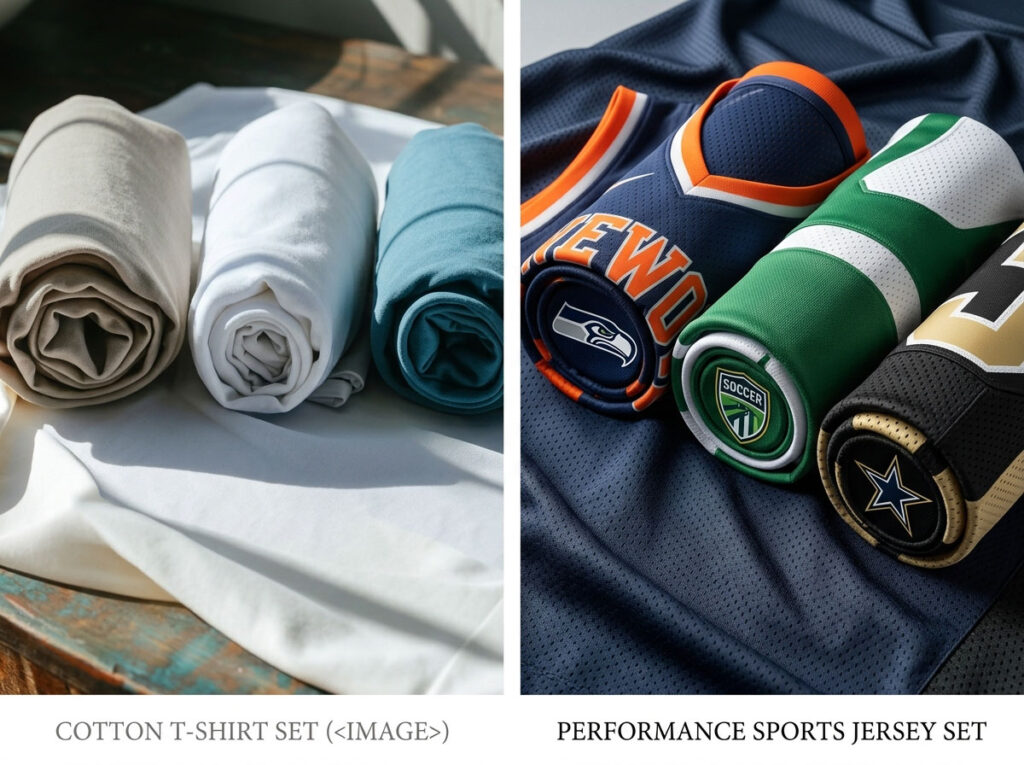
The right choice depends on where you are going, what you are doing, and what you want the garment to communicate.
Choose a T-shirt when everyday comfort, casual styling, or easy layering is your priority. Choose a jersey when you are participating in sports, supporting a team, or looking for a performance-focused athletic aesthetic.
Neither T-shirts nor jerseys are limited to one basic design. Both categories have expanded significantly as fashion and sportswear continue to overlap.
Graphic T-shirts use printed or embroidered artwork to communicate a brand identity, message, or visual concept. They are particularly effective for streetwear, promotional collections, and fashion brands.
Oversized T-shirts feature a larger silhouette and relaxed proportions. They are widely used in streetwear and contemporary casualwear because they create a comfortable, fashion-forward appearance.
Henley T-shirts combine the comfort of a T-shirt with a short button placket. This gives the garment more visual structure while retaining a casual feel.
Ringer T-shirts feature contrasting trim around the neckline and sleeve openings. Their retro-inspired appearance makes them popular for vintage, lifestyle, and casual collections.
Soccer jerseys are generally lightweight and designed to support movement during continuous activity. They often include breathable panels and performance-oriented synthetic fabrics.
Basketball jerseys are typically sleeveless to maximize arm movement and ventilation. Their loose silhouettes also provide room for active movement.
Football jerseys are generally designed with more room through the body and sleeves to accommodate movement and, depending on the design, protective equipment.
Baseball jerseys often feature a button-front construction and a more structured appearance. They can transition easily from sportswear into lifestyle fashion.
Fashion jerseys borrow visual elements from traditional teamwear, including numbers, logos, stripes, and athletic graphics, but reinterpret them for streetwear and everyday fashion.

The difference between a T-shirt and a jersey ultimately comes down to the distinction between everyday clothing, fabric terminology, and performance apparel.
A T-shirt is primarily a casual garment designed for comfort, versatility, layering, and branding. A sports jersey is a specialized garment designed around athletic performance, breathability, durability, and team identity. Meanwhile, jersey fabric is a type of knitted textile that can actually be used to manufacture T-shirts and many other garments.
For consumers, the best choice depends on the occasion and intended use. For clothing brands, understanding this distinction is even more important because fabric selection, garment construction, fit, printing methods, and customization requirements all change according to the product category.
Understanding these distinctions helps both consumers and apparel brands choose the right fabric, fit, construction, and customization method for the intended product.
T-shirts and jerseys may look similar at first glance, but they are designed with different purposes in mind. T-shirts focus on everyday comfort, casual styling, versatility, and easy customization, while sports jerseys place greater emphasis on performance, breathability, durability, and team identity. At the same time, jersey is also a fabric category, which means a T-shirt itself can be made from jersey knit fabric.
For apparel brands, understanding the difference between these terms is essential when developing new products. The right combination of fabric composition, weight, fit, construction, printing, and branding can turn a basic T-shirt or jersey into a product suited to a specific market. Whether the goal is everyday casualwear, streetwear, sportswear, or custom team apparel, selecting the right garment structure and material is the foundation of a successful clothing collection.
No. A sports jersey is a performance-oriented garment, while a T-shirt is primarily designed for everyday casual wear. However, both garments can use knitted fabrics, including jersey knit.
It can mean both. Jersey is a type of knitted fabric, but “jersey” is also commonly used to describe sports shirts worn by teams and athletes.
Yes. In fact, jersey knit is one of the most common fabric constructions used for T-shirts because it offers softness, stretch, and comfortable drape.
Sports jerseys commonly use polyester, performance blends, mesh, and moisture-wicking fabrics because these materials can provide lightweight construction, durability, and breathability.
Yes. Sports jerseys can be worn casually, particularly in streetwear and fanwear. Fashion jerseys are also designed specifically to incorporate athletic aesthetics into everyday outfits.
It depends on the purpose. T-shirts offer broad customization options for everyday branding and fashion, while jerseys are particularly suitable for team names, player numbers, logos, sublimation graphics, and sports-specific branding.

If you have any questions or require a quote, please leave
us a message. Our experts will get back to you within 24 hours to help you choose the ideal fashion products tailored to your needs.
Hi, I’m Lucy Cai, the founder of liantaoapparel.com. I’ve been managing a women’s clothing factory in China for over 16 years. With extensive experience in garment production and OEM services, I’m passionate about sharing insights into women’s fashion, apparel manufacturing, and global sourcing.
If you have any questions or need a quote, please contact us.
Please add us WhatsApp:+86 189 4809 3145
Provide us with detailed information about your requirements, supply design drawings or tech packs,
reference images, and share your ideas.
We will customize the best solution based on your needs and drawings, and provide a specific quote within 24 hours.
Once we receive your confirmation and deposit,we will commence mass production and take care of the subsequent shipping arrangements.