


🏭 Looking for a Custom Apparel Manufacturer?
We are a leading OEM/ODM clothing factory with 20+ years of export experience. Custom styles, flexible MOQs, and retail-ready quality.
Finding an apparel manufacturer is one of the most important decisions when building or expanding a clothing brand.
A manufacturer does more than turn fabric into finished garments. The right production partner can help you develop product specifications, select materials, create samples, manage bulk production, and maintain consistent product quality.
However, not every clothing manufacturer offers the same services.
Some factories specialize in large-volume production. Others focus on custom apparel, private-label clothing, or OEM and ODM manufacturing. Some suppliers can support product development from the design stage, while others expect buyers to provide complete technical specifications before production begins.
Choosing the wrong partner can result in inconsistent sizing, unexpected costs, delayed shipments, or products that do not match your original design.
This guide explains how apparel manufacturing works, what to evaluate before choosing a clothing manufacturer, and how to reduce production risks through sampling and quality control.
Whether you are launching a new fashion label, sourcing custom hoodies, developing private-label T-shirts, or ordering bulk apparel, understanding the manufacturing process will help you make better sourcing decisions.

An apparel manufacturer is a company or production facility that makes clothing based on a buyer’s product requirements.
Depending on its capabilities and business model, an apparel manufacturer may provide services such as:
Not every manufacturer offers all these services in-house. Some coordinate specialized suppliers for printing, embroidery, washing, or other processes.
Before requesting a quotation, clarify which services are handled directly by the factory and which are outsourced.
These terms are sometimes used interchangeably, but they describe different business models.
| Business Type | Main Function | Best For |
|---|---|---|
| Apparel manufacturer | Produces garments based on specifications or designs | Clothing brands and businesses needing custom production |
| Clothing supplier | Sources or provides garments, sometimes from multiple factories | Buyers looking for sourcing support |
| Clothing wholesaler | Sells ready-made products in bulk | Retailers and resellers purchasing existing styles |
| Private-label manufacturer | Produces garments that can carry a buyer’s brand identity | Startups and established fashion labels |
| Apparel sourcing agent | Helps buyers identify and coordinate suppliers | Businesses needing sourcing assistance |
The distinction matters because a wholesaler selling ready-made clothing may not be able to modify patterns, fabrics, construction, or branding in the same way as a custom apparel manufacturer.
If your goal is to develop an original collection, look for a partner with relevant product-development and manufacturing capabilities.
Before contacting factories, identify the manufacturing model that matches your project.
A custom apparel manufacturer produces garments according to a buyer’s design and specifications.
This may include:
Custom manufacturing is suitable for fashion brands that want more control over product design and differentiation.
For example, a streetwear brand developing oversized hoodies may require a specific shoulder drop, body width, fleece weight, rib construction, and embroidery placement.
A manufacturer must understand these requirements before production can begin.
A private label clothing manufacturer produces garments that are sold under another company’s brand.
Depending on the manufacturer’s services, buyers may select existing garment styles and customize elements such as:
Private labeling can simplify product development because buyers may not need to create every garment detail from scratch.
However, it is important to confirm which elements can actually be customized. Not every private-label program offers the same flexibility.
OEM stands for Original Equipment Manufacturer.
In apparel production, an OEM arrangement generally means the buyer provides the product design, specifications, or technical package, and the manufacturer produces the garment according to those requirements.
OEM production is suitable for brands that already have a clear product concept and want manufacturing support.
The buyer may provide:
The manufacturer then evaluates the specifications, confirms production feasibility, and provides a quotation.
ODM stands for Original Design Manufacturer.
An ODM manufacturer may provide existing designs, product concepts, or development support that buyers can adapt for their own collections.
This model may be useful for businesses that want to launch products without developing every element independently.
However, design ownership, exclusivity, customization rights, and intellectual property terms should be discussed before placing an order.
Understanding the apparel manufacturing process helps buyers identify potential problems before they become expensive production issues.
Although individual factories may use different workflows, a typical custom clothing project follows these stages.
| Production Stage | Main Activities | What Buyers Should Confirm |
|---|---|---|
| 1. Product brief | Define garment type, target market, and design direction | Product requirements and intended use |
| 2. Tech pack development | Prepare technical drawings, measurements, materials, and construction details | Complete and approved specifications |
| 3. Fabric and trim sourcing | Select fabrics, labels, zippers, buttons, and other components | Composition, weight, color, and availability |
| 4. Pattern development | Create or adjust garment patterns | Pattern accuracy and fit expectations |
| 5. Sample production | Produce prototype garments | Sample quality and design accuracy |
| 6. Sample approval | Review fit, measurements, fabric, and construction | Written approval and revision records |
| 7. Bulk production | Cutting, sewing, finishing, and assembly | Production schedule and quality checkpoints |
| 8. Final inspection | Check finished garments against agreed requirements | Inspection results and defect handling |
| 9. Packing and shipment | Label, pack, and prepare orders for shipment | Packing requirements and shipping documents |
Start by identifying exactly what you want to manufacture.
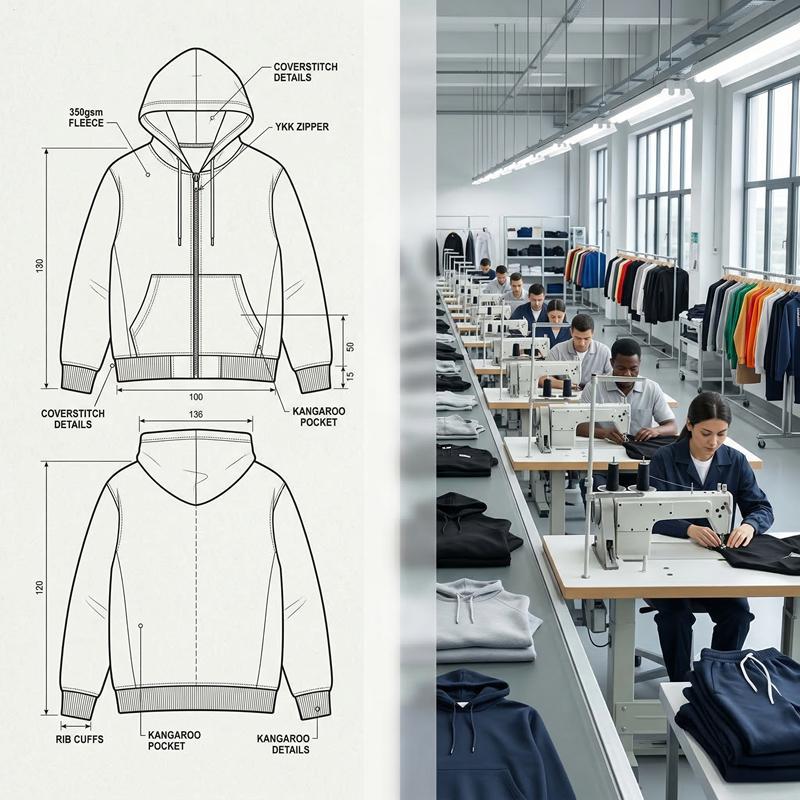
For example, a hoodie project should specify:
A vague request such as “I need 500 custom hoodies” is not enough for an accurate quotation.
A detailed product brief helps the manufacturer understand the project and identify missing information early.
A tech pack is a technical document that communicates how a garment should be made.
A useful apparel tech pack may include:
The more complete the tech pack, the easier it is to evaluate production feasibility and compare quotations.
For new brands without technical design teams, ask whether the manufacturer provides technical development or sample-development support.
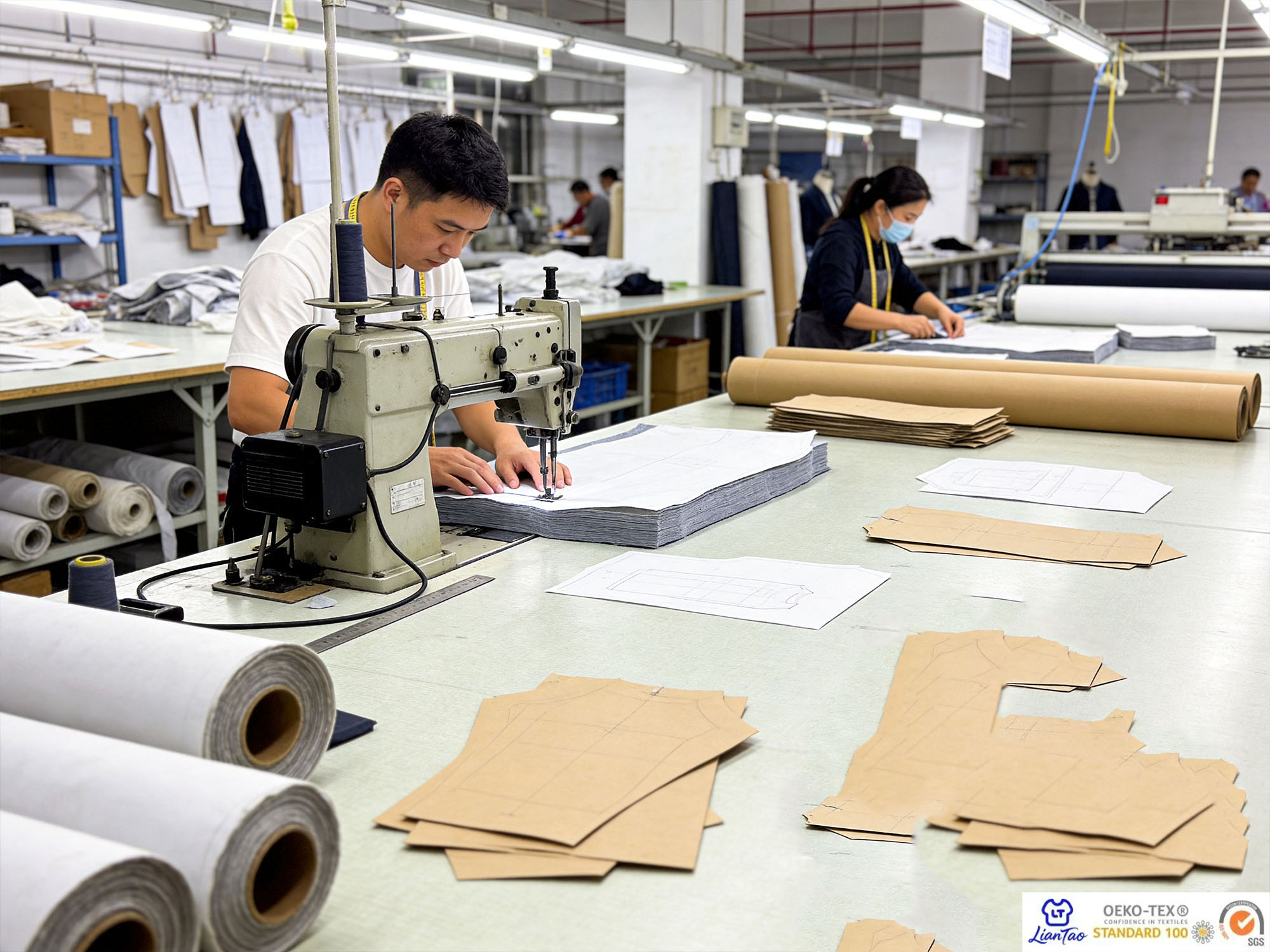
Fabric selection affects garment appearance, comfort, durability, and production cost.
For example:
| Fabric Type | Common Apparel Applications | Key Considerations |
|---|---|---|
| Cotton jersey | T-shirts and casual tops | Softness, shrinkage, weight, and surface appearance |
| French terry | Sweatshirts and lightweight hoodies | Loop construction, hand feel, and weight |
| Fleece | Hoodies and sweatpants | Warmth, brushing, pilling, and shrinkage |
| Polyester blends | Sportswear and performance clothing | Stretch, moisture management, and durability |
| Rib knit | Cuffs, collars, and waistbands | Recovery, stretch, and dimensional stability |
| Woven cotton | Shirts, trousers, and lightweight jackets | Weave, drape, and dimensional stability |
Do not select fabric based on composition alone.
Two fabrics with the same fiber composition may have different GSM, hand feel, shrinkage, surface texture, and performance.
Request fabric samples and confirm the approved material before bulk production.
Sampling is one of the most important stages of apparel manufacturing.
A sample allows the buyer to evaluate whether the manufacturer’s interpretation matches the original design.
Check:
If changes are required, record them clearly and request a revised sample when necessary.
Avoid approving bulk production based only on verbal discussions or an incomplete sample review.
Choosing the right production model depends on your product-development resources, customization requirements, and launch strategy.
| Factor | OEM | ODM | Private Label |
|---|---|---|---|
| Design ownership | Usually buyer-led | Depends on the design agreement | Depends on the selected base product and agreement |
| Product development | Buyer provides specifications | Manufacturer may provide design support | Often based on existing styles |
| Customization | High, subject to factory capability | Varies | Varies by program |
| Technical requirements | Usually detailed buyer specifications | May receive development assistance | Often simpler for standard styles |
| Best for | Brands with established designs | Brands needing design or development support | Businesses building a branded product range |
| Main consideration | Specification accuracy | Design rights and exclusivity | Customization limits |
Choose OEM if you already have a tech pack.
This model is useful when your brand has established designs, clear measurements, and specific construction requirements.
Choose ODM if you need development support.
This model may suit businesses that have a product direction but need help turning concepts into manufacturable garments.
Choose Private Label if you want to build a branded collection efficiently.
This may be suitable when you can work from existing styles and customize selected branding or product details.
The most important point is to confirm the actual services, customization limits, and ownership terms in writing. Business terminology can vary between manufacturers.
A well-prepared inquiry helps manufacturers assess your project more accurately.
Instead of sending only a product photo, provide as much information as possible.
| Information | Example | Why It Matters |
|---|---|---|
| Product category | Hoodie, T-shirt, joggers, jacket | Identifies the production category |
| Design reference | Sketch, photo, or tech pack | Communicates the intended design |
| Fabric | 100% cotton French terry | Helps evaluate material requirements |
| Fabric weight | 350 GSM | Defines the target fabric weight |
| Quantity | 500 pieces | Supports production and pricing evaluation |
| Size range | XS–XXL | Helps plan grading and size allocation |
| Branding | Embroidery and woven label | Identifies additional processes |
| Target market | US, UK, EU, or other market | Helps identify relevant labeling and compliance requirements |
| Target delivery date | Required delivery window | Supports production planning |
Imagine a fashion startup wants to manufacture an oversized hoodie collection.
Its initial product brief might look like this:
| Specification | Requirement |
|---|---|
| Product | Oversized pullover hoodie |
| Fabric | Cotton-polyester fleece |
| Target weight | 350 GSM |
| Fit | Relaxed oversized fit |
| Colors | Black, grey, and cream |
| Branding | Chest embroidery |
| Labels | Custom neck label and care label |
| Size range | S–XXL |
| Order quantity | 500 pieces |
| Packaging | Individual polybags |
This is a starting brief, not a complete tech pack.
The buyer should still confirm exact measurements, tolerances, fabric composition, color standards, construction details, and artwork before approving production.
MOQ means Minimum Order Quantity.
It refers to the smallest order quantity a manufacturer is willing to accept under specified conditions.
There is no universal MOQ for apparel manufacturing. Requirements vary by factory, product type, fabric availability, customization, and production process.
Several factors may influence minimum order quantities:
When comparing manufacturers, ask whether the quoted MOQ applies to the total order, each style, each color, or each fabric.
The unit cost of a garment is influenced by more than fabric price.
| Cost Factor | How It Affects Cost |
|---|---|
| Fabric | Composition, GSM, quality, and sourcing |
| Trims | Zippers, buttons, labels, cords, and other components |
| Labor | Sewing complexity and construction time |
| Printing and embroidery | Artwork size, placement, technique, and number of colors |
| Washing and finishing | Special treatments and additional processing |
| Packaging | Individual packaging, hangtags, and custom boxes |
| Order quantity | Production setup and economies of scale |
| Quality requirements | Inspection, testing, and special handling |
| Logistics | Freight, duties, and destination requirements |
Do not compare unit prices without checking what is included.
A lower quotation may exclude custom labels, printing, packaging, testing, or other services that another supplier includes.
Ask every manufacturer to quote against the same specifications.
A useful quotation comparison should include:
This makes supplier comparisons more meaningful and reduces the risk of unexpected costs.
A sample is not simply a miniature version of a bulk order. It is an opportunity to test whether the product can meet the brand’s requirements.
For clothing brands, a poor sample can reveal problems before hundreds or thousands of garments are produced.
| Sample Type | Purpose |
|---|---|
| Prototype sample | Evaluates the initial design and construction |
| Fit sample | Checks garment measurements and fit |
| Size set sample | Reviews grading across the size range |
| Pre-production sample | Confirms the approved design before bulk production |
| TOP sample | Represents garments taken from the production process for buyer review |
The exact sampling sequence depends on product complexity and the manufacturer’s process.
To make sample approval more objective, brands can use a structured evaluation sheet.
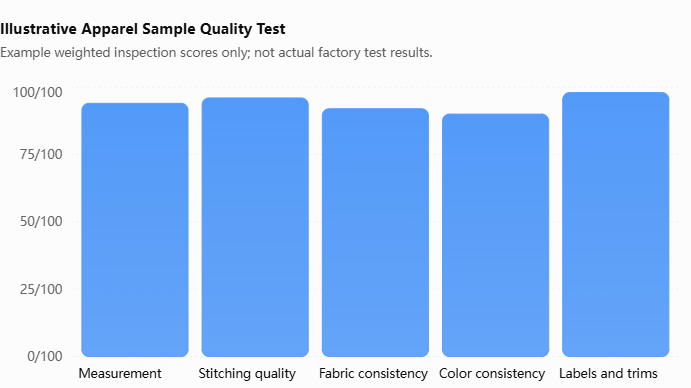
The following example is an illustrative test framework, not a report of an actual factory experiment.
Assume a brand is evaluating 30 sample garments across three production or sample batches.
Each garment is checked against five quality categories.
| Test Category | Evaluation Method | Example Acceptance Rule |
|---|---|---|
| Measurement accuracy | Compare key points of measure against the approved spec | Within the agreed measurement tolerance |
| Stitching quality | Inspect seams, skipped stitches, and loose threads | No critical construction defects |
| Fabric consistency | Compare hand feel, weight, and visible appearance | Consistent with approved fabric |
| Color consistency | Compare against approved color reference under controlled lighting | Within agreed color tolerance |
| Label and trim accuracy | Check label content, placement, and trim details | Matches approved artwork and placement |
For an illustrative scoring exercise, assign each category a score from 0 to 100.
| Quality Category | Illustrative Score | Weight |
|---|---|---|
| Measurement accuracy | 94 | 30% |
| Stitching quality | 96 | 25% |
| Fabric consistency | 92 | 20% |
| Color consistency | 90 | 15% |
| Label and trim accuracy | 98 | 10% |
The weighted score is calculated as:
Weighted Quality Score = Sum of (Category Score × Category Weight)
Using the illustrative values above:
94 × 30% + 96 × 25% + 92 × 20% + 90 × 15% + 98 × 10% = 93.8/100
This score demonstrates how a brand could summarize several inspection categories. It is not an industry benchmark and should not replace defect classification or mandatory acceptance criteria.
For a real test, use the following procedure:
A larger production inspection should also use an appropriate sampling plan rather than relying only on a small convenience sample.
The purpose is not simply to produce a high score. It is to identify repeatable problems, understand their causes, and prevent them from reaching customers.
Apparel quality control should take place throughout production, not only when finished garments are packed.
A useful quality-control process includes several checkpoints.
Before cutting, check:
Fabric defects discovered after cutting can result in material waste and production delays.
During cutting, verify:
Incorrect cutting can affect garment symmetry, fit, and construction.
During sewing, inspect:
Before shipment, check:
Not all garment defects have the same impact.
| Defect Category | Example | Typical Response |
|---|---|---|
| Critical | A defect that may create a safety or regulatory risk | Stop, isolate, and investigate |
| Major | A defect that makes the garment unsuitable for normal sale or use | Repair, replace, or reject according to the agreed plan |
| Minor | A small cosmetic issue that does not materially affect use | Assess against agreed acceptance criteria |
The classification and acceptance limits should be agreed before production.
For larger orders, buyers may also use an AQL-based inspection plan. AQL is a sampling-based acceptance framework, not a guarantee that every individual garment is defect-free.
Apparel production timelines vary depending on garment complexity, fabric availability, sample revisions, order quantity, and factory workload.
A typical project may involve the following stages:
| Stage | Main Activities | What Can Cause Delays |
|---|---|---|
| Product development | Design review and technical specifications | Missing information or design changes |
| Material sourcing | Fabric and trim confirmation | Stock shortages or custom material requirements |
| Sampling | Prototype and fit development | Multiple revision rounds |
| Sample approval | Buyer review and confirmation | Delayed feedback |
| Bulk production | Cutting, sewing, and finishing | Production capacity and quality issues |
| Final inspection | Inspection and corrective action | Defects requiring rework |
| Shipment | Packing and logistics | Freight schedules and customs procedures |
There is no reliable universal lead time for all apparel projects.
Ask the manufacturer to provide a project-specific timeline with milestones.
It is also important to distinguish between:
A quoted production period may not include every stage.
For seasonal fashion collections, confirm the schedule early and allow time for sample revisions and unexpected material issues.
Selecting a clothing manufacturer should be a structured evaluation rather than a decision based only on price.
Use the following checklist when reviewing potential suppliers.
A manufacturer with experience producing T-shirts may not automatically be suitable for tailored jackets or technical sportswear.
Ask for examples of products similar to yours.
If you need help turning a concept into a finished product, confirm whether the manufacturer can support:
Ask how MOQ is calculated and whether it changes with fabric, color, style, or customization requirements.
Ask how the manufacturer checks materials, samples, work in progress, and finished garments.
Request examples of inspection reports or quality documentation where available.
A reliable manufacturing relationship requires clear communication.
Confirm:
Requirements depend on the destination market and product category.
Ask about relevant testing, labeling, chemical restrictions, and product documentation for your intended sales markets.
Do not assume that a supplier’s general statement of compliance covers every product or destination.
Before placing an order, clarify:
A clear agreement protects both the buyer and the manufacturer.
Even experienced fashion businesses can encounter problems when production requirements are not clearly communicated.
Avoid these common mistakes:
Choosing a manufacturer based only on the lowest price.
A low initial quotation may exclude important services or use different material specifications. Compare complete quotations rather than unit prices alone.
Starting production without an approved sample.
Bulk production should follow an agreed sample and confirmed specifications. Otherwise, the buyer and manufacturer may have different expectations.
Providing incomplete measurements.
Terms such as oversized, relaxed, and regular fit are not precise technical instructions. Use measurement charts and tolerances.
Changing materials after approval.
Fabric and trim substitutions can affect fit, appearance, performance, and cost. Require approval before any specification change.
Ignoring size grading.
A garment that fits well in one size may not fit correctly across the full size range. Review size set samples where appropriate.
Waiting until final inspection to identify problems.
Quality issues are easier to correct when identified during material preparation, cutting, and sewing.
Failing to clarify branding and packaging.
Custom labels, hangtags, embroidery, and packaging should be included in the approved specifications and quotation.
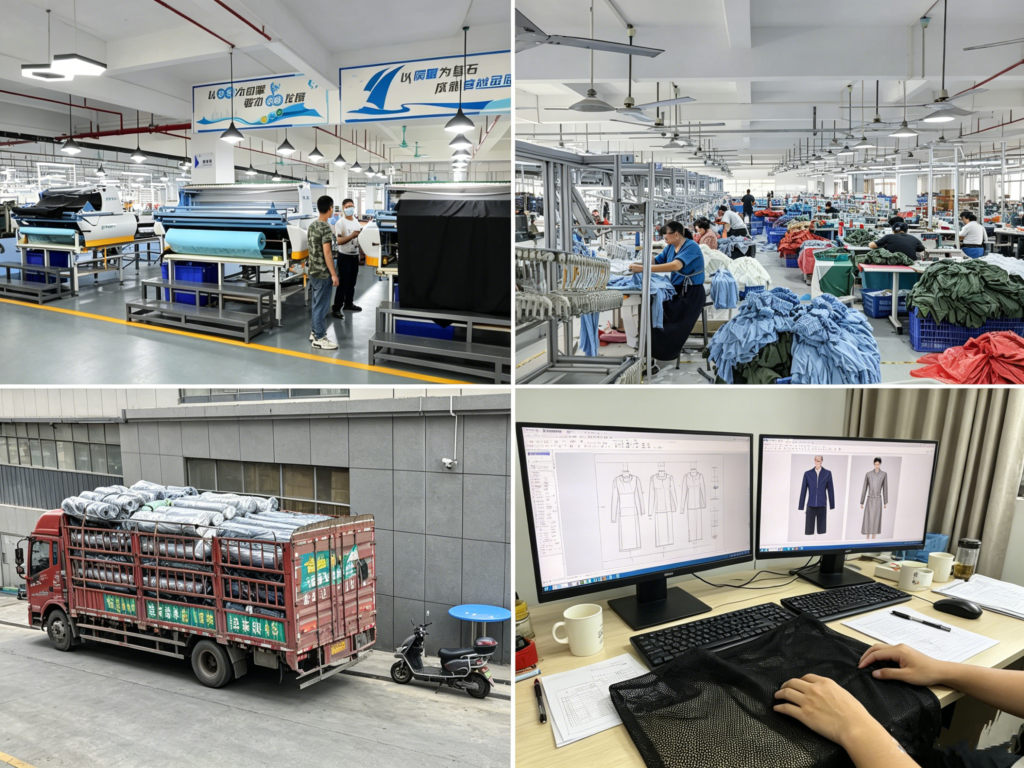
An apparel manufacturer is a business that produces clothing according to product designs, technical specifications, or agreed product requirements. Its services may include fabric sourcing, pattern development, sampling, cutting, sewing, finishing, and quality control.
Start by defining your product requirements, then identify manufacturers with relevant product experience. Review their samples, production capabilities, MOQ, quality-control procedures, communication process, and commercial terms before placing an order.
An apparel manufacturer produces garments, while a clothing supplier may manufacture, source, distribute, or resell products from different factories. Confirm whether a supplier owns production facilities or coordinates external manufacturers.
A private label clothing manufacturer produces garments that businesses can sell under their own brand names. Customization may include labels, tags, packaging, colors, prints, or selected garment details.
OEM generally involves producing garments according to buyer-led designs and specifications. ODM may involve manufacturer-led design or product development support. Actual responsibilities and intellectual property rights depend on the agreement.
MOQ varies by manufacturer, garment type, fabric, customization, and production requirements. Always confirm whether the minimum applies per style, color, fabric, or total order.
A tech pack is strongly recommended for custom production because it communicates measurements, materials, construction, colors, and branding requirements. Some manufacturers may provide development assistance if you only have sketches or reference images.
Sample approval helps verify fit, fabric, construction, measurements, and branding before a large quantity is produced. It also creates a reference for subsequent quality inspections.
Many apparel manufacturers produce products such as T-shirts, hoodies, sweatshirts, joggers, and other casualwear. However, buyers should confirm relevant product experience, fabric options, customization methods, and production capabilities with each supplier.
Prepare a complete tech pack, approve materials and samples, confirm production specifications in writing, establish quality checkpoints, and agree on inspection and defect-handling procedures before bulk production.
Choosing an apparel manufacturer is not simply about finding a factory that can produce clothing at a competitive price.
It is about finding a production partner that understands your product requirements, communicates clearly, supports the necessary development stages, and follows an agreed quality-control process.
Before placing an order, make sure you have:
Whether you are developing a new hoodie collection, launching a private-label clothing brand, or sourcing bulk T-shirts, a well-managed manufacturing process can help reduce avoidable risks and create a more consistent product.
Looking for an apparel manufacturing partner for your next collection?
Liantao Apparel can use this opportunity to introduce its relevant apparel development and manufacturing services to brands, designers, and bulk buyers.
Share your product category, design references, estimated order quantity, fabric requirements, and target delivery schedule to start a project discussion.
Contact Liantao Apparel to discuss your custom apparel, private-label, or bulk clothing production requirements.
If you have any questions or require a quote, please leave
us a message. Our experts will get back to you within 24 hours to help you choose the ideal fashion products tailored to your needs.
Hi, I’m Lucy Cai, the founder of liantaoapparel.com. I’ve been managing a women’s clothing factory in China for over 16 years. With extensive experience in garment production and OEM services, I’m passionate about sharing insights into women’s fashion, apparel manufacturing, and global sourcing.
If you have any questions or need a quote, please contact us.
Please add us WhatsApp:+86 189 4809 3145
Provide us with detailed information about your requirements, supply design drawings or tech packs,
reference images, and share your ideas.
We will customize the best solution based on your needs and drawings, and provide a specific quote within 24 hours.
Once we receive your confirmation and deposit,we will commence mass production and take care of the subsequent shipping arrangements.


